My fairy new brise starter chewed up the flywheel. Lately, the starter didn’t catch properly and I had to push the car in gear to get the starter going. Removing the starter revealed a pretty beaten crownwheel. Changing the flywheel means engine and gearbox out, because of my 5 speed…Question: the original starter engages from the rear, unlike the Brise starter. Do I have a chance to get away with tearing the car apart (for now) installing the old starter again?
Philipp

No starter motor of any persuasion is going to start that engine with the ring gear looking like that. And when you get the engine out, make sure you clean up all the swarf that has been thrown about, it looks like it is everywhere. You may need a new clutch plate and have to get the flywheel surfaced, depending on what you find when you are in there.
Also make sure that you fit the correct 110 tooth ring gear mated to a 9 tooth pinion on a good quality original inertia starter motor. You know it makes sense.
Leslie
Phill,
That ring gear looks too bad to use, but if you have an old type bendix starter then it won’t require much work to try it.
Presuming that you will have to take the engine out quite soon to change the ring gear and that you wish to continue with a pre engaged type starter, you should check that the starter engages correctly with the ring gear whilst the engine is out, as once the engine and gearbox are joined I don’t think you can check.
Hope this helps,
Richard Hawkins
I bought a Brise many years ago and they are…… 
I even spoke with Mr Brise to explain the issue. And the issue (well my issue) on my Elan was the depth of engagement of the drive dog into the flywheel. My email to Brise is below, and what happen to your flywheel is what I told them would happen. Also see the picture. I just never fitted it again……
Hi,
I hope this email finds you safe and well.
I bought the above type of starter from you a few years ago, but never found it satisfactory due to the terrible noise of the pinion engagement. You even supplied me with a 10 tooth pinion to see if it would fix the issue, which unfortunately it did not. I ended up re-fitting the original Lucas inertia starter which works flawlessly.
Now that the engine has been out for a rebuild I though would recheck the starter motor alignment on a new ring gear I had fitted. You can see from the photos that the engagement into the ring gear is less than 50% and I cannot believe this is correct as it would probably strip the ring gear in a short space of time. From the photos it seems that the starter pinion only makes contact with the thinner part of the teeth of the ring and I don’t think this would help ring gear life. The old ring gear showed marks high up the teeth too from I am guessing when I fitted the starter.
So in essence do you have a deeper pinion that I could fit, as otherwise the alignment is perfect. I attach pictures I took to show you the issue.
Regards
Mark Kelly

A gear reduction starter pinion should sit, at rest, about 1.1" from the surface of the mounting ears. The flywheel ring gear should sit about 1.2 inches away from the bell housing mounting surface. These two numbers combine to say that the starter should sit about .1" from the ring gear at rest. A Denso starter motor throws out about .5-.55" when energized.
This means you should see about .4-.45" of engagement, or with all possible tolerances taken into account, .35 to .5"
If a vendor is selling the same gear reduction starter for a T/C and a Mini, they are idjits and it is not going to work on one or the other, even though the Lucas starter was the same for both
The “red tape” in my photo was used to hold the pinion at maximum travel. This travel is fine, the depth of engagement is not. Hence the OP’s need to replace his ring gear.
Cheers
The correct pinion is a 9 tooth 29 mm diameter pinion. Properly concentric with the 3.5 inch locating boss it should engage properly with the flywheel. If it does not, then I start questioning the ring gear
Depth of engagement is a bit imprecise.
Gear mesh would be the term for what you are speaking of, or center to center distance, where I would call depth of engagement the throw of the pinion being insufficient, or the distance too large.
Truth is, in the OPs case, if the ring gear looks ok from the far side, the stock starter should work acceptably for a while.
The Brise pinion was 28.5ish, see attached.
Interesting that this didn’t fit either my old or new ring gear. The meshing is very poor.
Cheers
Mark

Whilst that meshing doesn’t look good I’m not sure that it’s the root cause of the problem. Has the solenoid engagement timing been checked to ensure the the starter motor only rotates after the gears have fully meshed? Whilst that meshing isn’t ideal I’m not sure that it would actually shear teeth off and if it did the stress point would more likely be lower down the tooth and not at that point halfway up the tooth. Either that or perhaps the solenoid is not successfully keeping the gears in mesh after initial engagement. How was the ring gear installed also? If it was severely overheated you risk destroying its hardness. These are all other possibilities.
I can confirm that both Lucas (exchange unit in my case) and the Brise have ~28,5 mm dia/ 9 teeth. When I switched to the Lotus 5 speed gearbox, approximately 3000 km ago, the flywheel was changed to a good used item, but w/o the welding on the former. I am now looking for the next flywheel…. Is there any way to check the hardness of the gears without laboratory equipment??

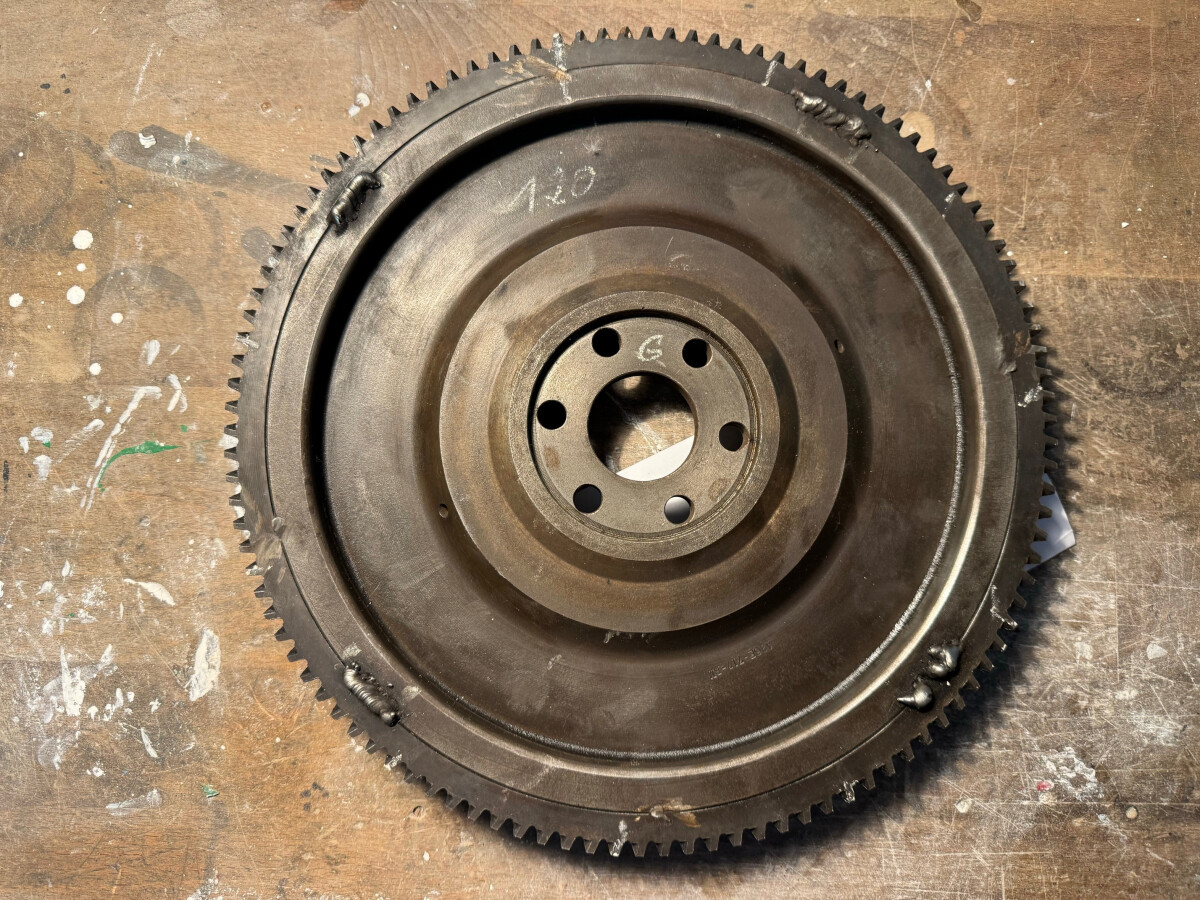
I have put the Lucas starter back in and for now it works without nasty noises with the chewed up flywheel. It took some time, as I had to ‚restore‘ the external solenoid electrics. A new starter ring is on order (thank you Mazzini!!) and time at a local shop is booked. I am still puzzled, why the Brise starter messed the flywheel up. It was claimed that the Brise starter has wrong dimensions, but from what I can see, similar starters have very, very close dimensions. My Brise AXG is sold for +10 years (for @ £700 or @ €1100 here), it’s hard to believe that is has a fundamental issue?
I’ll report once the flywheel is off, if there are any visible issues with the gears (hardness?)
Philipp
Did you check what I suggested? If a rotating pinion hits a stationary ring gear things are going to get smashed up. Check also to see that there isn’t a wiring error that has caused to starter engagement solenoid to activate at the same time as the motor itself being energized.
But yes - forget the hype and good old much maligned Lucas will solve your problems permanently
My error was to use the standard ring gear with the pre- engaged starter. A different ring gear specific for pre- engaged must be used. It’s unfortunate that neither the Brise website, nor the other usual suspect sellers point this out, so for a newbie like myself, it’s easy to make that (expensive) mistake. Correct ring gears are available from all of the sellers cheaply. For now, my Lucas set up works well. I wait until the engine is pulled anyway, most likely this winter.
Philipp
Hello
I thought it was the same ring gear, but, turned around
Edit, & matted to the edge closest to starter teeth?
Hi Philipp,
Are you able to expand on your comment “A different ring gear specific for pre- engaged must be used” please - do you mean different in terms of the number of teeth, orientation, or something else? And do you get the impression that this requirement only applies to the Brise starter?
Many thanks,
Will
I bought a Powerlite pre-engaged starter from Paul Matty about 4 years ago.
Before I bought it, I specifically asked whether the ring gear needed changing/rotating, or whether any other (wiring) changes were required. The reply was that it should be a straight swap and no changes to the ring gear or wiring were required.
I have had this starter fitted for four years now without any problems. It did appear to be a straight swap.
When asked, Powerlite stated that there starter would cope with the ring whether it was chamfered or not. There is no need to do anything except fit the starter, two screws and one wire. Ask them yourself for confirmation.
Eric in Burnley
1967 S3SE DHC
Original starter pulls in, new style pushes out
I missed when the OP stated back in June that he had put the starter back in and that it starts the engine. Quite frankly, I am amazed, and am also amazed that one would want to replace the starter with all that swarf in and around the flywheel and clutch. Even if a clean up operation was carried out, you are only going to be able to do so much.
The other thing that would worry me would be is the starter going to continue to grind away at the ring gear creating yet more swarf. And lastly, at some point, the starter is not going to be able to start the engine and could leave you stranded, possibly when out and about, and that is a pita, even if you have recovery.
Leslie
The difference between interia and pre- engaged ring gears are the chamfers that need to face the starter pinion. Thus the chamfers for a pre- engaged need to be on the gearbox side and not on the engine side. Also, the number of theeth have to be compatible with the starter used. Burton sells 110 theeth gears for intera and 132 theeth for pre- engaged.