Good update, Steve. Any more info on Advanced Distributors? I just get HVAC places on my searches.
The bores could be “mirror smooth” as a result of the fuel mixtures being way too rich and therefore the fuel washing the lubricant off the cylinder walls. How do the bores look below the piston where the rings don’t travel? Are the honing marks still there?
Your primary problem seems to be fuel mixtures. You need to get that right first. If you don’t get that right further things can be damaged as a consequence - except for the distributor base and front cover crack of course. Those 2 issues are just down to either insufficient knowledge or negligence.The front cover crack is due to over tightening of the front cover to head through bolts and likewise the distributor crack is due to clamp bolt over tightening. It’s well worth investing in good quality torque wrenches and screwdrivers. In my box of weapons I have torque screwdrivers 0.3 to 1.5Nm, 0.6 - 3.0Nm, 1.2 - 6Nm. Torque wrenches 3.0 to 24Nm, 15 - 160Nm, 20 - 270Nm. Good quality torque measurement tools are worth their weight in gold.
No doubt that front cover crack is due to someone in the past noticing an oil leak in that area and deciding to tighten that bolt up a wee bit to try and stop it - “OK here goes, oops!” That bolt as it is tightened practically tries to pull the head towards the cover over thin air as the cork gasket underneath is a lot more compressible than the surrounding head gasket. It, the similar bolt on the other side and the middle bolt under the cam cover must not be over tightened or you risk this happening.
Here ya go…
AD is owned by Jeff Schwemmer, who posted a lot on the MGB Experience site when I was rebuilding my B. He rebuilt the distributor for that car… I’ve seen his ads in classic car mags as well. Highly recommended.
that in itself (whether from lack of or improper honing, or indeed rapid glazing) would not cause the engine “running rough” if the bores are all dimensionnally within specs for the pistons, it would only affect long term reliability (oil consumption to be monitored).
Picked the head up from the machine shop today. They milled .007" off - said it was warped diagonally. On the good news front, it passed the pressure test.
Barry wants me to replace the JE top ring with one from Total Seal - I just ordered a set, getting the gapless version.
I dropped the front cover off at the weld shop yesterday - he’s pretty certain he can fix it.
Distributor got shipped out yesterday as well.
I disassembled the rest of the block today. I’ll take in in tomorrow for rehoning - Barry wants a 280 grit hone. I’ve got gaskets coming from Ken.
On Friday we leave for a week tour of Normandy - really looking fwd to it. Most parts should be here when I get back, so the reassembly can begin. I’m guessing the distributor is the long pole - there’s a bit of a backup there. But the engine can go back in without it if it comes to that.
When you do get it going again and provided it isn’t squirting fuel everywhere drive it straight to the nearest reputable place capable of putting the car on a dyno for fine tuning of the ignition and fuel calibrations. You’ll save yourself a lot of grief, time and heartache. Sounds like you have a lot of friends with equipment. Surely one of them has a dyno. 151’s are supplied with a generic calibration only and will need fine tuning to suit the specific engine they are fitted to. This is best done on a dyno and despite what some people may say (particularly the ones selling them) not just an AFR mixture reader.
Hi Steve,
Enjoy Normandy pity only for a week.
We will be for a week Cote d’Amour st Brieuc. We live in Morbihan
Alan
Here’s an update covering the last couple of months.
Yes, one week in Normandy isn’t enough. We got more of a ‘sampler’ tour, so we’ll know where to stay and what to see in more depth next time. I would wish that every American have a chance to visit Normandy - it’s quite the experience, even if only for a week.
On to the car. I got right to picking up the cover, block, etc. - all were ready when I got back. Within a couple of days the distributor was back, and the rings arrived - gapless from Total seal.
Assembly took a bit of a delay when it turned out the lady in the row behind us on the plane home wasn’t coughing from a cold - so the wife and I went through another Covid spell.
Reassembly went smoothly - you actually get more efficient at this the more times you do it.
Initial tests showed that the oil leak was fixed. A leak down test showed the coolant leak was solved. An inspection after my spirited 8 mile test loop drive, which always showed gas in the airbox previously, was dry this time.
But the roughness on acceleration remains. The degree of roughness is proportional to the aggressiveness of the acceleration. No spitting or backfiring. I wouldn’t describe it as a stumble or dead spot. It almost sounds like an exhaust leak, but I tried a test with the exhaust pipe off and no change. It’s like a staccato feeling, as if one cylinder isn’t fully participating.
I reached out to Tim, who hooked me up with Chris - who’s got a shop in Oklahoma City that preps vintage racers, among other things, who suggested I check the strobe on a timing light at higher revs. Which I did, and it seemed to go a bit erratic above 3k or so. So I called Jeff S., who rebuilt the distributor - he recommended solid core plug leads and non-resistant plugs, check the coil, points, etc… So I ordered new wires and all new ignition parts from DBE, and stole the coil and BP6ES plugs, no longer available in the US, from my MGB. With all that, the strobe looks good, roughness decreased maybe a little, but is still definitely there. All at the cost of radio interference, but I think we can eliminate ignition as the ultimate problem.
I had welded a bung in the exhaust for my AFR meter. It shows about 12.5 at idle, dropping to 10-11 on acceleration, and when cruising at speed - around 3000 RPM in 5th, about 65 -70 mph. But of course that’s an average of the 4 cyl’s, so the problem could be a single throat problem of some sort. A bit rich,
So the investigation continues - I’ll reach out to Chris again - it sounds like he gets to Tulsa periodically, so maybe he can see it/drive it for himself.
That said, I think it’s at the point where I’m willing to drive it, even to LOG in 5 weeks, and to OKC to put it in Chris’s shop if he thinks that’s necessary.
I’ll keep you posted.
Well, I didn’t make it to LOG. Last year the car wasn’t driveable, either, so we went in a 528i. This year I was too discouraged for that, and their were other family things scheduled then, anyway, so we didn’t go.
But, with the help of the Lotus community, the major issue is resolved, and we’re back on the road. Here’s the story from where I left off.
It was too optimistic to think that I could drive the car to LOG in the state it was in. It just didn’t sound right, or have the power it should. I got too worried that there was something fundamentally wrong that could cause damage.
I’d been consulting with Keith Franck on sidedraft@vintagetechnologygarage on my issues. He suggested it might be preignition, which kind of made sense and fit the symptoms. So I went after that pretty intensively, raising the octane level, lowering compression with a thicker head gasket. But no improvement.
I asked Tim Webb to come over and drive the car, to test my sanity. He agreed it wasn’t right - power was less than it should be, and it didn’t sound right. He thought it was carbs, not preignition. He suggested we take it to Chris Campbell at Vintage Connections, a classic car shop in Oklahoma City, about 90 miles away, and offered up his race car transport rig to get it there. So off we went.
Chris agreed there was something wrong, and verified pretty much everything I’d done, eliminating compression, timing, ignition causes. Leaving us with the Webers, somehow. Chris knows quite a bit about Webers, since they’re used in so many vintage racers which are a key part of his business. But he got stumped, too.
Keith Franck offered to take my carbs and put them on his car. If the problem moved with the car, we’d know it was the carbs. And Keith knows more about these carbs than anybody else we knew, so he’d be in the best position to figure out the cause. So off the carbs went to Keith in California.
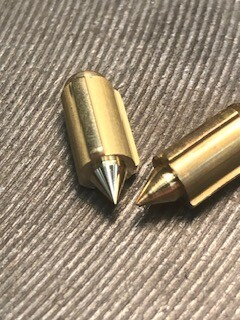
After a few days we heard back from Keith. Yes, the problem existed on his car with my carbs. And after digging into the carbs and pursuing several leads, he traced the issue to bad float needles. They were rough, so not sealing correctly, resulting in an over rich mixture that was so much worse with the secondary circuit engaged. Replacing the needles restored the power.
So back the carbs came with new needles, and sure enough on my car the ‘staccato’ sound was gone and power was restored. I could even chirp the tires on an aggressive start!
Keith indicated that these needles are a wear part, and I should keep a fresh set around. But since these carbs were sold to me as new, and I’d only put 600 miles or so on them, they were likely bad from the factory.
The car is still running a bit rich, so there’s more tuning to do, but in the meantime it’s a blast to drive, again.
So many thanks to Keith, Tim, Chris, Barry @ PHPRacengines, Ken at DBE, Ray at RDE, Jeff at Advanced Distributors, and all here who offered suggestions and moral support.
Thanks for the update!
Excellent!
What a saga which I’ve only just come across, having serious problem with my wife’s Xedos’ ECU.
I guess your Weber supplier owes you a refund for faulty goods, it doesn’t inspire confidence and I wonder how many other people are having this needle problem simply because of the time they’ve had the Webers; I fitted my 151s in 1999 and they’ve seen 80,000 miles so I think I’ll take a look at my needle valves. I’ll do it this winter when I take the head off to replace my Cometic head gasket which has a water leak on No. 3 cylinder, fortunately only into the head and not reaching the oil, causing misfiring straight after starting and low compression. The damage may be where it has to be cut away around the oil drainage rubber tube.
Your oil leaks on 1 and 4 were obvious from the photo of the plugs in you first post. The real irony is that you changed the Stromberg head for a Weber one. Yet Miles Wilkins published his personal experience of the Stromberg producing more power with his late series SE cams than most Big-Valve Sprints; the factory checked out his 0-60 times after it was run-in and they were the fastest they’d ever seen.
Yes, one irony is that this would have cost me a lot less if I had just bought another set of Webers and trashed the original set. Assuming the 2nd set had good parts, which I guess is quite the assumption.
What oil leak? There was a coolant leak, solved with surfacing the head. There was an external oil leak, solved by welding up the crack in the front cover. I’m not aware of any internal oil leaks, but as you say, it’s been a long saga and I’m probably getting forgetful. I think what you saw in the first picture was the way over rich state given the needles.
You did make me go back and read my first post - the real irony is that Red Line asked me to check the needles - which I did, but I just couldn’t tell they were bad, since I had nothing to compare them to and the fault was pretty subtle.
Yes, I know the Strombergs were fine - I was more doing this more out of ‘why not’ than ‘why’. I do have more power now, but that’s because I’ve got a fresh lower end and much better compression.
“What oil leak?” Your post June 18:
“Maybe the bigger issue is the oil on top of the pistons and seeping in front of #1 and back of #4” suggests an oil leak somewhere. No sweat, just my reading of your report
BTW, I’ve only used a chain hoist to fit the head since having to juggle with the recently fitted 4-2-1 exhaust while fitting it. Actually that was back in 2016 when I was only 73 and weighed 130 lb but I still just lift the head off, or did two years ago.
Hello Steve,
I have a 67 Elan and seem to have a fuel/carb flooding problem too.
How did you get on with the HF Fuel Pressure test?
I’m thinking that I need to get my fuel pressure tested. A while ago a local garage (not Lotus specalty, but specializes in other British classic cars) replaced the mech. fuel pump. Not sure what they replaced it with.
I’d been having some issues of the car stalling out when idling on an incline. All of the ignition system has been check/replaced and so I was onto the Webers.
I took the tops off and found that the needle valves were too big (2.00 instead of 1.75) and the float clearance had been set at a whopping 16mm instead of the spec.d 8.5mm.
Feeling pleased with myself for thinking that I’d found a root cause, I reset the floats to 8.5mm
As soon as I started the car up, I had fuel pouring (not a drop, but a flood!) out of the air intake. After immediately shutting down the engine ( and counting my lucky stars for no fire), I ordered new 1.75 needle valves.
I’m wondering if the previous shop had set the float level so low in order to resolve a flooding problem.
It could be a worn / stuck needle valve, too big a needle valve or too much pressure.
As I mentioned, new 1.75 needle valves on order, but I was wondering how you went about checking the fuel pressure in your car?
Paul.
You do need fuel pressure tested, or simply a gauge and regulator up front by your carbs.
I’d rather not add a new piece of equip. (plumbed in pressure gauge) permanently.
I would just like to know what the normal pressure my fuel [pump is putting out and then take action (pressure regulator or replace pump) if warranted.
current
Paul,
I got a low pressure gauge from Amazon. The one I got was 0-5 psi, but 0-10 or 15 would do. Just don’t get a 0-100. With the carbs off, I plumbed it into the output of the fuel pump, removed the plugs and cranked the engine, and got something well over 7 psi. The book says Webers don’t like anything over 2.5 psi or so. The next step was to order a fuel pressure regulator from DBE. The std one they sell is a Holley and has 2 outlets - one got plumbed to my gauge, the other to the carbs. I installed the regulator on the front wall of the passenger footwell. I ran the engine and adjusted the regulator down to 2.25 or so, then removed the gauge and put a plug on that second outlet. That’s how I’m running now.
Regards,
Steve
Thanks Steve,
You’ve given me some ‘food for thought’ here.
It looks like a complete kit of gauge and regulator can be had for about $40 from Amazon:
https://www.amazon.com/LVOUP-Adjustable-Pressure-Regulator-Carburetor/dp/B0CJ8Z2YRB/ref=sr_1_1_sspa?crid=22J35VP8QOZSV&dib=eyJ2IjoiMSJ9.17cuBTcuNwLoaRUYttvXWsQxa25BHJvmO2xRxACRUG8souM9fhDJpb6jFBsJaByqgL-wBGoiVBGGSY9EAQvz4ZDWG3_oQCQQuAunnfjB2uhGGOWH_fD9iEWfpKEA8tmpYM1vs94onebKNs08uOOrEYjqO6pBC5quQzh7s5EAKv2C14TI9adlh5sYTFMbz8LXWqbyxopXykFEW6Ae3Hv05AXMlOFmuFbIxg_uOPG8VR4.Xef-swrqgZSQTXGD22NdUmzdww2KbU5xTxzKJx4tKXs&dib_tag=se&keywords=0-5%2Bpsi%2Bfuel%2Bpressure%2Bregulator&qid=1731140666&sprefix=0-5%2Bpsi%2Bfuel%2Bpressure%2Bregulator%2Caps%2C110&sr=8-1-spons&sp_csd=d2lkZ2V0TmFtZT1zcF9hdGY&th=1
When you had the Webers disconnected, but the gauge plumbed in, did you just have the output from the gauge flow into a bucket/fuel can when you cranked the engine?
If the original mechanical glass bowl fuel pump has been replaced by the all metal body type (no glass bowl) type then they are notorious for delivering a much higher incorrect fuel pressure and will certainly cause your Weber carburettors to flood.
Alan.