I’d suggest you need to accurately measure the fuel pressure because that determines whatever else happens in the carb. Whether you wish to take that advise is entirely up to you however. The level of fuel in the carburettor when it is running on road may not be the same as when the engine stopped especially if the carb is leaking.
Too much fuel pressure will force fuel past the needles causing a high level in the carb bowls especially if the engine is not running smoothly. The floats bounce around from the vibration and bounce the needles off the seats. Target fuel pressure should be 2-1/4psig. 2-1/2 max.
On my DCOE Tipo 31’s I have just measured how far it is from the top of the main body with the lid removed to the bottom of the fuel delivery port/hole that drops the fuel from the emulsion tube wells down into the carb throat - that measurement is averaging 22.6mm and will be around 18mm to the top of the hole (can’t measure that and it’s not really relevant, but provided just for the sake of it).
Whenever fuel gets to or above the bottom of this hole, the fuel spills over and runs into the carb throat - the float level being too high will cause this. I think of this port like a hand wash basin overflow port.
Add to this the fact that the hole for no.4 side sits lower in relation to the fuel than no.3 - due to fuel sitting level but the engine is higher at the front than the back - then you can get a situation where one is ok and the other isn’t.
The important question is: is solid fuel leaking over (ie solid rather than proper air/fuel mixture) during proper running / driving of the car when fuel demand is higher, or is it just when idling at low demand / idle.
If I were using Weber original emulsion tubes I’d be setting the fuel level just below this hole between 0.000-0.080" or so and experiment. If it’s too low the emulsion tubes won’t have enough fuel for all fuel demands.
If I understand correctly you have Keith Franck custom tubes and he clearly goes against the grain to make his work differently, with a potential downside.
Perhaps this is the time to mention a fuel pressure gauge that I just purchased from Amazon-
I confess I have not used it yet but it is surprisingly well made and very easy to read since it only reads from zero to five psi:
amazon.ca/dp/B08TQJPY17?ref … tails&th=1
Steve,
Don’t know if you recall, but I have a Fuel Pressure regulator (with a gauge) immediately prior to the carbs. The regulator is a Holly product if I’m not mistaken.
Tim
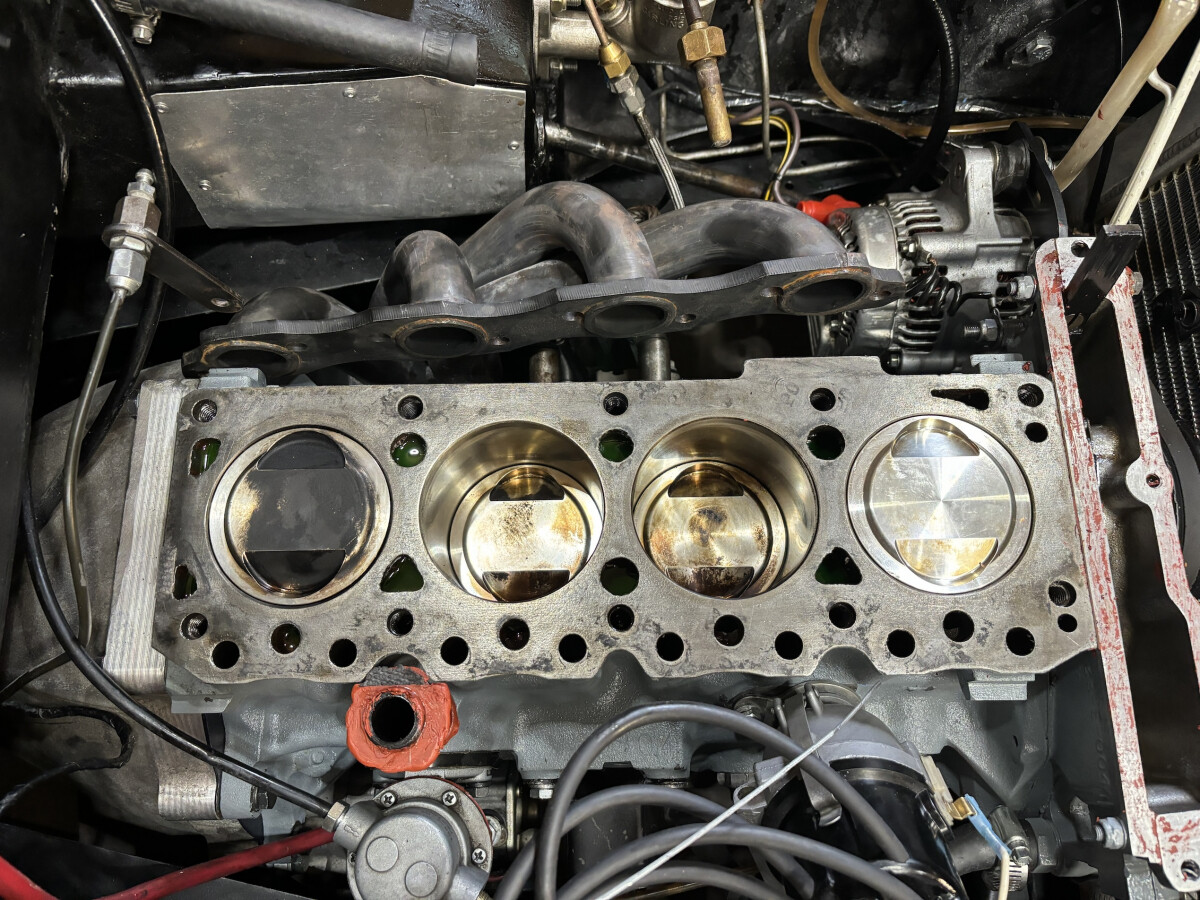
On Saturday I pulled the head off, took it to the machine shop on Monday, they repaired the #2 spark plug hole and I picked it up on Tuesday. $50 - not a bad deal.
On Sunday, for grins, I checked the valve lash. When I installed the head on the newly rebuilt block, 150 miles ago, all were within spec (ok, one was .001 over). On this check, #3 intake was at 0 gap. I called Barry, and he told me to call DBE get new keepers and retainer, that should fix it. So we’ll see. Those parts got ordered on Monday, so maybe I’ll have them by this weekend. Then the head will go back on.
What I was hoping to find was some sort of valve issue that could explain the rough running. Perhaps the 0 valve lash on #3I is that explanation - but I doubt it since the compression was good and some other symptoms point to #4,- but again, we’ll see.
The piston tops were interesting. #1 was still shiny. #2 and #3 had some carbon soot on them that wiped off with a paper towel. #4 had baked on carbon that wouldn’t wipe off without some lacquer thinner. So, hmmm.
With the carbs off, nothing really jumps out. The AV on #4 was firmly held in place with the set screw. Nothing obviously out of place.
Before taking the head off, I spent some time on the phone with Randy at the Weber warranty desk. He was focused on the idle screws - he wanted me to check to ensure the engine would die when each was closed in turn. Actually, it didn’t. With the engine idling at 900, which it does with the idle speed screw about 1/4 to 3/8 turned down from just touching the linkage, closing each of the idle screws in turn would drop the RPM to 550 or so, but it woudn’t actually die unless I pushed the front throttles ‘more closed’ - they should have been fully closed since the throttle cable was disconnected and the linkage was disconnected. So there’s a bit of air leaking past the front carb throttle plates with the internal throttle return springs the only thing forcing them shut.
I also captured some diagnostic data. With the engine at operating temperature, the 1-3 headers read 325-350 deg F, but #4 reads about 50 degrees lower. With a new Automate 63 plug in #4, after 10 minutes or so it’s quite dark, whereas 1 and 3 are still white (#2 was still an NKG BP6ES due to the thread issue). The AFR meter swings pretty wildly at idle between 14.3 to 18+. At 3k RPM, swings from 13 to 15+. Which makes me think that the mixtures from one throat to another are quite different. Even though the jets and tubes are the same.
So something seems up with #4. When I put the carbs back on, I’ll swap them front to back, and see if the symptoms move to #2.
Re: fuel pressure, in spite of the fact that nobody has come up with a good explanation re: how my fuel levels could be fine, or even a bit low (I checked with Keith, and he says my levels are within tolerance for his emulsion tubes) if the fuel pressure is high, I’ve decided to bend to the will of my audience and check it. Since the carbs are off, I’ve got a clean shot at the fuel pump. Last week I ordered a 0-5 psi gauge off Amazon - I’ve got it in hand now. After a quick trip to Lowe’s for fittings, I’m ready to attach the gauge to the pump outlet. Once the head is on, and before the carbs, I’ll run that test and report back.
I’ve been asking my local friends for any good Weber knowledgeable mechanics in Tulsa. I’ve got a few leads, so if when I get this thing back together and the problems remain, taking it to one of them is the next step.
Steve, I have been following your saga. I found on my Elan that the idle was always a little high and did not return to idle rapidly. I fitted the external return spring from Pierce manifolds to the rear carb and it now completely closes the butterflies and I get a rapid return to idle. I can set it any RPM I want and it is consistent. You might give it a try. As to #4 cylinder I have nothing to offer but I hope you find it soon. See you in Austin. Gary
If you just have a short O2 probe in the exhaust pipe it will swing due to air getting in. At higher revs it swings less as less air gets in, it does not necesssarily indicate a problem. I use a long flexible tube fitted to the Innovate probe to insert it deeper into the exhaust and the swinging goes away.
If the clearance problem is due to the retainer moving up on the collets so its contacting the follower and lifitng it off the valve stem and shim then I would want to know why as the same issue could apply to all your valves
cheers
Rohan
Thanks, Gary. I’ll keep the add’l return spring in mind.
Rohan - that makes perfect sense. I’ve been fussing around with other things, but maybe it’s time to weld the bung into the exhaust pipe.
My understanding from Barry is that since this head was at the minimum thickness, or below, he had to modify the valves a bit (shortening the tip?). Does that help explain it? I just assumed that given his response, it must be wear in either the collets or retainer or both.
After pulling the head off after the 1st 500 miles, when I rebuilt the block, we saw the same problem with the #1 intake - but for that one Barry recommended a thinner follower. Not sure why he went to a different solution this time - I’ll ask.
Thanks again,
Steve
Generally wear in retainers or collets does not happen. I have seen retainers come off valve stems but only in badly built engines where the collets and retainers used did not match the valve stem or excessively high spring loads were used on race engines.
Its possible that with the valve tips ground shorter the shim used was not contacting the valve tip and follower pad and the follower was always resting on the retainer and that when the engine was run the retainer seated a little more in the collets and closed up the gap. You need to check all the valve installations to ensure you have sufficient clearances to install shims that contact properly the valve tip and follower pad. You may need to go to thinner followers or different style retainers to achieve that, as it sounds that the valves are seated deeper than normal in the head.
cheers
Rohan
It should be possible visually to observe the height of the valve stem versus the retainer but you might be able to observe something amiss also by putting some plasticine inside the follower and turning the engine over to see where things are making contact
$50 sounds pretty cheap for a spark plug thread repair. Hopefully they used an aluminium insert dedicated for this application and not just a Helicoil.
Hello,
What do you reproach Helicoils for?
My cylinder head was repaired in this way by a previous owner, and I didn’t change it when I rebuilt my engine. And as I haven’t started it yet, I’m having a bit of a cold sweat about your statement.
Regards
Stéphane
My son designs rockets in Long Beach. Apparently Helicoil inserts are widely used in aerospace when fittings are screwed into aluminium and apparently provide a more secure fixing than simply using a tapped hole. Having said that, I have seen reports that other styles of inserts are better suited to applications which require repeated fitting and removal - like a sparking plug.
For my work, on 2-stroke engines with aluminium cylinder heads, I used to fit inserts in the form of steel bushes made for this purpose, but the bush ended up on the spark plug when I first dismantled it. Now I use inserts based on the same principle, but made of copper and crimped with a tool. It’s the Time Sert brand, and I’ve had good results so far. I’ve never tried it with Helicoils because I didn’t like the principle for spark plug threads.
I didn’t put this on my cylinder head, because I was afraid of having too big a hole, once the Helicoil was removed, to fit a Time Sert.
Regards
Stéphane
Helicoils will work but are prone to backing out in the spark plug application. Ever noticed the soot on the threads of a removed spark plug? Lots of heat and carbonized oil can cause issues with Helicoils. There’s better solutions available. Stainless steel isn’t good at heat transfer either.
I have one cylinder head with a helicoil inserted many years ago by a previous owner. Never had any problem with it coming out but I use nickel antisieze on the plugs and never over tighten them. If using a helicoil make sure no coil threads go into the combustion chamber as the head threads finish at an angle due to the combustion chamber shape
Cheers
Rohan
Gary, do you have a picture of this setup? The Pierce Manifold site lists several springs but only show
the springs, unless I’m missing it (very likely  )
)
I was in Aerospace also Helicoils in all threads in alloy no problem
But you need to know how to fit them.
When helicoils are damaged next step is Keyed Thread Inserts giving you a second bit of the Cherry.
Alan
For me at least, the issue with Helicoils in applications that require a pressure-tight seal is that there is an easy path for gas / fluid to travel up - and if the sealing face - for the gasket on the spark plug for example - doesn’t have a perfect face or enough surface area, it’s likely to leak. That’s not to say they aren’t successful, it just needs to be done carefully.
Time-Sert is a better method but prohibitive in cost!
I would say that using a Helicoil isn’t a “no-no” but be prepared to potentially go back in again at another time. That’s the beauty of a Helicoil - they’re cheaper and can do the job to a good standard.
That’s certainly a good reason to consider other options. Similarly nothing should ever be held into a Helicoil with thread lock as that will likely wind the coil back out if it doesn’t otherwise cause a mess.
Don’t mean to hijack this thread. This is for Greg. At Pierce Manifolds, look at the Linkage/fuel components window for part LT 5000, External spring kit, $35.00. Gary