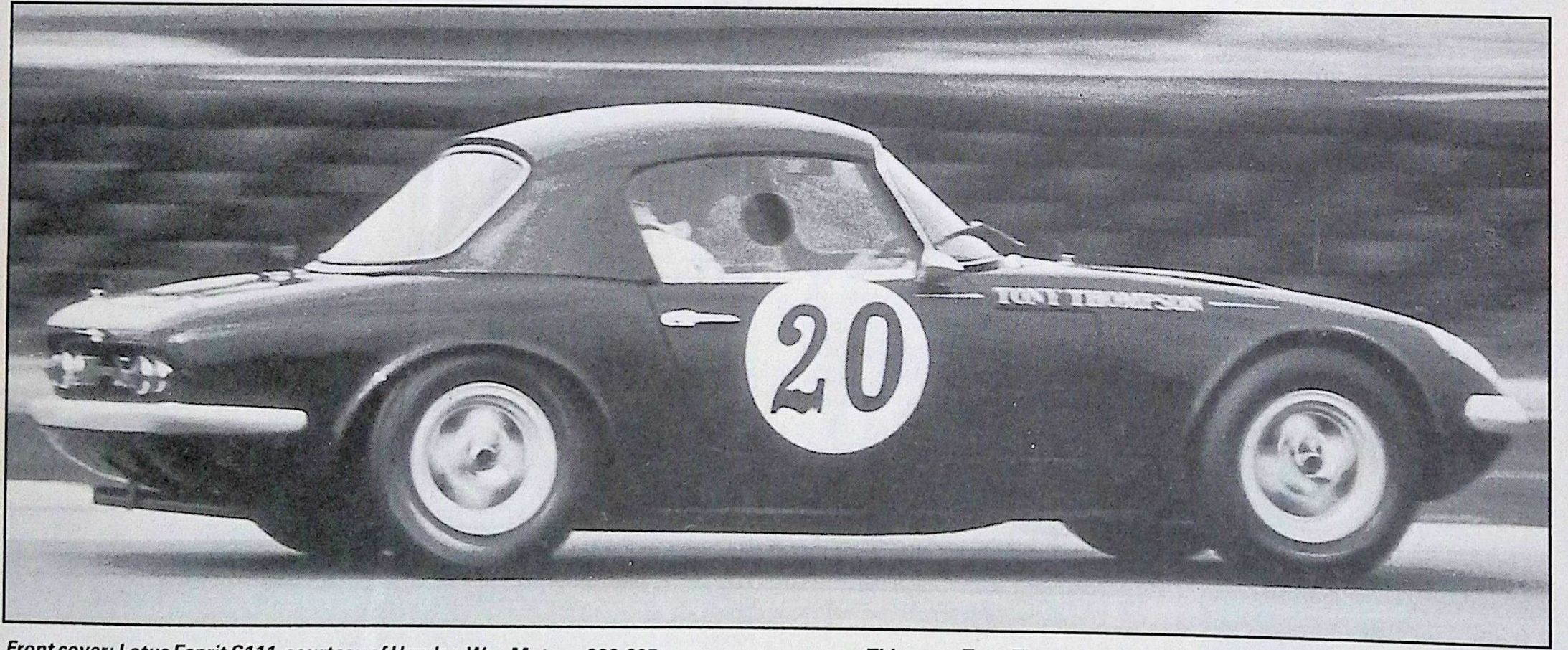
They didn’t want to do it
Thoroughbred & Classic Cars, June 1985
Tony Thompson runs the best Lotus Elan 26R in the country. Tony Dron tells the story Photography by Tim Wren
TAKE an extract from the sales blurb for the ‘Racing Version Lotus Elan’ of 1964: “The standard Lotus Elan as produced by Lotus Cars Ltd is a production high performance luxury sports car designed to give the owner value on a money to performance basis hitherto unequalled in the small capacity market. It is not suitable for racing…”
The trouble was that owners were beginning to race Elans very frequently whether Lotus Cars wanted it or not, so the company was forced to react. Lotus Components built the Elan 26R to satisfy this demand. From the start it was an outstanding success, very very quick and a great challenge to drive on the limit. This then is the story of the car they didn’t want to build.
Peter Westbury took delivery of the first production 26R March 20, 1964, this being followed by a further 51 examples of the Series 1. It was followed immediately by 43 Series 2 26Rs, the last of which was despatched on July 23, 1966. The first of these dates is important today because it bars the 26R from competing in International Historic GT events which are open only to cars which appeared up to the end of 1963. When new the car was homologated into Group 4, which required 100 to be made. Cleverly, Lotus homologated the road car, listing most parts as ‘modified’, a worthy phrase that gave a free hand for future modifications. Around 40 26Rs are thought to survive in raceable condition about the world, including that of the remarkable Jack Holme in South Africa, a driver who is still winning at the age of 72.
In Britain the car qualifies for the Historic Sports Car Club’s Rolatruc Classic Sports Car Championship, and you can see the example we have been testing in the Club’s big international race weekend at Brands Hatch on June 8 and 9. There can be little doubt that Tony Thompson’s 26R is the best in this country, for it won the HSCC’s Dion Pears award as the best-prepared car in historic racing last season. It is also stunningly quick, as we shall see, but first to business: what is it like on the track?
To look at, Tony Thompson’s British Racing Green 26R is almost indistinguishable from any other Elan but there the similarity stops. The bark of that lovely Twin Cam engine, which has been rebuilt over the winter to produce 178bhp, tells you this is no soft road car. Tony warmed the machine up for a few laps and handed over with the warning that it had to be held in top gear, for despite parting with much loot to have it fully rebuilt the lever would jump forward into neutral with the slightest lift off power. The 'box is a standard Mk1 Lotus Cortina type with Leeson gear kit.
Despite the difference in height between TT and myself I felt comfortable in the cockpit and did not wish to have the seat moved at all. The normal rev limit is 8000rpm, though 8500rpm is permissible on occasions. I decided to change up at 7500rpm though I soon found that with the 4.44:1 final drive the car might pull 8000rpm in top before the chicane. On the first lap I checked out the gearbox and, yes, it jumped straight into neutral making me decide to hold it firmly in place whenever top gear was in use.
First impressions
My first reaction was very favourable it was obvious enough that apart from the gearbox it had been very well put together. The engine can only be described as superb for despite its high state of tune it has plenty of torque in the mid range and runs without a trace of temperament. It really wants to go and responds instantly to throttle opening whether the pedal is booted to the floor or opened with precision for handling control in a corner.
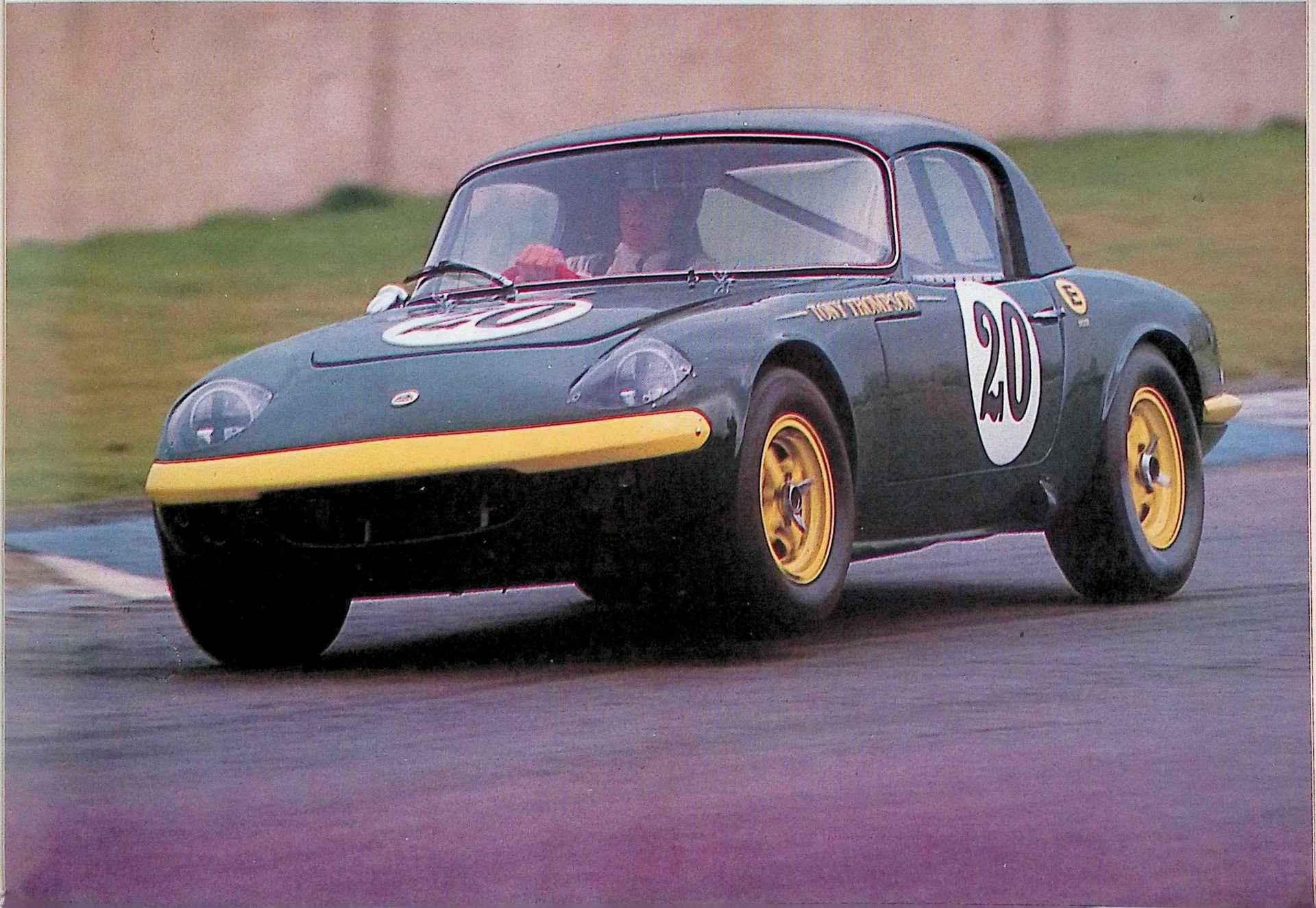
Tony Thompson’s 26R out of the Donington chicane with the nearside wheel well off the ground. His exertions on this particular lap resulted in a time well under the class record
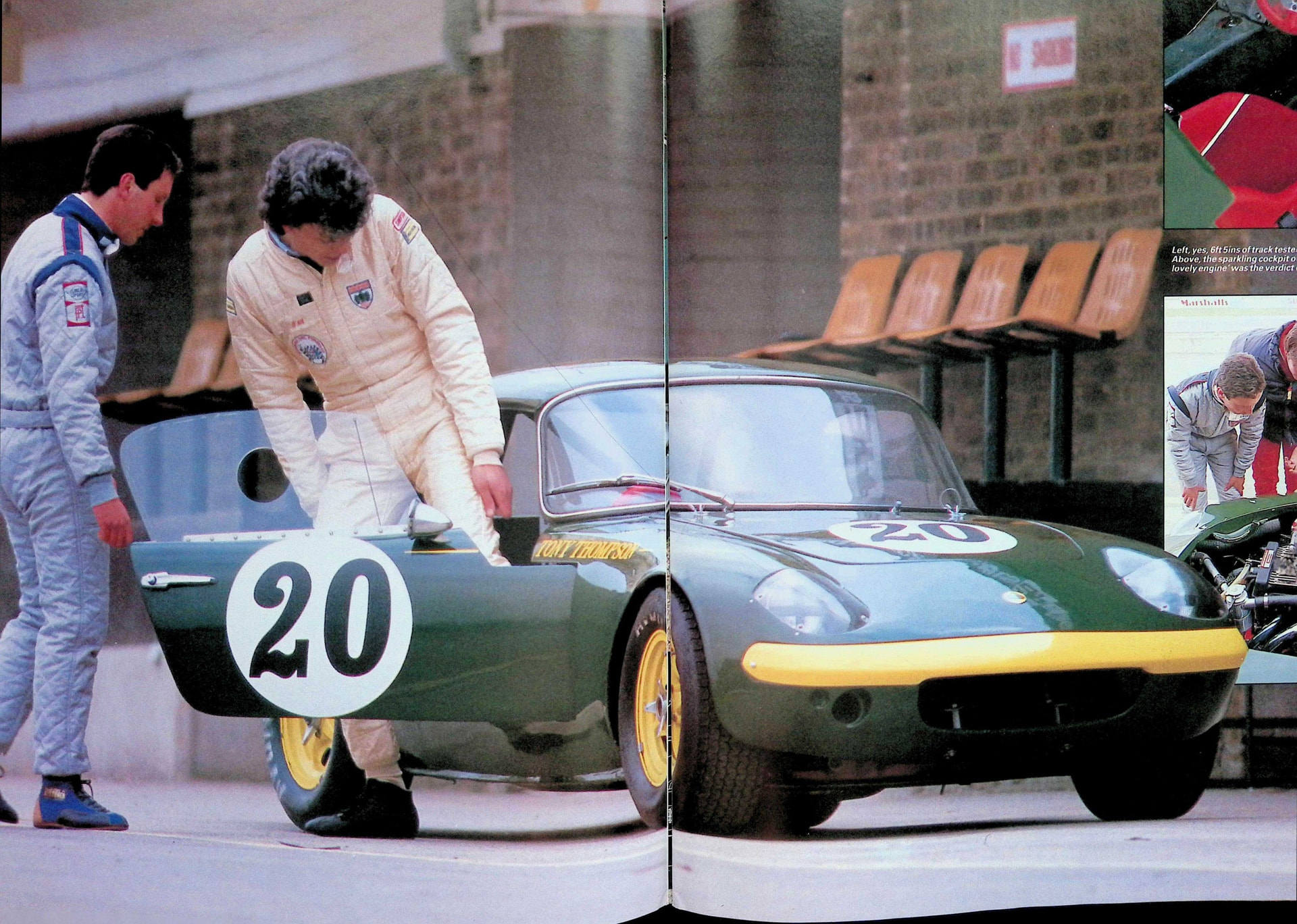
Yes, 6ft 5ins of track tester will fit into the little Elan.
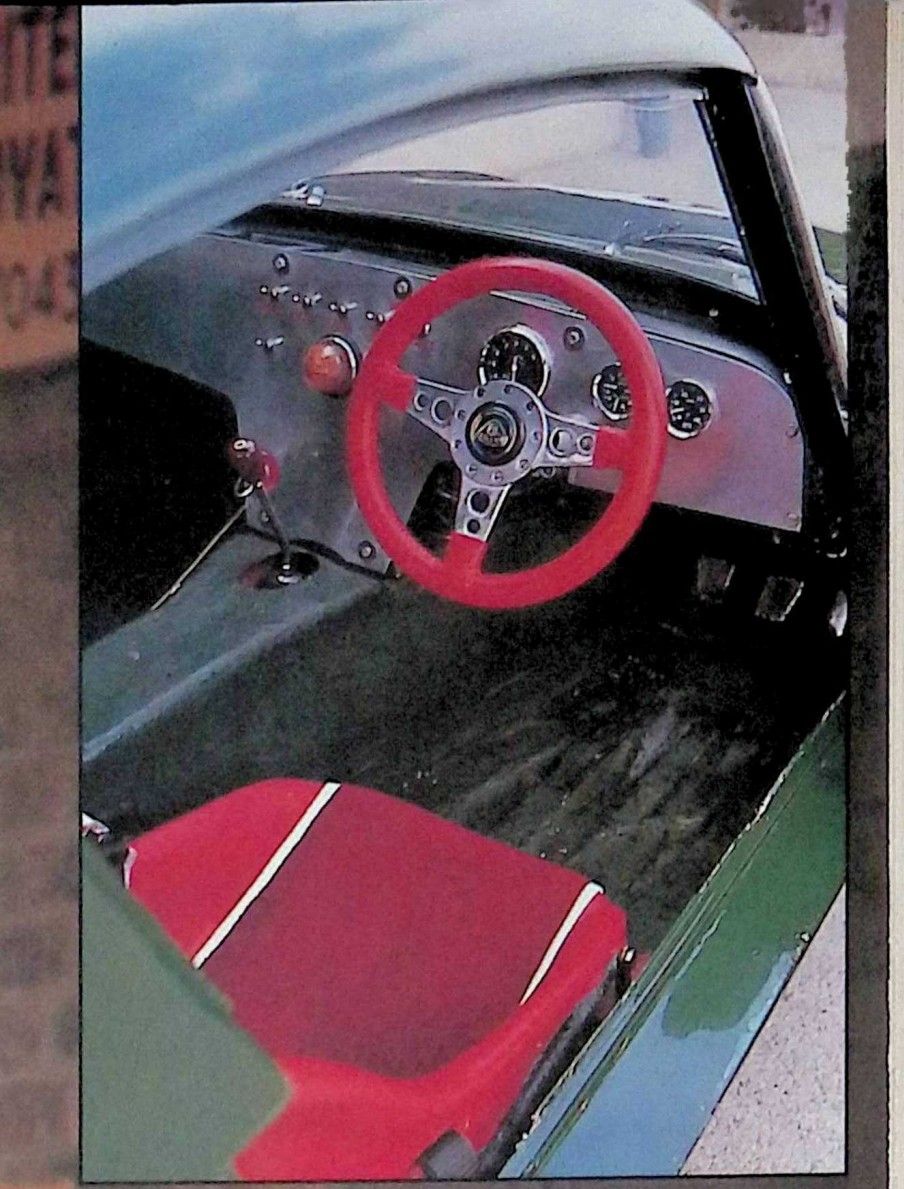
The sparkling cockpit of the 26R.
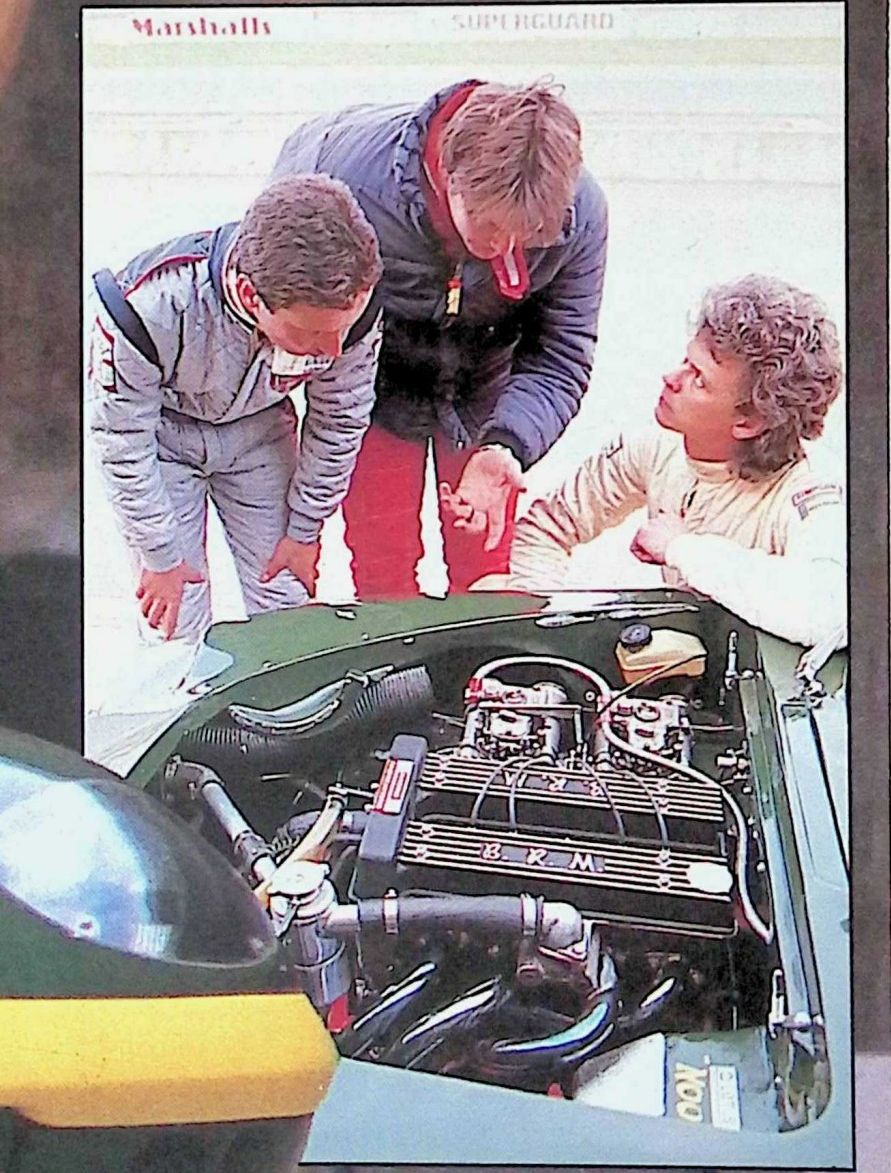
‘What a lovely engine’ was the verdict on the Elan’s twin cam
When Tony bought the car it was fitted with a Racing Fabrications-built engine and he has maintained this link. George Wadsworth of that company should be given the credit due to him for a really fine piece of work. Last season it was turning out 167bhp but with the increase in power Tony’s rival Roger Ealand, who is the acknowledged class winner in his Marcos, will have to have some magic up his sleeve in 1985. Roger holds the class lap record at Donington at 1m 24.16sec.
Running in the high 1m 24sec bracket for the first five laps I found the car somewhat hard on its suspension, giving a slightly bouncy ride down the straights, though the steering was light and direct if lacking slightly in feel. The brakes were fantastic, permitting surprisingly late use for a car with no downforce, especially considering that the 26R weighs in much the same as a standard roadgoing Elan. At those lap speeds the car would understeer gently, shifting to a neutral to (just) oversteering attitude with power on in the corners. As is my usual habit on these occasions I pulled in after five laps for a chat with the owner. Didn’t he find it a bit hard in the suspension? He reckoned it went better like that, so fair enough. The four-speed gearbox had excellent ratios for the circuit but it was a bit hairy steering one-handed through the Craner Curves in top, which some people reckon to take flat in such cars. Tony agreed with all this though he said he had never taken those curves without lifting. Would he mind if I did three more laps for a time? Not at all.
Next time around I gave it some stick coming out of the chicane in a nice tail-out slide with the front left wheel well off the road. Up to third at 7500rpm and then into top. What a lovely engine! Brake near the end of the pit wall and change down to third and it is apparent that the car is a different animal when pushed, nervous and light, but it fairly shoots into Redgate Corner and accepts about half throttle straight away, rising to full power near the exit. The car felt less happy here than I expected but it obeyed instructions and headed for the downhill Craner Curves very quickly indeed for a 21-year-old 1594cc two-seater. Top is required in the slight right just as the downhill left is coming into view. I can say here and now that only an idiot would attempt this lefthander without lifting.
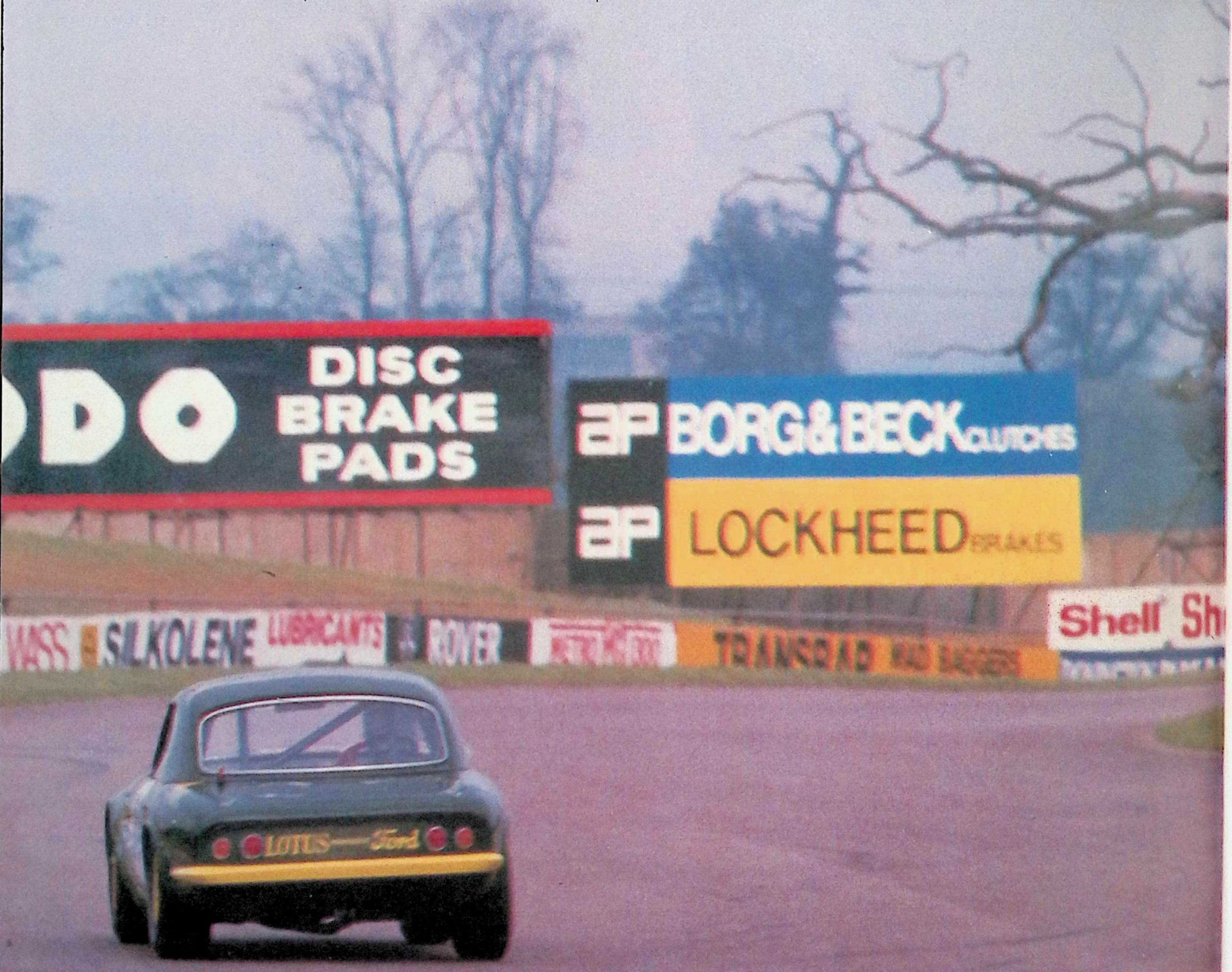
Setting the car up for a fast right hander. It may have looked as if it was on rails but didn’t feel like it from the driver’s seat.
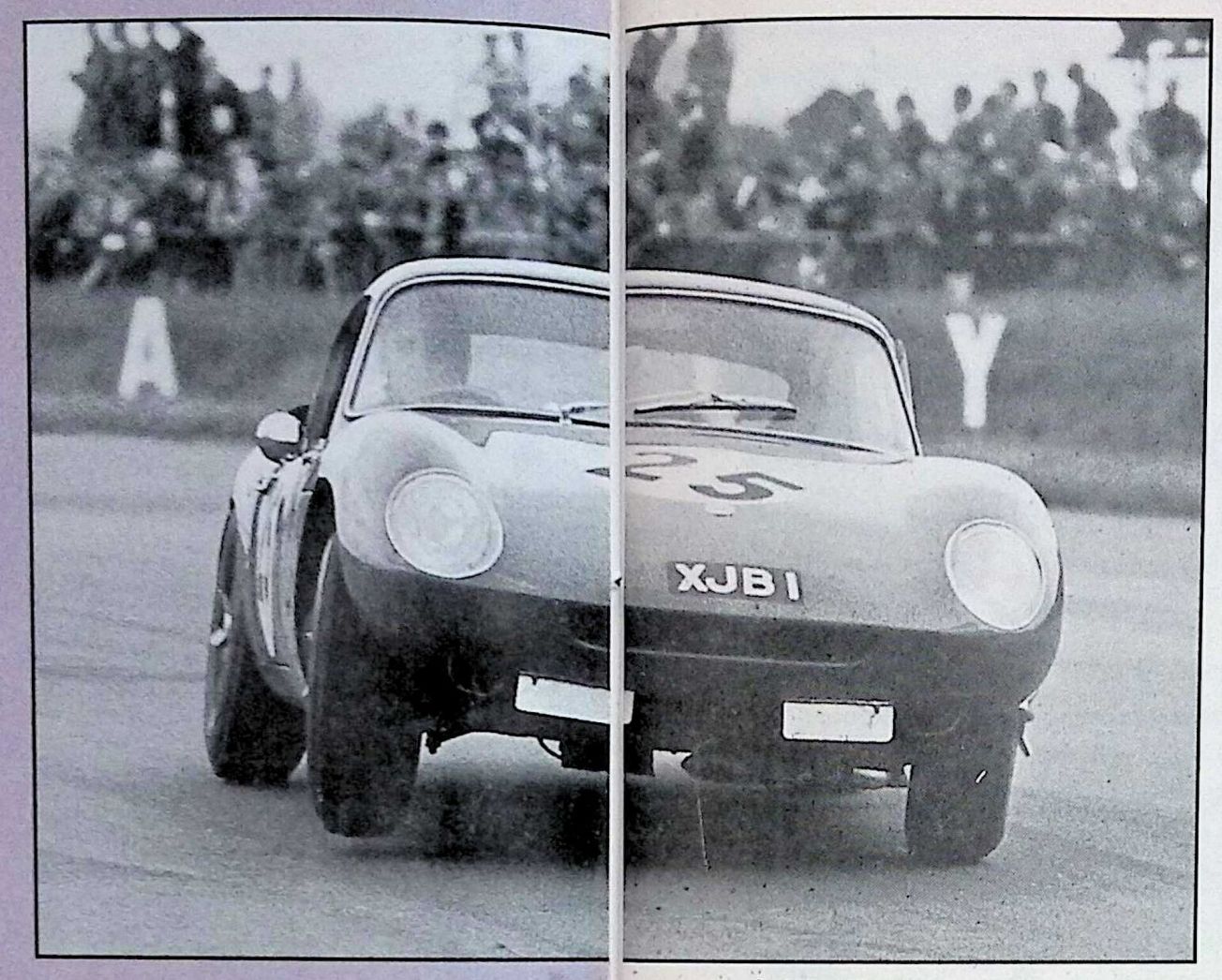
The Gordon Ramsay racing Elan at Silverstone in 1965. Note the illegal diff cooling flap under the car
To go really fast it is necessary to come some way off the throttle pedal, just a bit and so, so smoothly, putting the foot fully back to the boards only once the car is well and truly in the downhill groove. With two hands it would be possible to work hard on getting the car to leave the corner a little quicker but even then it would only be flat if the driver didn’t mind losing time getting it all correctly aligned for the Old Hairpin, which requires precise braking (not too hard) and a quick smooth change down to third. It is vital to extract every bit of roadholding for a quick exit here as it is followed by a long uphill section in fourth, which is all flat until the left hand sweep before Macleans, a sharp uphill right. Between these two the car can be made to go very quickly indeed, but it is extremely twitchy at the tail end. It probably looked like it was on rails but it felt as if it was changing its mind about where to go next every few yards. “Would you like to go backwards or forwards into that nice solid marshals’ post?” it seemed to be asking me but by that time we were braking and back in third gear, flicking neatly right with only the tiniest steering wheel movement into a very stable full-power slide with the tail just out. Yes, that’s it, thank you very much, and now for Coppice. There’s no point in changing up before this double apex righthander which starts with a rise onto a plateau. The engine almost reaches 8000rpm before the brakes go on hard, pressure being immediately trailed to zero for a stable entry. Over the top the car goes very light but soon takes full power and then we are back in top for the straight. Over the bump under the bridge the hard springs make the chassis buck slightly before the run down to the chicane again. I back off a little early, to avoid going over 8000rpm which in top represents about 134mph on this axle, and then brake, down to second and another quick squirt out of the chicane.
And that was enough, thanks. My advice was to take out the gearbox and drop it on the foot of the man who put it together. The time was 1m 23.2sec, one secohd under the lap record. As I said: watch out, Roger, as that green Elan could fly this season.
Modified road car
The 52 Series 1 Elan 26Rs built through the 1964 season were really lightly modified road cars. Most of those which survive today have been brought up to Series 2 specification and modified in other ways too.
The chassis of all 26Rs were not specially built; Lotus Components drew standard chassis from the production stores and then modified them. Series 1 chassis had strengthened rack mounts and gussets added to the front of the Y-frame and the rear turrets. The later Series 2 had similar mods but the gussets were enlarged. Special wishbones at the front lowered the ride height though the standard rubber bushes and balljoints were retained. Stiffer springs, a stiffer anti-roll bar, adjustable dampers and special hubs to take the 13in $\times$ 51/2in knock-on mag alloy wheels completed the Series 1 front suspension.
At the back there were competition dampers and springs, a special wishbone with adjustable spherical bearings at the inboard and again special hubs for the lightweight wheels. The rubber doughnut (Rotaflex) couplings were abandoned in favour of heavy duty roller spline driveshafts in spite of Colin Chapman’s by then confirmed dislike of such things. A light alloy diff nosepiece and carrier were standard with a limited slip diff and a choice of three axle ratios (3.9:1, 4.1:1 and 4.44:1). The brakes were uprated with special front discs with light alloy calipers and DS11 pads all round, plus an uprated master cylinder and a balance adjustment bar.
An untrimmed lightweight body with hardtop was fitted with lightweight glass fibre bucket seats, though the pop-up headlights were retained at first. Further efforts were made to lighten the car through the use of a Varley battery, light alloy radiator and a separate header tank but in fact the 26R Series 1 was similar in weight to the standard car, if much quicker. Small scoops just ahead of the rear wheel-arches fed cooling air to the brakes and diff. Some racing Elans prior to the 26R had had underfloor scoops for this purpose. A lever that looked like a hand brake was used to close this flap and restore sufficient ground clearance to satisfy any post-race scrutineers.
By the time the 26R appeared the Lotus Ford Twin Cam engine had been in use for a couple of years. The Series 1 was fitted with a Cosworth-tuned example which raised the power from 105bhp to 140bhp at 6500rpm and which was known as the Cosworth Mark 15. The valves, crankshaft and main bearing caps were standard but most other parts were changed or modified. Twin Weber 40DCOE2 carburettors were used and the car had a four-branch exhaust manifold and big bore tail pipe. A long range fuel tank was available for £27-10s-0d.
The whole car cost £1645 in component form at which time the standard car cost £1095. A year later, in January 1965, a roadgoing Elan in component form cost £1179 and the 26R Series 2 racer was announced at £1995.
This big jump in the price of the racing model indicated that Lotus had made much more of an effort to produce a full-race specification for the car. This time they used the BRM tuned version of the Twin Cam (BRM Spec No 84) which gave 145bhp in standard form. Later on Phase II and Phase III engines, costing an extra £155 plus £100 respectively, became available and around 160bhp was extracted from the Twin Cam for the 26Rs when they were current racing models.
About 112lb were saved by much more extensive use of light alloy castings and the replacement of the pop-up lights with fixed covers. Still the Lotus Cortina close ratio 'box (Bullit) was used, but there were many changes. The rubber bushes of the upper inboard front wishbones were changed for adjustable spherical joints and at the back an anti-roll bar was added. Wider 6in rims were specified and there were dual master cylinders for the brakes, with the light alloy calipers now fitted all round.
Thompson’s Tale
As with any racing car, customers immediately set about changing the standard specification when the 26Rs were new. This car’s first owner, Barry Woods, fitted one of his own special aluminium fastback tops, lowered the front suspension by 11/2in and fitted stiffer front springs, and raised the rear ride height by 5/8in. This was apparently to increase rubber driveshaft coupling life, though mysteriously the car should have been fitted with roller splines if the factory spec was to be believed. As chassis number 26 R-20 it was built in the middle of the Series 1 production run but a track test of this particular car by John Blunsden in 1966 specifically states that it had rubber couplings. Over the next couple of years Barry Woods updated the car with Series 2 mods and his own ideas, making it one of the quickest 26Rs around.
Many famous drivers drove these cars when they were new, including Jim Clark, Jackie Stewart, Jackie Oliver, jazzman Chris Barber and perhaps most notably John Miles, whose famous win at Brands, when he beat Bernard Unett’s Tiger by a nose after a pitstop to deal with a flapping bonnet, led to a works Lotus F3 drive and a Formula 1 seat.
This car was originally red but was painted in fashionable orange by its new owner in 1967, Derek Robinson, who used it for two seasons in races and at his racing schools at Zandvoort and Zolder. Steve Thompson had driven it under the Opposite Lock Club banner at some stage prior to this and rumour has it that Jackie Stewart drove this actual car once. Robinson gave drives to Vern Schuppan and Robin Darlington before selling it to John Dent, who sprinted it in 1969 and 1970. It was converted to a factory type of hardtop around this time before being sold to two club drivers who had little success with it.
Dave Preece then acquired it and got it going properly again, winning numerous awards before selling it in 1979 to Tony Griffin who won his class with it in the 1982 HSCC Classic Sports Car Championship. Since then Tony Thompson has run the car following a major strip down and rebuild in which the chassis work was carried out by Simon Hadfield, the Lotus restoration expert and sometime Lotus racer near Donington.
Over the years the spring rates have been steadily raised on this car so that it is now fitted with 240lb/in fronts and 150lb/in rears. The original setting-up notes for the Series 1 specify 128lb/in fronts and 100lb/in rear which I am sure would be too soft with modern tyres and high power but I would be inclined to do some serious wet weather testing with much softer settings all round if the car were mine. There’s no doubt that the car is very fast—the times prove that—but I prefer to feel a car move on its springs a bit more than this one does at present and would like to try it with softer rear springs and softer damping on the back even in the dry. The object of this would be to try to get it to enter corners even faster and with a less nervous feel. But then perhaps it is quicker set up like a roller skate: only a proper test session could answer this. Tony has abandoned the Series 2 type rear anti-roll bar and I am sure this was a wise move.
The 26R is an under-rated Classic today and Tony Thompson’s example must surely be the best of the survivors. We have heard that another magazine was due to test Malcolm Ricketts’ similar car at about this time though we have not yet seen such an article in print. If so, the two tests might make an interesting comparison.
Copyright by Thoroughbred & Classic Cars, Vol. 12 No. 9, June 1985
COPYRIGHT NOTICE: This article is reproduced for non-commercial historical preservation purposes only. Copyright remains with the original publisher. If you are the rights holder and have questions or concerns about this content, please visit our Copyright and Historical Preservation Policy and contact us. We will respond within 24 business hours and will remove or restrict the content promptly upon a valid request.