The 3 Positions of Lotus: Europa, Elan S4 and Elan +2
Antidotes for the blahs and for a succession of shining moments — CAMELOT ON WHEELS / By John Christy
Motor Trend, August 1971

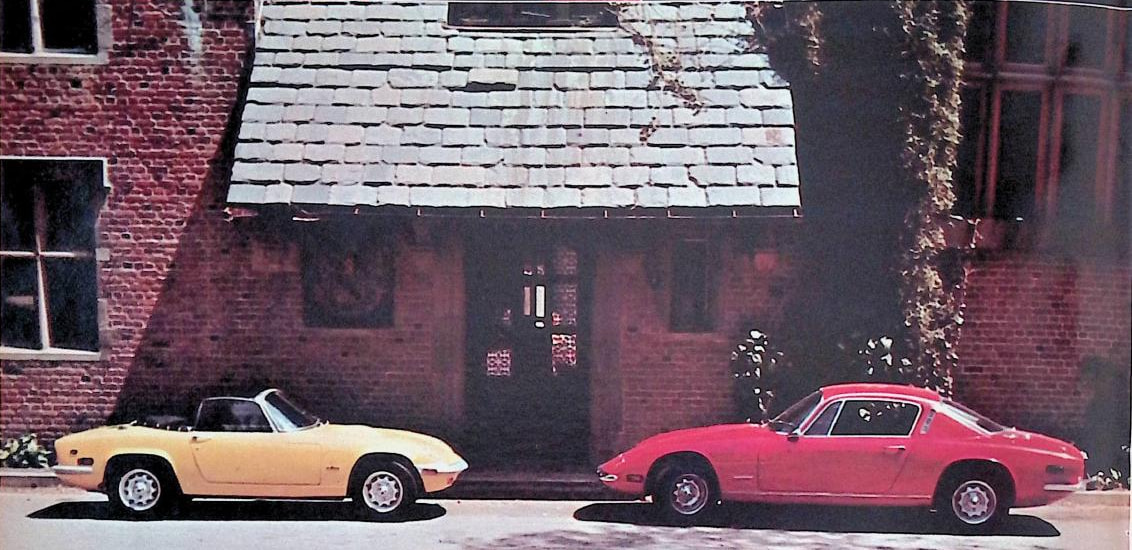
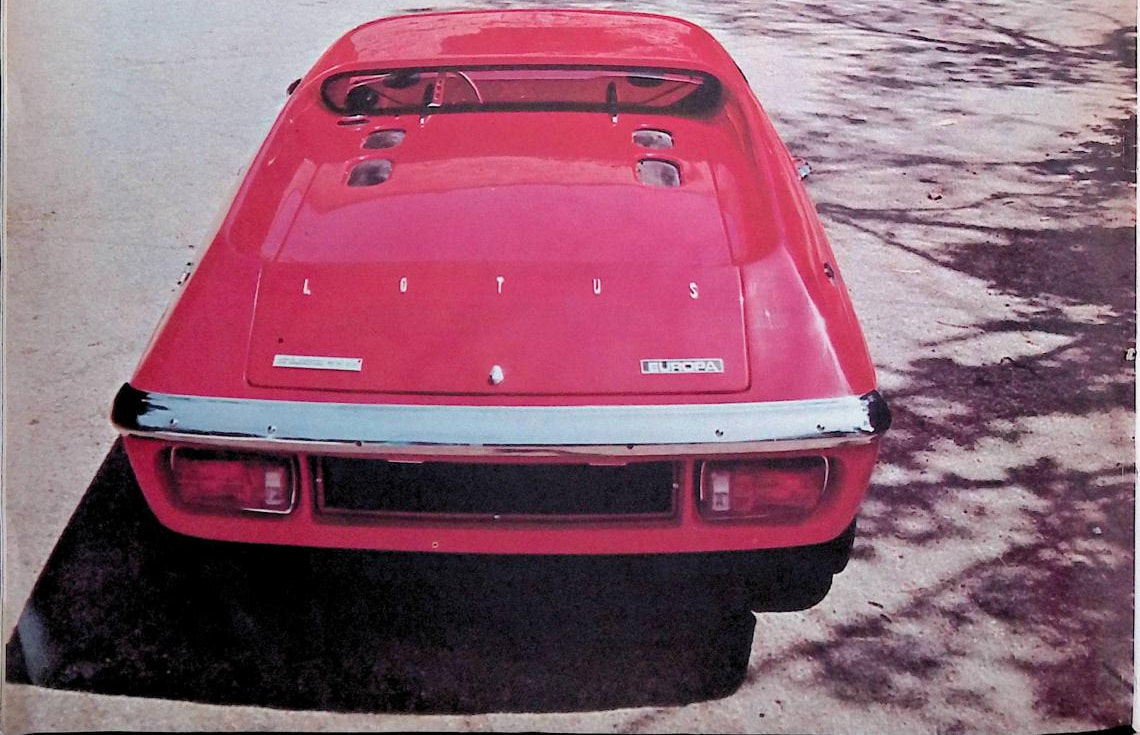
A Lotus is the 180-degree antithesis of the common view of a “safety” car. Small to the point of being tiny, constructed largely of fiberglass on a light backbone-type frame/chassis it is seemingly as fragile — and frangible — as an eggshell. Thoughts of traffic jams send Lotus owners miles out of their way — willingly. The idea of parallel parking in this era of driving by ear and 5 mph-crash bumpers gives them the shuddering sweats. A Lotus, any Lotus, is deceptively fast and handles as though it were an extension of the driver’s nerve and muscle system, given that he has taken the time and effort to be at one with the car.
The car is, in short, a gauntlet thrown in the face of nearly every safety bureaucrat in the world. Yet were everybody to drive a Lotus or its equivalent, alcoholics, drug addicts and similar incompetents aside, it is an absolute certainty that the traffic toll would drop so dramatically that the whole subject would cease to be worthy of political football games. This is not to say that you can fetch a Lotus up against a wall or tree at a high rate of knots and emerge unscathed; you can’t. It is merely that a Lotus will make it much less likely that you will hit the wall or tree in the first place. There are stronger cars, there are faster cars, there are quicker cars, there are more comfortable cars and there are more enduring cars but it is a rare car indeed that will outperform the Lotus in going exactly where it is bidden or stop when it is told — instantly. Which, when all is said and done, is the essence of active automotive safety, that of preventing the incident from becoming the accident.
The whole thing comes into perspective when it is understood that the original Lotuses were racing cars from which the street-going sports and grand touring versions grew rather than the opposite situation where a sports car or GT is developed from a cooking version of passenger car. The heritage shows throughout the entire product range from the rather spartan Mk 7 to the totally luxurious Elan Plus 2-S. To put a point on it, they are sports cars in every sense of the word.
The point about sports cars being made, take note of the word “cars.” Once maligned, with some justification, as being kits of parts bolted together for convenience of shipping (In fact the early Lotus cars were indeed sold as kits.), the charge can no longer be leveled. In the last couple of years, coincident with the development of the new Hethel plant near Norwich, a new production incentive plan coupled with tighter quality control (See Cars of England, MT July 1971) has made sure that Lotus cars are finished as well as or better than most.
All of which brings us to the subject at hand — the Europa and the two versions of the Elan, the S4 and the grand touring +2S. It would be hard to imagine two cars more different in the concept, design and execution than the Europa and the Elan. The Europa is the street embodiment of the endurance racing Group 6 machine while the Elans are traditional — if highly sophisticated — front-engine, rear-drive cars of the short deck, long hood school of sports car design. Yet they are made by the same company in the same point in time, cost nearly the same (in the case of the Europa and S4) and perform as nearly alike in normal trim as any two comparable cars on the market. The raison d’être lies in their development. Where the Europa sprang full-blown from Lotus Components (now full-blown Lotus Racing Ltd.), the Lotus Group competition department, as a street version of the Lotus 47, a real Group 6 racer, the Elans are the result of a long line of development stretching back through the delightful Elite of the late '50’s to the Mk 7 roadster and before. The Mark 7, incidentally is still being made in the form of the Series IV but, unfortunately, it comes under the growing list of cars which can no longer be imported legally.
EUROPA
It is quite possible that the Europa would still be relegated to the endurance courses as the Mark 47 had it not been for the happy coincidence of the introduction in France of the Renault 16. This then-new offering from Regie Renault featured front-wheel-drive with the engine hung out ahead of the transaxle. One can almost hear the thought stream in Colin Chapman’s head, or that of one of his employees: Engine ahead of transaxle — production item — inexpensive — if moved to the rear in situ — Mark 47? — Voilá! In light of Mr. Chapman’s past ties with Regie Renault in the matter of gearboxes for the Lotus 18 Formula Junior cars that may be a bit apocryphal, but in any event the Renault 16 engine and gearbox wound up in the stern of the 47 and the Europa was born.
The Renault R-16 engine as applied to the Europa neé Mk 47 is not only dead stock but in the Federalized, desmogged (de-toxed) form, a seeming anomaly in a product from a firm that has become known as the home of the twin cam engine. But it has a couple of things going for it that, in the Europa, makes the car the equal in performance to the other cars in the Lotus production car (as opposed to racing car) range. First, the head and block are both aluminum and second, the car it pushes weighs a miniscule 1,455 lbs., wet. And, of equal importance, while it was not designed in a wind tunnel (Lotus designers work in a drafting office like other designers) it was tested in one with the result that it has only 145 lbs. drag at 100 mph — an energetic squirrel in a roller cage could probably get it up to legal freeway speeds. As a consequence the 82 horses that live within it are quite adequate for the job. As far as pure, mindless acceleration is concerned a den mother in a 429 CID Ford Country Sedan with the back end full of cub scouts could yank a Europa away from a stoplight if she tried hard enough — until the first turn or the first stop. But consistent 80 mph speeds in the 16-second bracket over the quarter-mile isn’t exactly standing still and the Europa can do that sort of thing all day long if the driver is unimaginative enough not to find better things to do with it.
In a car designed to be nearly fool-proof with 200-plus horsepower doing the propelling any off-road or agricultural excursions with the 82-hp version must absolutely be laid at the feet of the driver. At maximum lateral side load in a constant radius turn, which is on the order of .8g, the car is dead neutral to very slightly understeering. Put another way, with the power available it is virtually impossible either to spin it or to plow it off the road in box-stock, showroom condition. This sort of road holding coupled with steering with only two-and-a-bit turns lock to lock and braking that is dead level and on the order of .9g consistently combine to produce an agility and feeling of security under any condition that is positively uncanny. A few days with the Europa dictate a complete reappraisal of the criteria from which one judges handling and road holding of other (one is tempted to say “lesser”) production cars regardless of category.
Unfortunately, any jar of ointment must have its fly and any masterpiece its flaw. So it is with the Europa which has its share, few or many depending to some extent on the size and shape of the beholder. To someone over five feet, ten inches and 160 lbs. with a shoe size greater than nine, the flaws are numerous, the main one being that such a person just plain doesn’t fit, assuming they can wiggle into it in the first place. Entering it or leaving it is an exercise in agility made somewhat easier through practice but arthritics and the corpulent had best not try. However, if you fit and master the ingress-egress action you will find that you don’t sit in it or on it, you wear it — you’re packaged, which is a very secure feeling indeed. Another flaw, albeit a somewhat carping one is that with only the driver up, plus a full load of fuel — totaling in our case 205 lbs. — the car gets an imbalance that produces understeer in right hand turns, both the driver and the fuel tank being on the same side in the U.S. version. It isn’t objectionable unless you’re hanging everything out but the wash, but it is there. The solution lies in carrying a passenger or, alternatively, eschewing the two generous luggage trays that lie under the front and rear lids, and piling all one’s dunnage in the passenger space. We could also carp about such things as fittings, like hood and deck locks being on the insubstantial side (but they’re typical of almost all British cars) and the somewhat Spartan interior for a $4,700-odd car, but again that is in the interest of lightness. For our single self (who happens to fit the car) such details can be forgiven in the throes of the sheer pleasure of driving the car. About the biggest objection we have in the matter of quality control is in the various pieces of linkage, primarily the shifting linkage. It is, in a word, vague. Quick but vague. The gear lever is connected to the transmission by means of a tube that is secured at each end merely by a small Heim joint and rod which is sure to wear as time goes on, making things even more indistinct. Surely Mr. Chapman could have come up with a better, more positive piece of hardware than this. Maybe he will, given the proper nudge from the right direction. In a car where every other control is so precise, such a shifter is an anathema.
One of the more perverse pleasures of the Europa is driving it in the rain. About the only problem we found was that, because the car is so low, you get the full benefit of spray from any vehicle on the road directly ahead. Other than that and the nagging worry about others being able to see the car, there is no problem or trauma at all. But for the fact that the windshield wipers are working and there are raindrops on the windows the weather might as well be dry for all the Europa driver can tell at normal road and highway speeds. The perversity part comes in watching drivers of other, good-handling sports cars decide that the better part of wisdom lies in slowing down for turns that the Europa driver zips through as though the car was tethered to a wire. Perverse, but one of those things that makes Lotus ownership worthwhile.
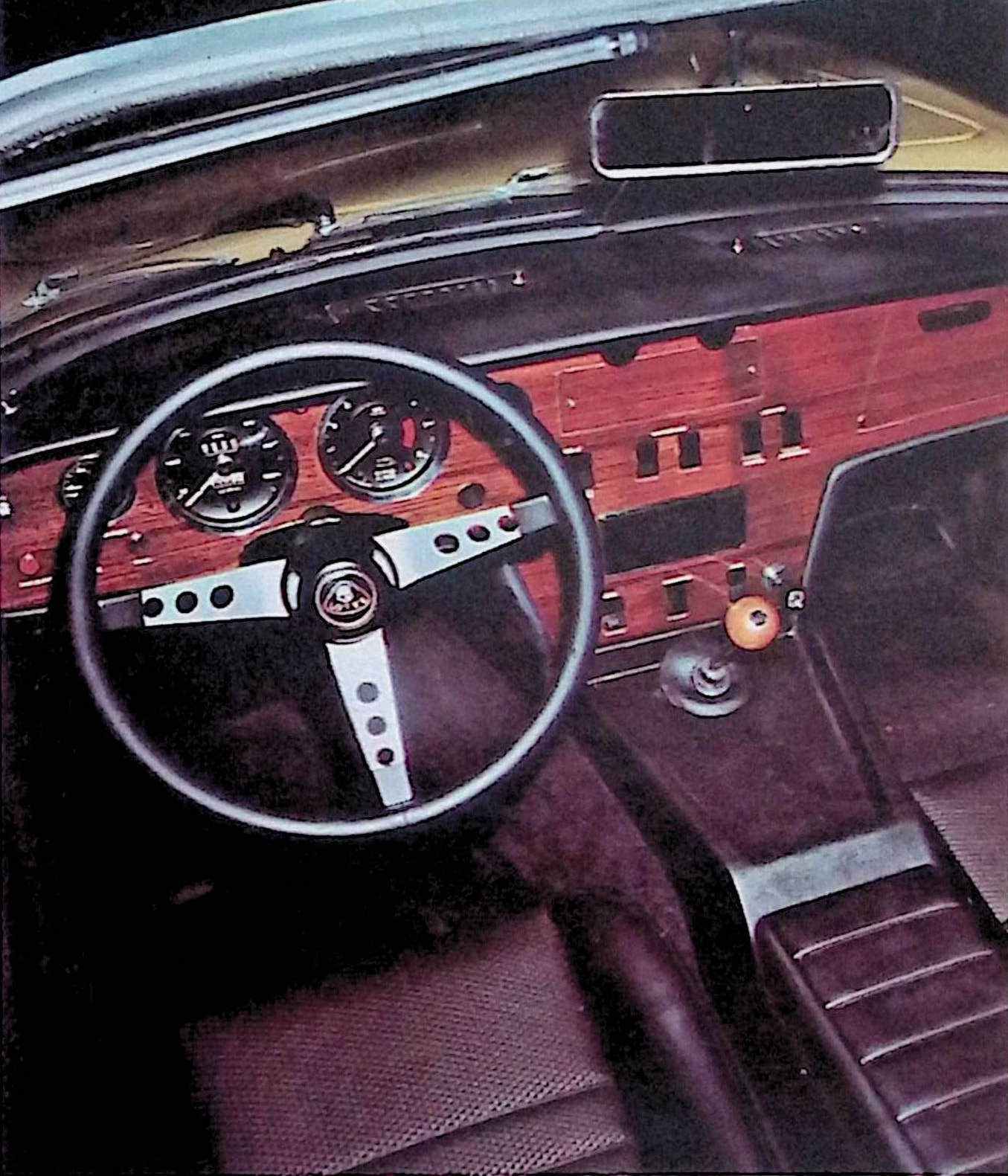
Top: Cockpit of the Elan S4 is snug but comfortable, illustrating the somewhat trite description of “everything falling readily to hand.” Instrumentation is excellent with nothing hidden by the vinyl-covered padded wheel. The Europa cockpit (not shown) is even more snug but is equally comfortable if not more so — if you happen to fit into it.
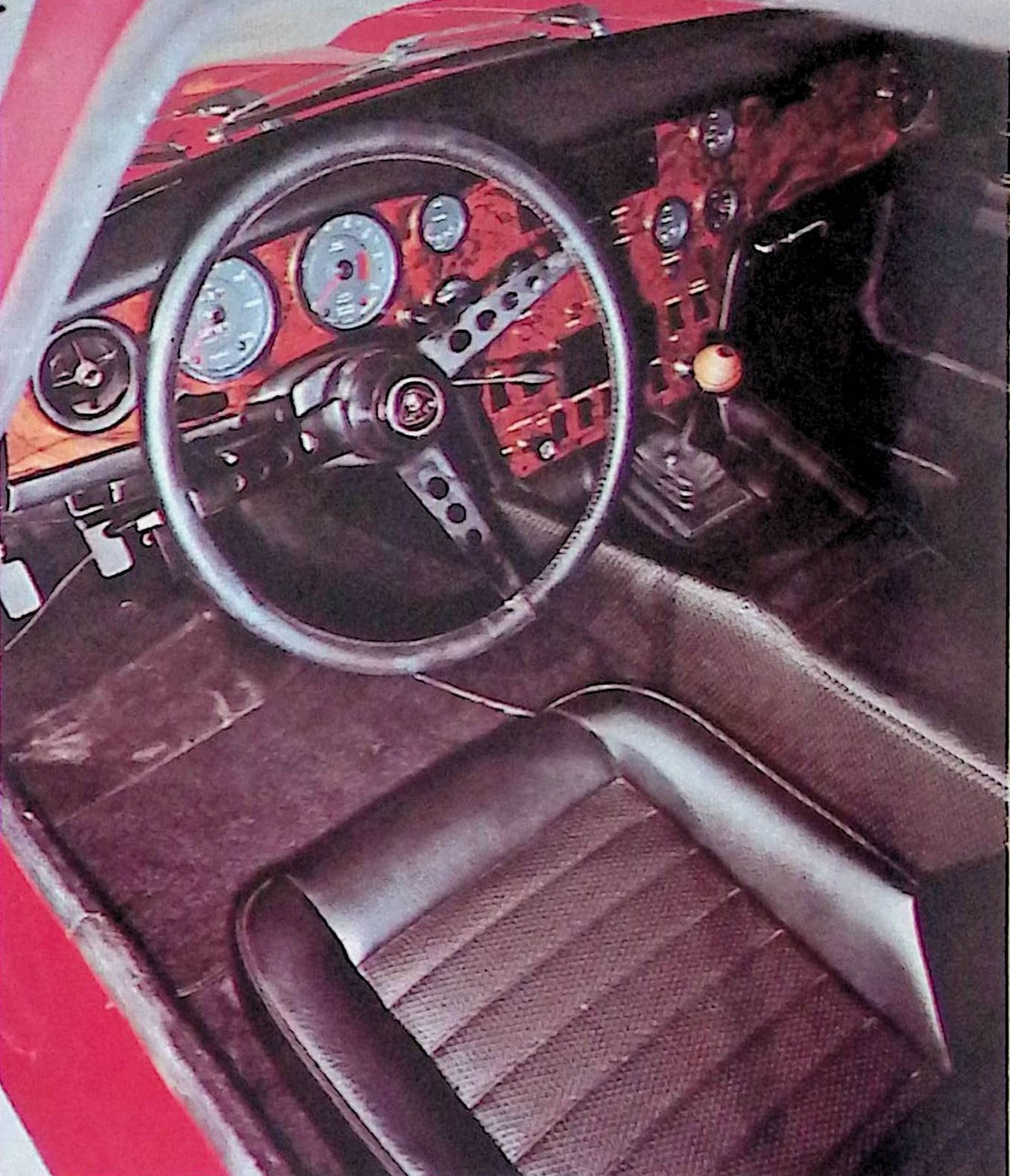
Top: The office of the Elan +2 is similar but even more completely equipped with more gauges, map light, leather covered wheel and not one but three ash trays. It is also roomier since the car is nine inches wider than the smaller +2. Appointments are generally more lavish and detailed throughout, befitting a true Grand Touring car.

Bottom: Both Elans share the Federalized (for which read detuned) Stromberg carbureted, Ford-based 1558 cc (95.1 c.i.) engine with the Lotus Twin-Cam head. Power output in this form is 118 bhp at 5800 rpm though it can be revved past 6500 rpm safely. The Stromberg CDS carburetors can’t be changed since the manifold is cast integrally.
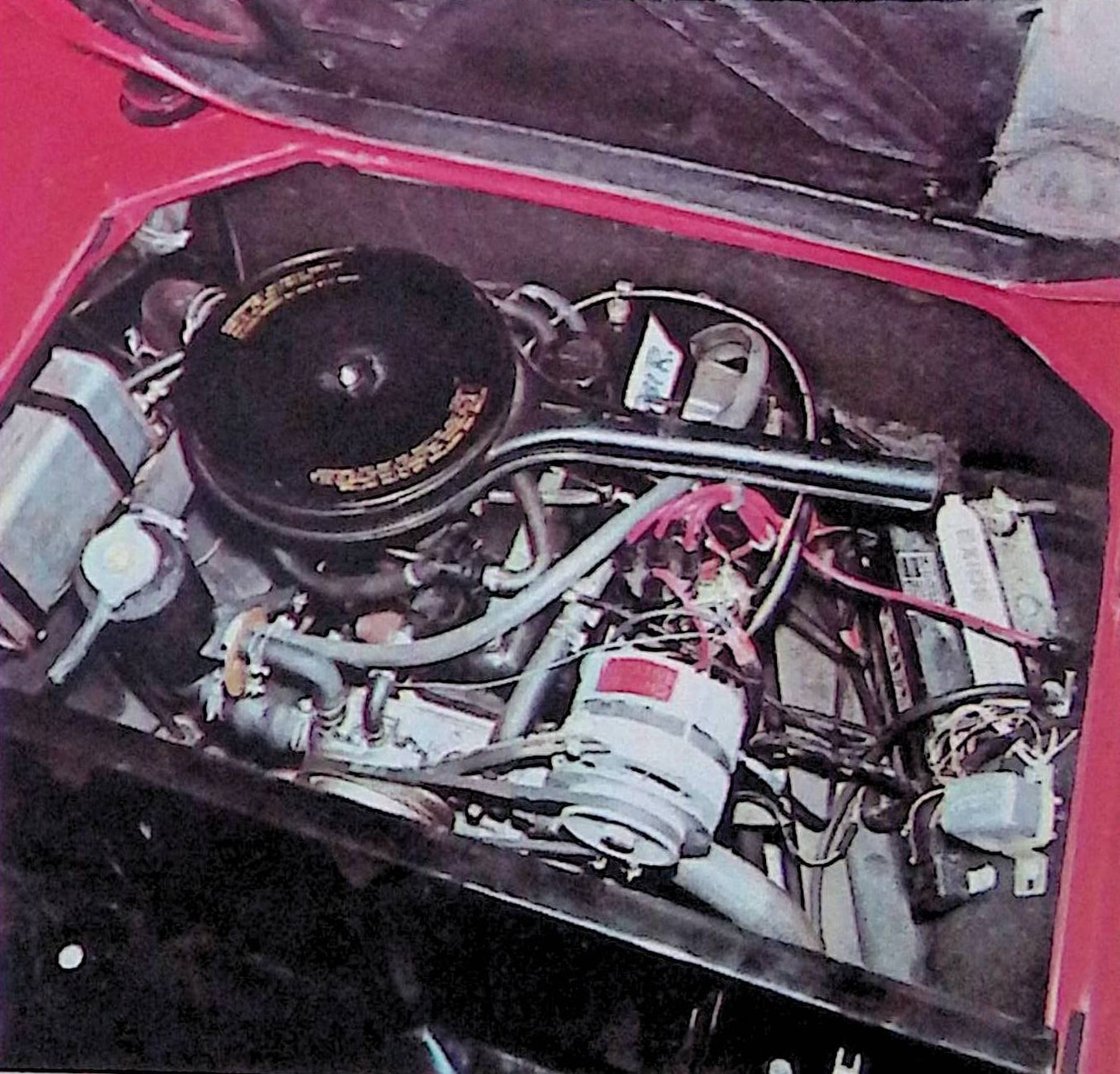
Bottom: The Europa is alone in the Lotus line in carrying the Renault 16 engine and transaxle. The comparatively low 82 bhp at 6000 rpm is actually the equivalent in its performance in the 1455-lb. car to the stronger Twin-Cam in the other cars, however. Its “stock” characteristics allow the Europa to trickle along in slow traffic.
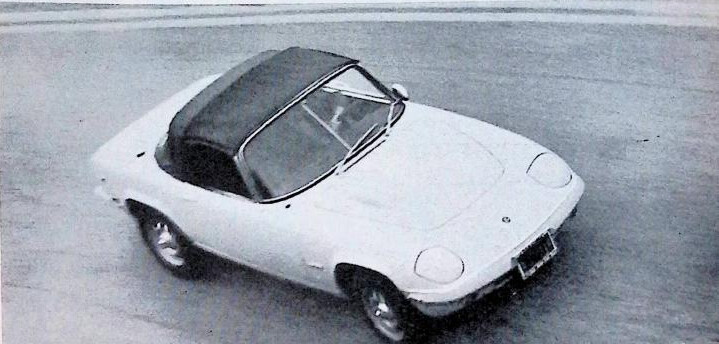
Above: The Elan S4 is basically an understeering car (note front wheels) but can be tossed into a turn if you want to tighten things up. Short wheelbase makes it extremely agile but forgiving.
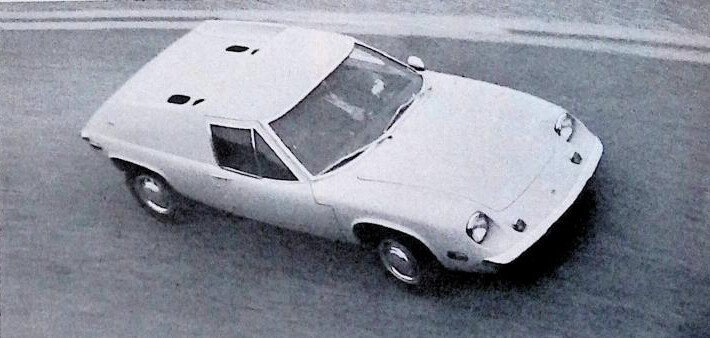
Below: The Europa, on other hand, doesn’t like being tossed, preferring to follow a pre-planned line through a turn. The difference is similar to that between a Formula car and production car.
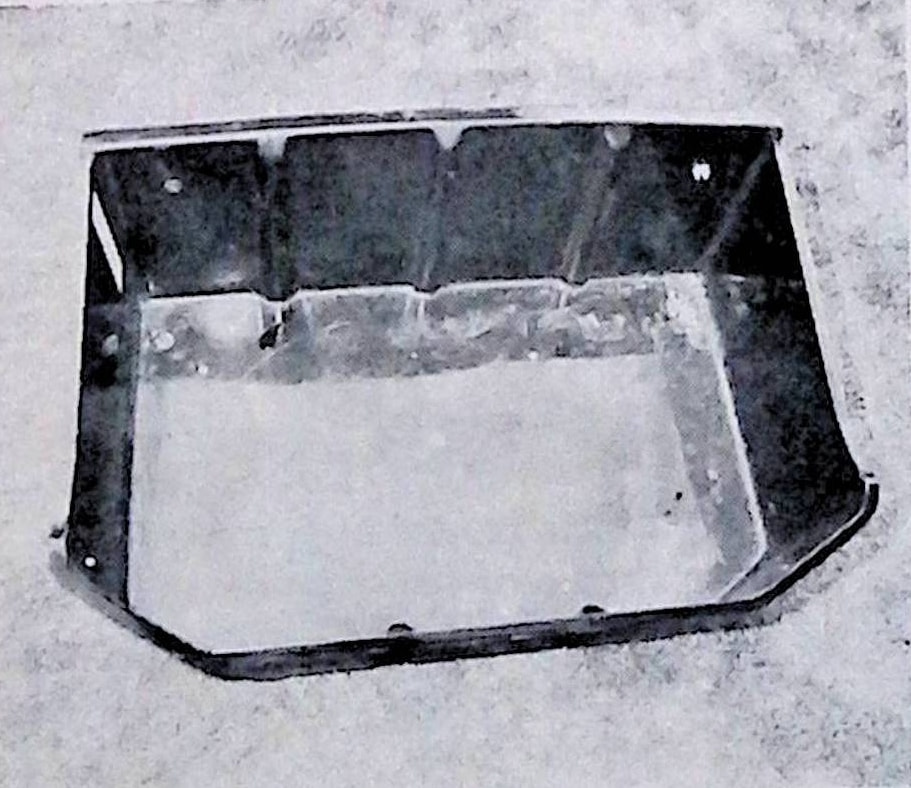
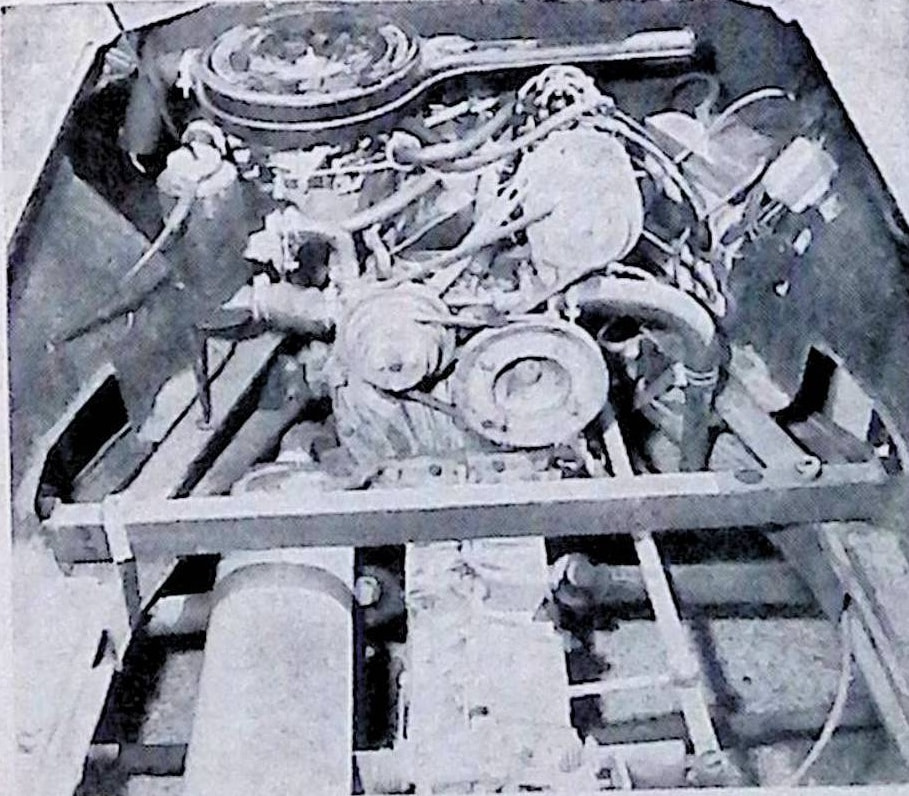
Spacious rear luggage tray (left) bolts into the space over transmission behind engine. It will hold one large 3-suiter and small gear or two medium cases or 6 large grocery bags. When it is removed by undoing two bolts (right) the entire engine bay is revealed and both engine and transaxle become easily accessible. A person can stand right in the engine bay and do work.
ELAN +2
Poles apart in one sense from the Europa and very much like it in others, the Elan +2 is best described as “civilized.” It is what in Detroit parlance is known as the top of the line. Bigger, roomier, far more luxurious, the +2 can be had with almost any interior convenience known to man — at least that sub-species known as sports car man. About the only things you can’t have are power seats, power steering and (probably) air conditioning. The first two are unnecessary and the last, considering the ventilation system and the lack of spare room under the hood for the required plumbing, is impractical. The seats move easily back and forth on their tracks to an almost infinity of positions to accommodate almost any human body style between midgets and pro basketball players.
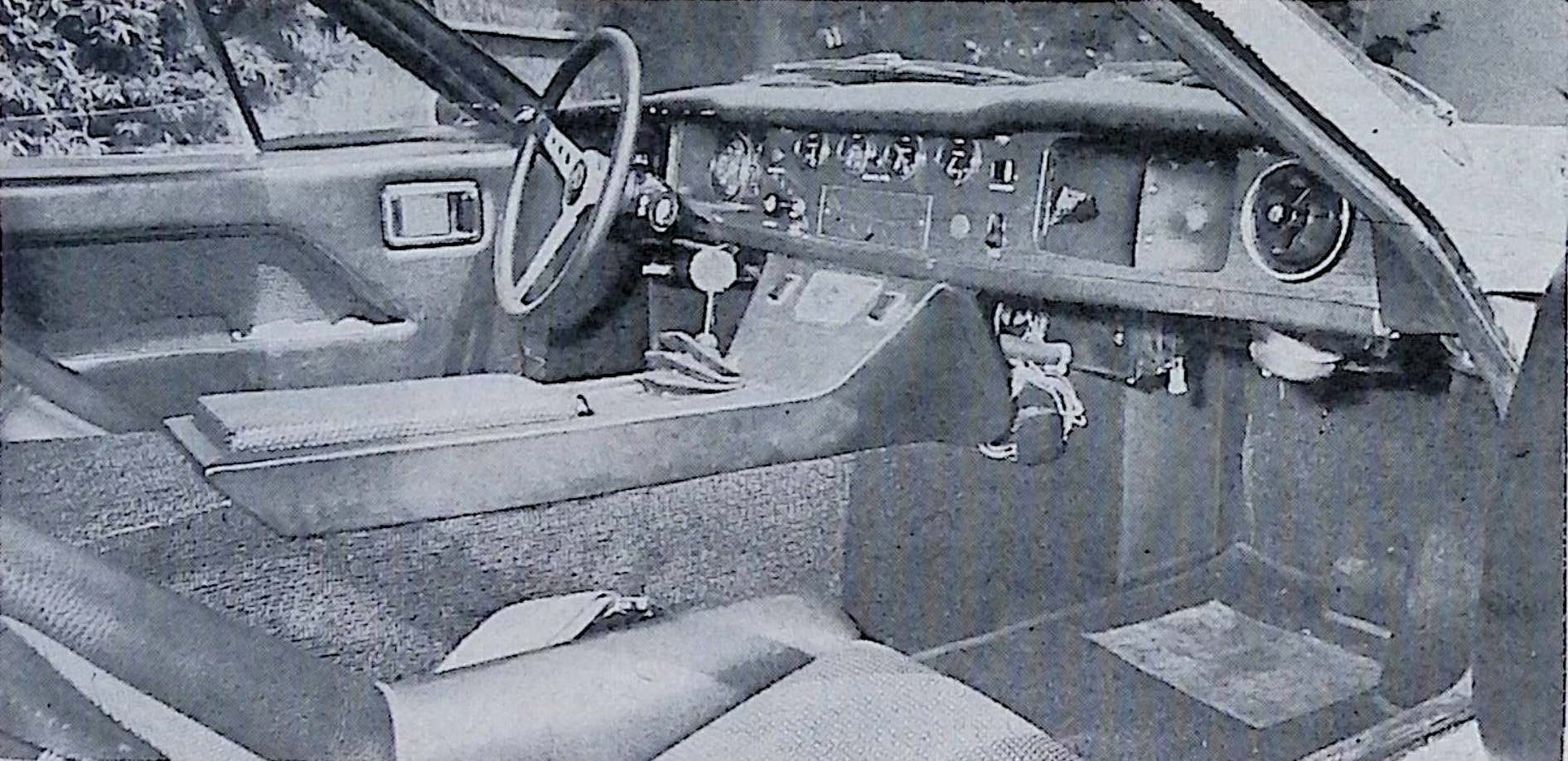
The snug but very secure and comfortable cockpit of the Europa. Seating is lower than in the Elan, making the backbone divider seem higher. The seats recline at roughly a 45-degree angle, enhancing the racing car feeling. It is strange at first but gets comfortable if you fit it and get used to it. Visibility to the front and sides is excellent but training is required to see out rear.
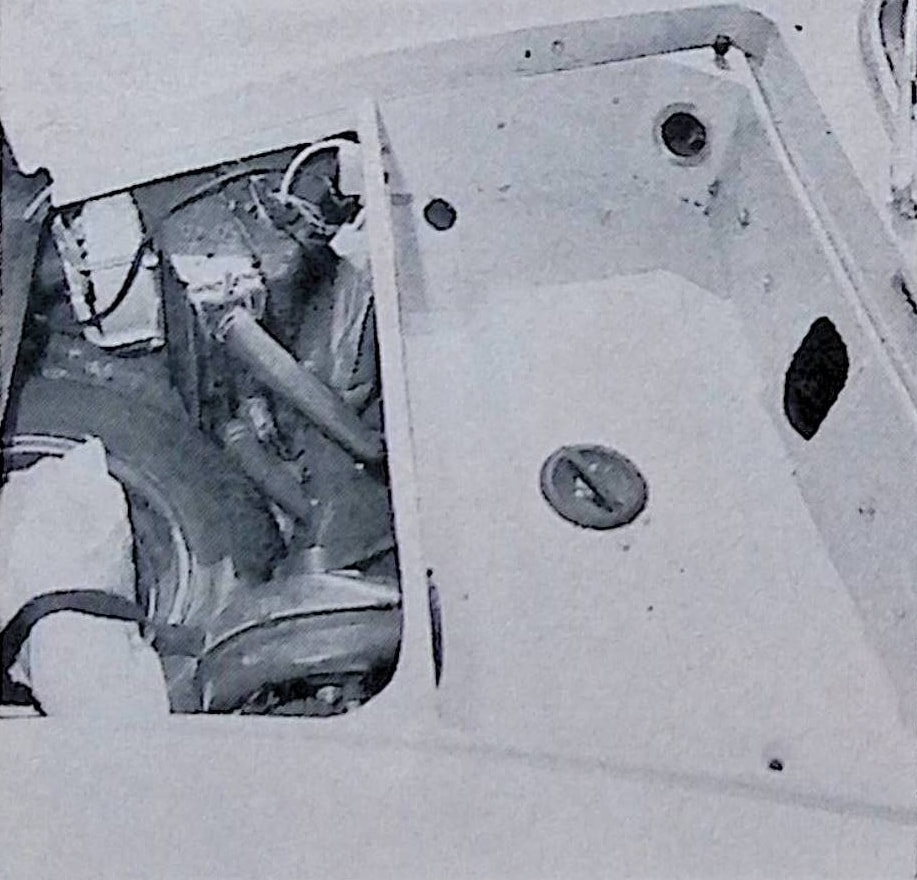
Front compartment carries the radiator, spare, jack and vent blower. Tray can be used for small luggage and serves as an interior air plenum. It could possibly carry ice for A/C!
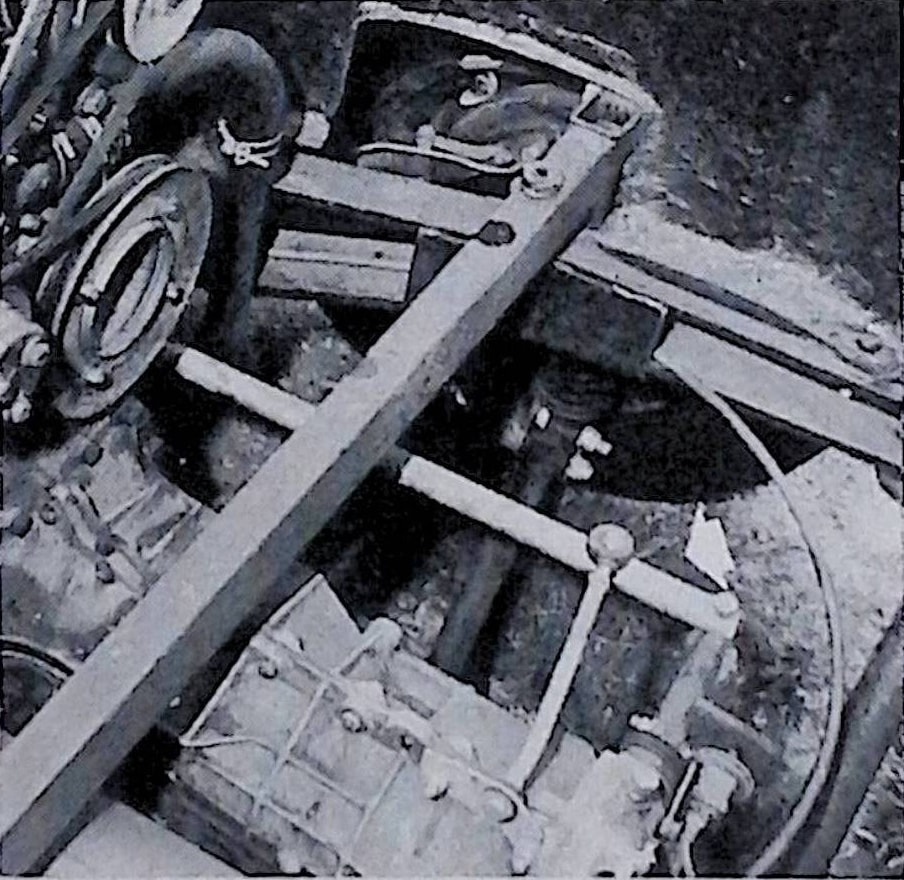
One of the areas of the Europa that could be improved is in the shift linkage (arrow). It works but it is stiff and vague and there is better hardware available, if they’d look.
The steering is what the makers of power steering units wish they had but have yet to achieve. Even with fat, gummy 165 x 13 radial tires it can be swung its full 2.75 turns lock-to-lock parked; not necessarily a good habit to form but it can be done with ease. In motion it is light, precise and quick though not so quick as to be disconcerting to any but those irrevocably accustomed to the more prosaic products of Motown, U.S.A. To anyone used to American power steering or the quicker but harsher units on most imports, the Elan’s steering apparatus will come as a total delight.
As for the rest, everywhere you look, you get the idea that Colin Chapman and his designers care for you. And obviously they expect you to care for the product. There is a gauge or instrument to tell you just about anything that is going on with the exception of the air pressure in the tires. They are all legible, with the major ones close to the driver, are not obscured by the driver’s hands on the wheel and can be read at one sweeping glance. As in the Europa, they are recessed under a ledge at the top of the polished walnut dash paneling in such a way that there isn’t a hint of reflected light on the windshield. The British have gone big for rocker-type switches of late and Lotus is no exception. There are a bunch of them, all grouped within ready reach, even with a shoulder harness and they would be confusing if they weren’t so well marked and positioned so that you almost automatically poke the right one once you know what each one is. On the passenger’s side, tucked away is a map light, not one of those goose-necked, chromed flex-cable items but a neat, small light set on a series of universal joints that automatically comes on when it is swung out and goes off when it is swung away. Thoughtful. As a matter of fact you have to live with the car for a day or so for all the unobtrusive little thoughtful touches to make themselves known. Such as the courtesy light under the hood and in the trunk as well as in the cockpit and the red lamp in the door edge that goes on when you open it as a warning to those who might be passing too closely. And then there are the three ash trays, one in each door and one in the center of the dash. You don’t need to worry about your passenger snuffing a butt on the back of your hand when you’re making a sudden third-gear shift. And then the power windows. It would be next to impossible for a driver to reach over and open the passenger’s window if there were no passenger to do it for him so there are two rockers in the console to activate the windows. In fact this feature is in all street Lotuses except the Super 7 which doesn’t have windows and for us is academic anyway.
Perhaps one of the greatest differences between the +2 and the Europa is that you don’t have to get fitted for it; you fit it to you. It doesn’t require getting accustomed to, at least not on entry. You just get in, sit down, adjust the seat and that’s it: the thing fits. In fact, it fits so well that it can breed overconfidence. All of which can, if you haven’t been tutored in the ways of the Elan, lead to an abrupt loss of confidence, either in yourself or the car.
The gearbox is one of those that are a thing of beauty and a joy forever. You snick it into low and gingerly let out the clutch pedal — and this is where it happens. That clutch is not meant to be slipped (and therefore fried). If you try to slip it, it chatters. What you do, or learn to do, is to pick the revs just off idle and let the clutch out smoothly but with some dispatch, which means that you have to decide to do a thing and then do it; you more or less have to commit yourself. The minor shock of the action is taken up all through the driveline by Metalastik (a combination of metal and rubber-biscuit) universal joints. As one factory executive remarked, you can proceed down the road like a kangaroo in a series of hops at each shift if you aren’t familiar with it. The whole exercise takes a certain amount of right-to-left-foot coordination at first but once the knack is found and you learn how to keep the joints properly loaded the process is unbelievably smooth. The Europa, on the other hand, does not have this feature and as a result it takes off more like a real racer with instant, insistent forward motion. In a way, it is easier to master but is nowhere near as smooth unless you slip the clutch. Each in its way is superb, they’re just different and each requires acclimatization on the part of the driver, also different.
It’s when you get acclimatized that the differences disappear. Both will rap off consistent quarters in the upper 16-second bracket in the low 80’s. The Europa with its lighter weight and stock Renault engine will pull out just a bit quicker and more strongly while the more powerful (but sadly “Federalized”) twin cam will show its stuff at the top end. This is the same twin cam unit Lotus buyers of pre '69 knew and loved but it has undergone a few changes in the interest of quick compliance with the emissions regulations. For some reason known only to its makers, the twin cam head is cast integrally with the manifolding for the carburetion with which it is to be used, rather than incorporating bare ports and using different manifolds for different purposes. The current British answer to emissions is the Zenith-Stromberg CDS carburetor which is similar to the long-favored SU except that it uses a diaphragm to operate the needle which controls the mixture rather than a piston, and has a fixed jet rather than an adjustable one. The latest Lotus heads are cast with flanges for this device, two to a head. Short of some expert surgery with a milling machine and equally expert heliarcing, or outright purchase of a Lotus Formula B head, there’s no chance of back-dating to the 40 DCOE Weber carburetion that graced earlier models. Be that as it may, it is still a vastly more sophisticated engine than that in the Europa.
Interestingly enough, though, not only is the acceleration between the two virtually equal but so is the ultimate top speed. The lighter weight and better aerodynamics of the Europa allow the lower-powered engine to reach its redlined speed of 6,500 and 115 to 118 mph where the detuned twin cam runs out of breath pulling the heavier, less slippery Elan at 115 mph, give or take a couple. It’s a bit sad in a way. While we all want cleaner air, it would seem hardly likely that a limited production car that gets anything from 30 to 40 miles per gallon of gasoline would contribute significantly or even measurably to air pollution.
Fortunately what the Lotus has lost, or not been given in the realm of pure, witless straight-ahead speed is made up for in other areas in such a way that almost anything else you can license would be hard-put to follow one on anything but an empty freeway (or Bonneville).
ELAN S4
The Elan S4 lies somewhere in between the Europa and +2 but it’s a bit hard to say just where. It shares the engine, general design, running gear and cockpit layout with the +2 but it lacks much of the sophistication in appointments and creature comforts of the bigger car without quite approaching the charm of the Europa in some indefinable way. For the average person not disposed to learn, or physically unable to fit into or do the ingress-egress act with the Europa it is a more practical car. Sharing the superb, slot-car-like handling characteristics of the other two, it is every inch a Lotus. It also has the advantage of coming in both soft- and hard-top versions, for the edification of those souls still dedicated to wind-in-the-hair motoring, something that is getting more rare by the year. With the other two the only choice of tops you get is in the color of the car, both arriving in hard-top form only — although the idea of an open-top Europa is intriguing. Cam-Am on the street!
As with the others the S4 is, despite appearances, an exceedingly strong piece of construction. All are monocoque fiberglass bodies over a relatively simple backbone chassis to which the important loads are attached. This runs down the center of the car and branches out front and rear to support the suspension and such components as the engine and transmission. Of and by itself it isn’t very strong but in combination with the brilliantly engineered body shell it becomes an extremely rigid and very light structure. It is also pure Chapman, having been pioneered with the earlier Elite. Like that car the Elans use the unique Chapman strut rear suspension, somewhat similar to a McPherson strut front end but lighter, where the Europa makes use of a trailing arm with axle-and-strut location for each wheel, similar to that used in the pure racing cars. Interestingly enough the cars all have very nearly similar weight distribution, regardless of the position of the engine. In the case of the Europa it is 46% / 54% front to rear; in the +2 it’s 48% / 52% while the S4 falls almost exactly in between, all of which may deliver a message about the way Mr. Chapman thinks about handling packages.
SUMMING UP
There you have it — three cars, three prices ranging over about $1,500 from top to bottom. How do they compare among themselves and how do they compare with whatever else is on the market that we can have in this country without ducking customs agents and starting a shooting war with the Border Patrol?
The Europa might appear in some eyes as a toy, though what is known as a “toy car” it definitely is not. For those who can fit it and fit in it, the Europa is indeed a car. For those who fit the above two categories and to whom the handling characteristics of other cars have paled it approaches the ultimate. To those who fit the above categories and whose Walter Mitty propensities dictates a desire for a Group 6 car that can be driven on the street it IS the ultimate, in the Lotus or any other line. In that it has more luggage room than driver room, is water and weather tight, carries more creature comforts than most cars of its size, and gets anywhere from 30 to 40 miles to gallon it is a practical car insofar as any sports or GT car is practical.
At roughly $600 and change more, it can be compared roughly with the Porsche 914 and win hands down in terms of sophistication, handling, comfort and all-around performance. It is about the equal in practicality and a little ahead in mileage and it would lose abjectly in the matter of availability of service but for the fact that the engine can probably be taken care of by any Renault dealer as can the gearbox. Certain other pieces can be handled at one or another British-Leyland products dealers. But when all is said and done, a service manual is a recommended option. The 914, on the other hand can be taken care of by either the local V-Dub dealer or the
Porsche-Audi man and one or the other of these you can find almost anywhere. The Europa is not everybody’s dish of tea; it wasn’t meant to be. But then, neither is a Cadillac Eldorado.
The S4 is a different thing entirely. It is a touring sports car in the modern-classic mold, a pure two-seater with a choice of hard and soft tops. Reasonably fast, quicker than most, economical to operate and extremely comfortable, the S4 is FUN. It is a sports car for commuting and week-ending and just charging around where the roads are winding and relatively empty, a car for enjoying. For anything longer that requires luggage for more than a few days at most, though, you’d best take the family wagon.
Its market equivalents would be the Porsche 912 (when you compare you might as well use the standard of the world, right?) and the Alfa Romeo 1750. In the case of the former you spend more money and get more practicality but you’d lose on overall performance again. In terms of design you could probably get an argument in any bar in the civilized world; in terms of execution of the design you’d be in the clear — NOBODY faults Porsche’s execution of their serious machines. In the case of the Alfa you’d spend considerably less money, get equal or better straight line performance, more luggage space but not as good mileage. Nor, though the line of demarkation is marginal, would you get Lotus handling. That you don’t get in anything Italian that’s licenseable and importable with the possible exception of the works of Carlo Abarth.
With the +2 things are a little different. You’re talking good money but not as much money as anything nearly comparable. The +2, as has been noted, is a highly civilized S4. If you don’t take your kids along it has enough room for two weeks’ worth of luggage assuming that your traveling companion doesn’t insist on living with a steamer trunk. It has as many of the necessities as any true GT anywhere near its size anywhere at any price. It combines the performance and sheer joy of driving with the practicality of the GT car, which is what GT cars are all about.
The +2 is almost but not quite as well finished as the 912 and has approximately as much room — and will run circles around the usual example, especially in the wet. In the latter case it would probably give a 911 a rough time as well. Its mileage, at upwards of 30 mpg at cruising speeds will also be above anything comparable. In the case of service in areas other than where Lotuses are sold, it falls down when compared to the Porsche, any Porsche, but then so does almost anything else including some American products we could name.
One thing is sure, Colin Chapman must be proud of the car — his signature appears on the steering wheel of every Elan. In a time when the emphasis is on “safety cars” — Panzerwagen like armored eggs carrying their occupants in a yolk of passive restraints with a view to allowing their drivers to smash with impunity into immoveable objects and other motorists — that signature has to say something about where active safety really is. But perhaps more important to the enthusiast, Colin Chapman has made possible a succession of shining moments — Camelot on wheels. /MT

Exterior of the Elan +2 shows the greater attention to detailing that befits a true Grand Touring machine. What is not apparent, other than the longer wheelbase, is that it is larger in every dimension than the other Elans. Interior hip and shoulder room is consequently greater.
SPECIFICATIONS
| EUROPA | ELAN S4 | ELAN +2 | |
|---|---|---|---|
| Engine | In-line 4, OHV | In-line 4, DOHC | In-line 4, DOHC |
| Bore and stroke — ins. | 2.99 × 3.19 | 3.24 × 2.86 | 3.24 × 2.86 |
| Displacement — cu. in. | 95.5 (1565cc) | 95.1 (1558cc) | 95.1 (1558cc) |
| HP @ RPM | 82 @ 6000 | 110 @ 6000 | 110 @ 6000 |
| Torque: lbs.-ft. @ RPM | 79 @ 4000 | 104 @ 4500 | 104 @ 4500 |
| Compression Ratio/Fuel | 10.25:1/Premium | 9.5:1/Premium | 9.5:1/Premium |
| Carburetion | 1 Solex 2 bbl | 2 Zenith-Stromberg CDS | 2 Zenith-Stromberg CDS |
| Transmission | 4-spd manual transaxle | 4-spd manual (Ford) | 4-spd manual (Ford) |
| Final Drive Ratio | 3.66:1 | 3.77:1 | 3.55:1 |
| Steering type | Rack and Pinion | Rack and Pinion | Rack and Pinion |
| Turning Diameter (Curb-to-curb-ft.) | 44 | 30 | 34 |
| Wheel Turns (lock to lock) | 2.2 | 2.7 | 2.7 |
| Tire size | 155 HR 13 | 165 HR 13 | 165 HR 13 |
| Brakes | Disc front/drum rear | Disc 4 wheels | Disc 4 wheels |
| Front Suspension | Independent length A-arms, concentric coil/shock | Unequal length A-arms, coil springs, tube shocks, sway bar | Unequal length A-arms, coil springs, tube shocks, sway bar |
| Rear Suspension | Independent trailing arm, concentric spring shocks, axle & strut lateral location | Independent with lower control arm, Chapman strut, concentric coil/shock | Independent with lower control arm, Chapman strut with concentric coil/shock |
| Body/Frame Construction | Steel backbone, w/subframes reinforced by body | Steel backbone, subframes, separate fiberglass body | Steel backbone, subframes, separate fiberglass body |
| Wheelbase — ins. | 91.0 | 84.0 | 95.7 |
| Overall length — ins. | 157 | 145.0 | 168.0 |
| Width — ins. | 64.5 | 56.0 | 63.0 |
| Height — ins. | 42.5 | 45.0 | 47.5 |
| Front Track — ins. | 53 | 47.1 | 54.0 |
| Rear Track — ins. | 53 | 48.4 | 55.0 |
| Curb Weight — lbs. | 1,455 | 1,635 | 1,870 |
| Fuel Capacity — gals. | 9.0 | 12.0 | 15.6 |
| Oil Capacity — qts. | 4.5 | 4.5 | 4.5 |
PERFORMANCE
| EUROPA | ELAN S4 | ELAN +2 | |
|---|---|---|---|
| Acceleration | |||
| 0-30 mph | 3.1 | 3.2 | 3.5 |
| 0-45 mph | 5.9 | 5.8 | 6.3 |
| 0-60 mph | 9.8 | 9.6 | 9.8 |
| 0-75 mph | 13.7 | 13.8 | 14.3 |
| Standing Start ¼-mile | |||
| Mph | 81.5 | 82.0 | 82.5 |
| Elapsed time | 16.9 | 16.9 | 16.9 |
| Passing speeds | |||
| 40-60 mph (3rd) | 5.5 | 5.8 | 5.2 |
| 50-70 mph (3rd) | 5.3 | 5.7 | 5.9 |
| Speeds in gears | |||
| 1st …mph @ rpm | 33 @ 6500 | 37 @ 6500 | 38 @ 6500 |
| 2nd …mph @ rpm | 53 @ 6500 | 55 @ 6500 | 58 @ 6500 |
| 3rd …mph @ rpm | 83 @ 6500 | 80 @ 6500 | 82 @ 6500 |
| 4th …mph @ rpm | 118 @ 6500 | 110 @ 6500 | 115 @ 6000 |
| Mph per 1000 rpm (in top gear) | 18.1 | 16.9 | 19.2 |
| Stopping distances | |||
| From 60 mph* | 133 ft. | 134 ft. | 134 ft. |
| Gas mileage range | 31-35 mpg | 26-29 mpg | 28-30 mpg |
| Speedometer error | |||
| Electric speedometer | 30 35 40 45 50 | 0.30 35 40 45 50 | 30 35 40 45 50 |
| Car speedometer | 31 36 41.5 47 52 | 32 37 42 47.5 52.5 | 32 37 43 48 53 |
*Stopping distances are result of hard stop just short of lockup