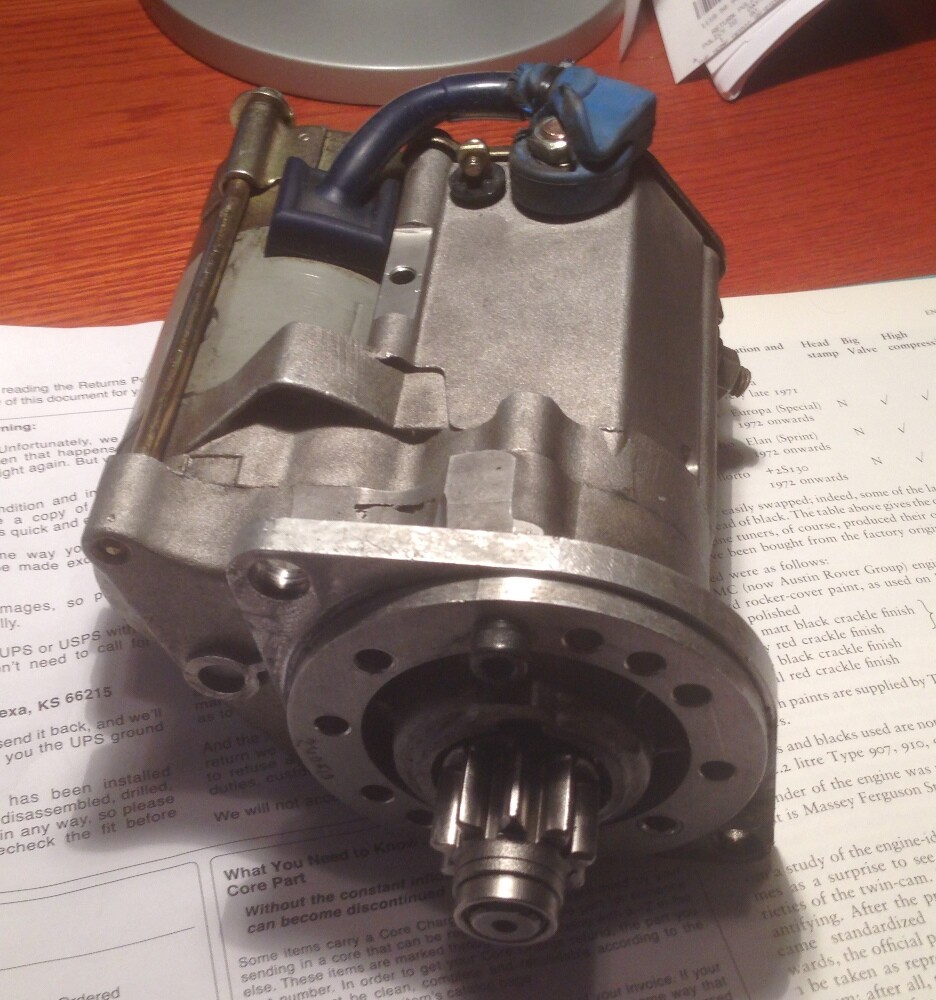
My OG starter recently went (went BANG, actually, and then just spun uselessly). I purchased and installed a new gear reduction starter motor from RDE. On first try I received a horrific grinding noise for my efforts. Turned the engine by hand until the next cylinder went to compression. Tried again but same ungodly noise occurred. Only engaged for a split second both times, so hoping for minimal damage, but haven’t had time to remove and check yet.
Any ideas on what can cause this? I have an S3 but with a four bolt crank. Not sure if that makes a difference, but might be relevant.
Battery was on a charger immediately prior to make sure it was fully charged before I tried to start the engine. Didn’t put an ammeter on it, nor do I have an amp gauge. But didn’t want to run it any longer, risking damage. I looked at the ring gear prior to the install and it looked fine then. As I mentioned in my post, I haven’t had a chance to pull the starter out. I did turn the engine by hand between the two start attempts.
Now, I have modified the wiring. I removed the original solenoid, and now the motor connection is a straight shot from the battery. The pigtail to the new starter’s internal solenoid is connected to the white-red wire from the ignition switch.
Hi. I have used the Brise starter in the past. The noted issue people have had with the Brise is alignment of the teeth on the starter drive wheel with the teeth on the flywheel. So it sounds like you need to check for damage, also measure the distance from the mounting surface on the bell housing, and the distance from the mounting surface on the starter motor to the starter drive wheel when it’s fully extended. You may find the starter drive wheel is not aligned with the flywheel teeth.
Also, when I fitted my Brise to my first car I had to fit helicoil inserts to the bell housing so that I could tighten the starter motor bolts properly. It may be that you’ve not got it aligned properly or the bolts are just not holding.
It “sounds” like the pinion is not properly engaging the ring gear teeth. The pinion teeth should mesh/engage about halfway across the ring gear teeth and physically mesh from middle of the pinion tooth to the middle of the ring gear tooth.
I would suggest removing the lower dust cover and having a careful look at where the pinion sits relative to the edge of the ring gear. The pinion should extend 13mm or 1/2" from rest.
One way to check the stroke of the solenoid and how it positions itself in the ring gear is to remove the large cable from the starter terminal but leave the solenoid wire in place. Energize the solenoid and the pinion will extend into the ring gear so you can see it’s relative position.
If your new starter is engaging properly it should sound like your cranking over a Honda Civic.
Hi. The threads in my bell housing were on their last legs and gave out completely when I tried to tighten the bolts. The helicoil inserts were my saviour.
How many teeth were on your old starter pinion gear and how many on your new one..? Could be 9 or 10 -should be same..The most common flywheel ring gear has 110 teeth -check yours -and works best with a 9 tooth pinion..but, as with everything Lotus twincam, there may be other, rarer variations..
The bevels on the ring gear are for a reverse or back engage starter, as OEM.
You battery may test fine, but I would sure make sure when you are cranking it has full 11v+. Not below 10v.
Again, your earthing or path to the starter and return to battery (and booster) is limited by contact path and amount of returns. An easy way would be to hook up more grounds, around the starter to the chassis or turrets with good contact. You will see sparks if you have good contact.
I suspect this is your issue, and shimming the starter away at 0.5mm increments would be last resort.
I recently chased a weak spark condition, and during the troubleshooting process I was routinely seeing 12+ Volts across various random spots on the engine block back to the battery cables and other electrical parts, ie distributor, coil points, solenoid, etc. So I’m not convinced that’s the issue. My ground connections seem pretty solid.
I understand that the voltage would drop when cranking the engine, but I don’t want to cause any additional damage to the ring gear while attempting to test it. Right now I can’t think of a way to test the voltage drop without the starter in situ.
I have to remove the starter anyway, so I’ll start by checking gear teeth and ring gear / pinion mismatches, and other potential physical issues. Proceed from there.