Now Dasher, Now Dancer
For road dancing, the Lotus Elan makes a memorable partner.
By Steven L. Thompson
Car and Driver, December 1989 · Photography by Cindy Lewis
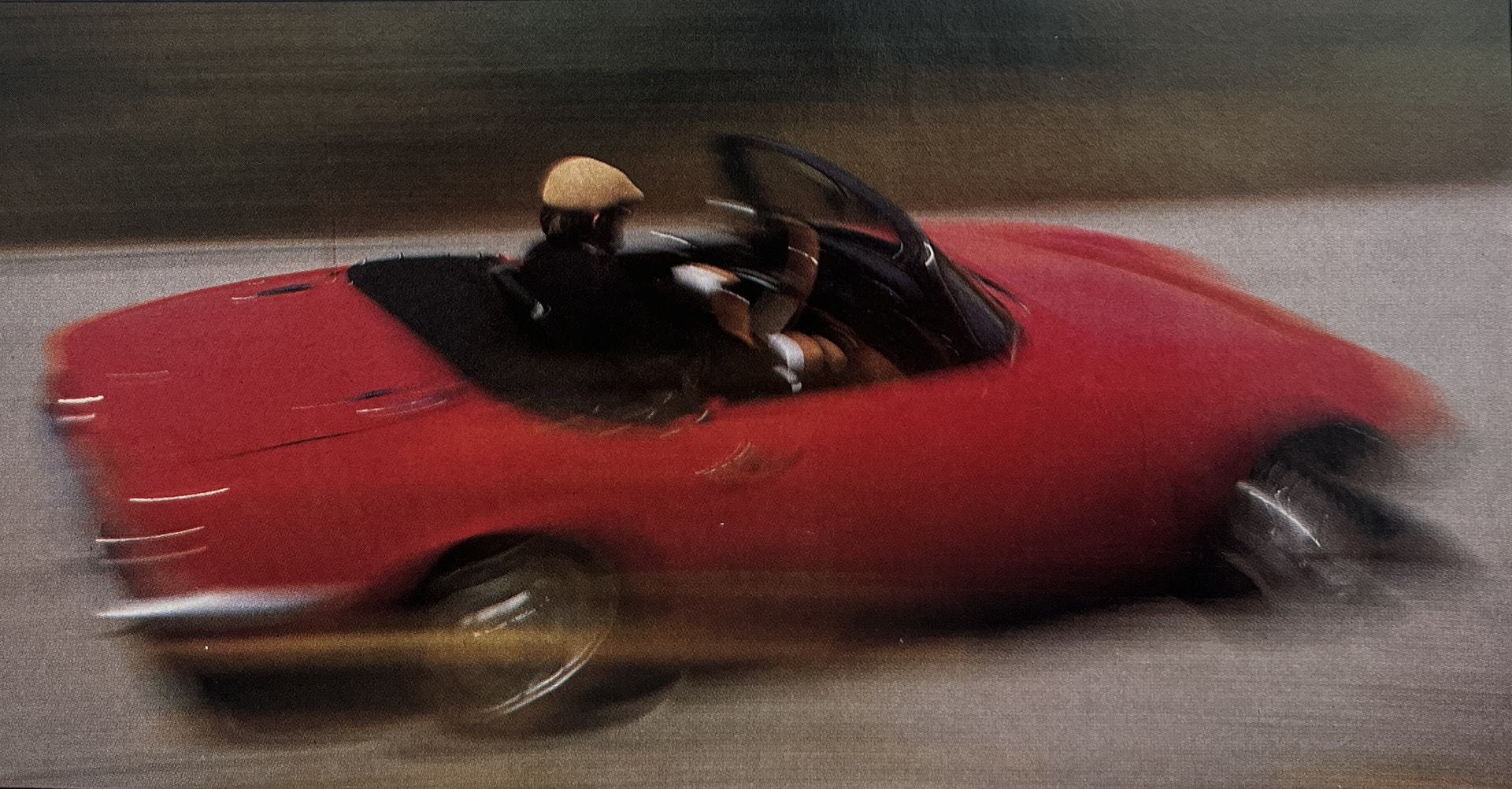
Plenty of people can resist the allure of the Lotus Elan, but I’m not one of them. My Elan is the best road-dancing partner I’ve ever had.
You know about road dancing. It’s not the same as driving, which is what we do most of the time. Occasionally, we transcend mere driving—even when we’re caught in freeway gridlock—and manage to have a little fun with our high-tech wondercars. But it’s still driving, just getting somewhere. Road dancing is something else entirely. Something to look forward to, something to dress up for, to plan for, and to savor. And unquestionably something for which you need the right partner.
When I go road dancing, I want to be Fred Astaire and I want my car to be Ginger Rogers. I want it to be both complementary and complimentary. I want it to make me feel good and look good. I want it to follow my lead, not make its own. And I want it to be beautiful. Not just nicely styled. Beautiful. Few affordable production cars can measure up.
The Lotus Elan does. Still saucy and seductive, though it’s more than a quarter-century and at least three automotive generations old, the Elan remains the definitive small-bore sports car, the standard by which all others have come to be measured. Yet, when Colin Chapman unveiled it at the Earls Court Motor Show in October 1962, he had no such lofty goals for the little roadster. Its main job was simply to make money.
It did just that. The Elan put Lotus firmly into the world of serious car manufacturers and made Anthony Colin Bruce Chapman a millionaire. Along the way, the Elan became a landmark. Not only because it was Lotus Cars’ all-time best seller, but because it pointed the way to cars and engineering of the future.
Consider the mechanical basics of the Elan: a 1558cc twin-cam four-cylinder engine, four-wheel disc brakes, a sophisticated independent rear suspension, vacuum-operated pop-up headlights, and almost perfect 50/50 weight distribution. All this, in concert with an all-fiberglass body wrapped around a box-section steel backbone chassis, added up to a highly stable, high-speed, high-revving, highly efficient car. In 1962—a time of overhead-valve engines, solid axles, drum brakes, and deep suspicion of anything fiberglass—this made the Elan avant-garde. That you could actually buy it for about $4200 made it miraculous.
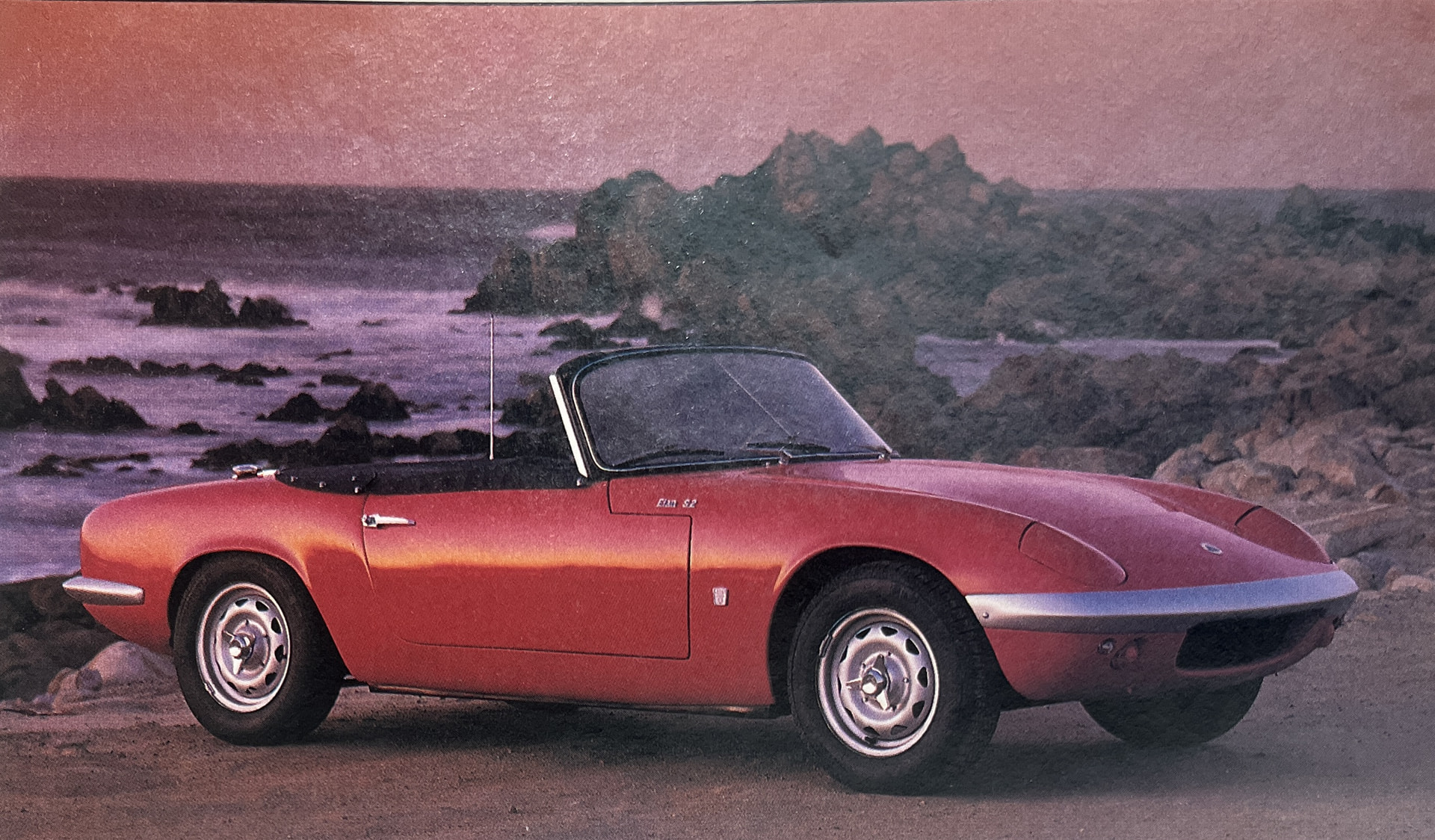
Today, Toyotas can match the Elan’s technical portfolio. But it took more than twenty years to get from Chapman’s Elan to Toyota’s MR2. Meanwhile, if you wanted something with the above specs, you had only one choice, because not only did the British sports-car makers not follow Chapman’s lead, nobody did. The Elan, for its entire production run—through four series and more than a decade—stood as an exemplar of the genre.
You don’t need a graduate degree in automotive engineering to figure out why. For starters, it looks right. No frills, no gimmicks, just an irreducible minimum of bodywork stretched as tautly as possible over man and machine. To my eye, it displays the same economy of line that distinguishes the Supermarine Spitfire, the Norton Commando Production Racer, and the Jaguar XJ6.
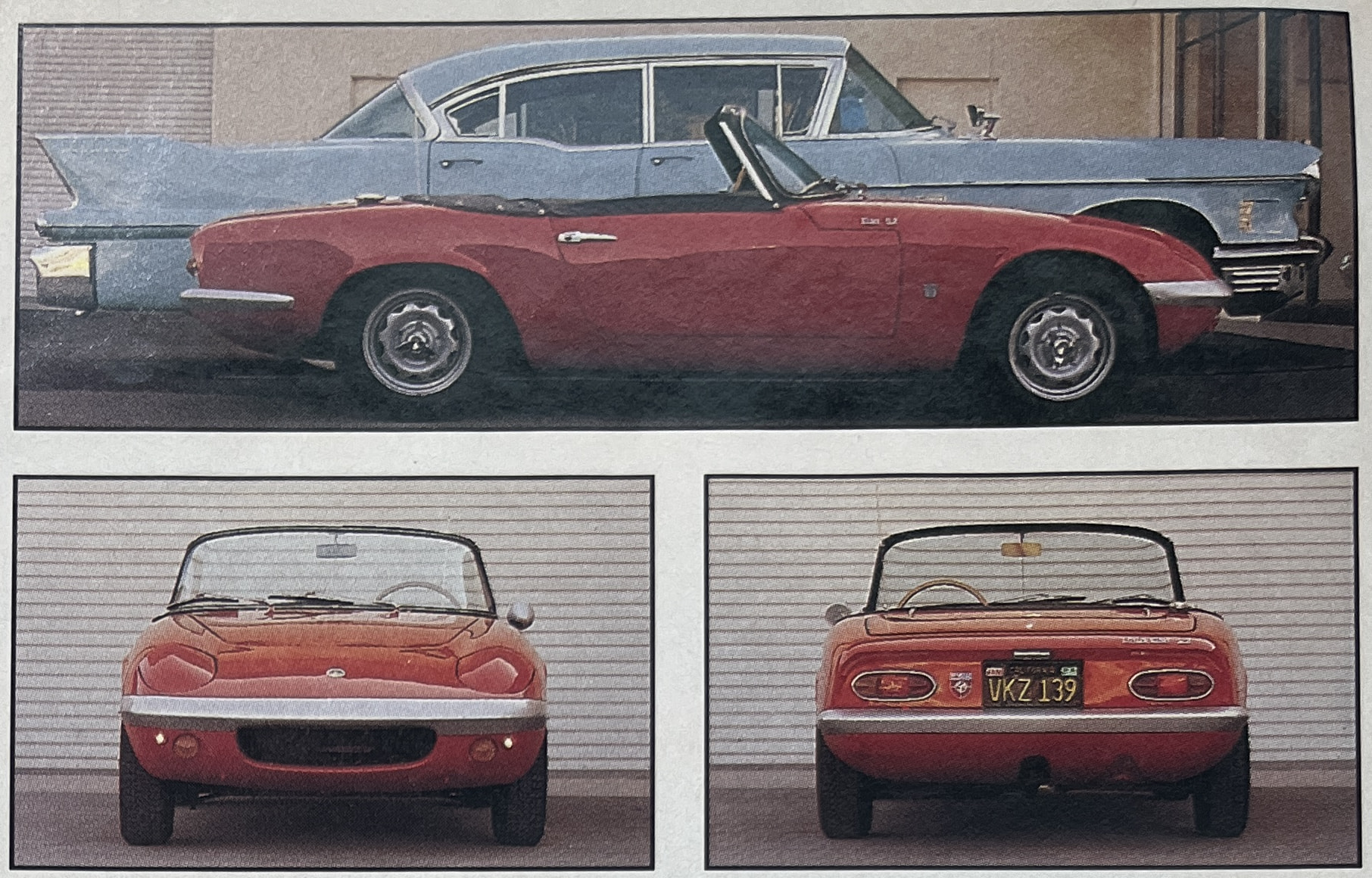
Seen from a distance, the Elan looks like a normal car. Approached, it shrinks dramatically until, as you stand next to it, you realise the meaning of the specs that say it’s only an inch more than twelve feet long and not even five feet wide. Its curb weight of 1540 pounds means that, among today’s crop of cars, only something like the Geo Metro comes close to it dimensionally. This is a car you put on like a pair of dancing shoes.
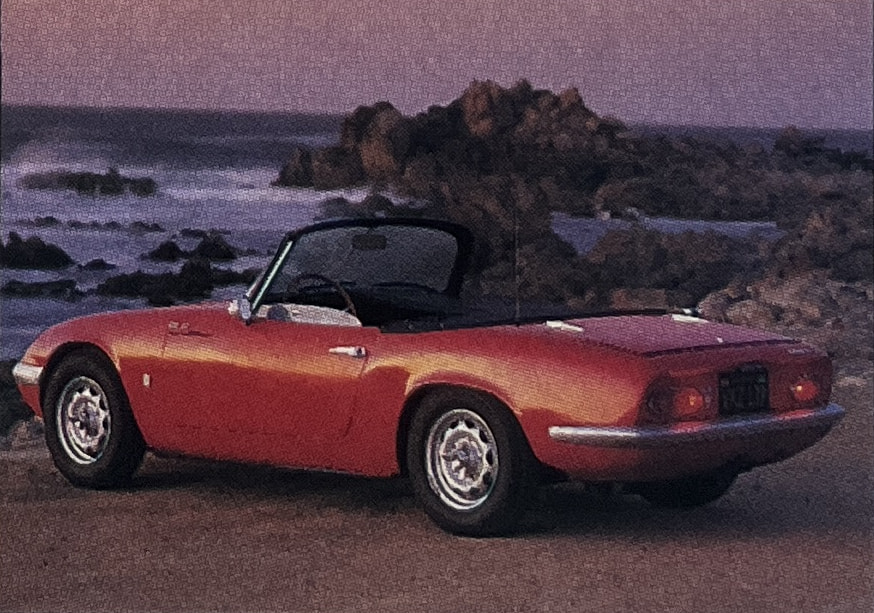
Yet the sense of smallness vanishes once you’ve donned the Elan. Getting into it is even easy, compared with its contemporaries. And once you’re there—cradled in a fixed-rake, mildly bolstered bucket with fine lateral and thigh support—you find a cockpit with surprisingly few surprises. My 1966 Elan S2 confronts you with a wooden dash, four Smiths chrome-bezeled instruments, and a fifteen-inch, three-spoke wooden steering wheel. The pedals are closely spaced, but the foot box is wide enough to welcome anyone but a size 13EEE to the dance. And the steering wheel can be adjusted fore-and-aft. Thus the wheel-seat-pedals relationship doesn’t suffer from what we then called “Italian disease”—wheel too far away, pedals too close.
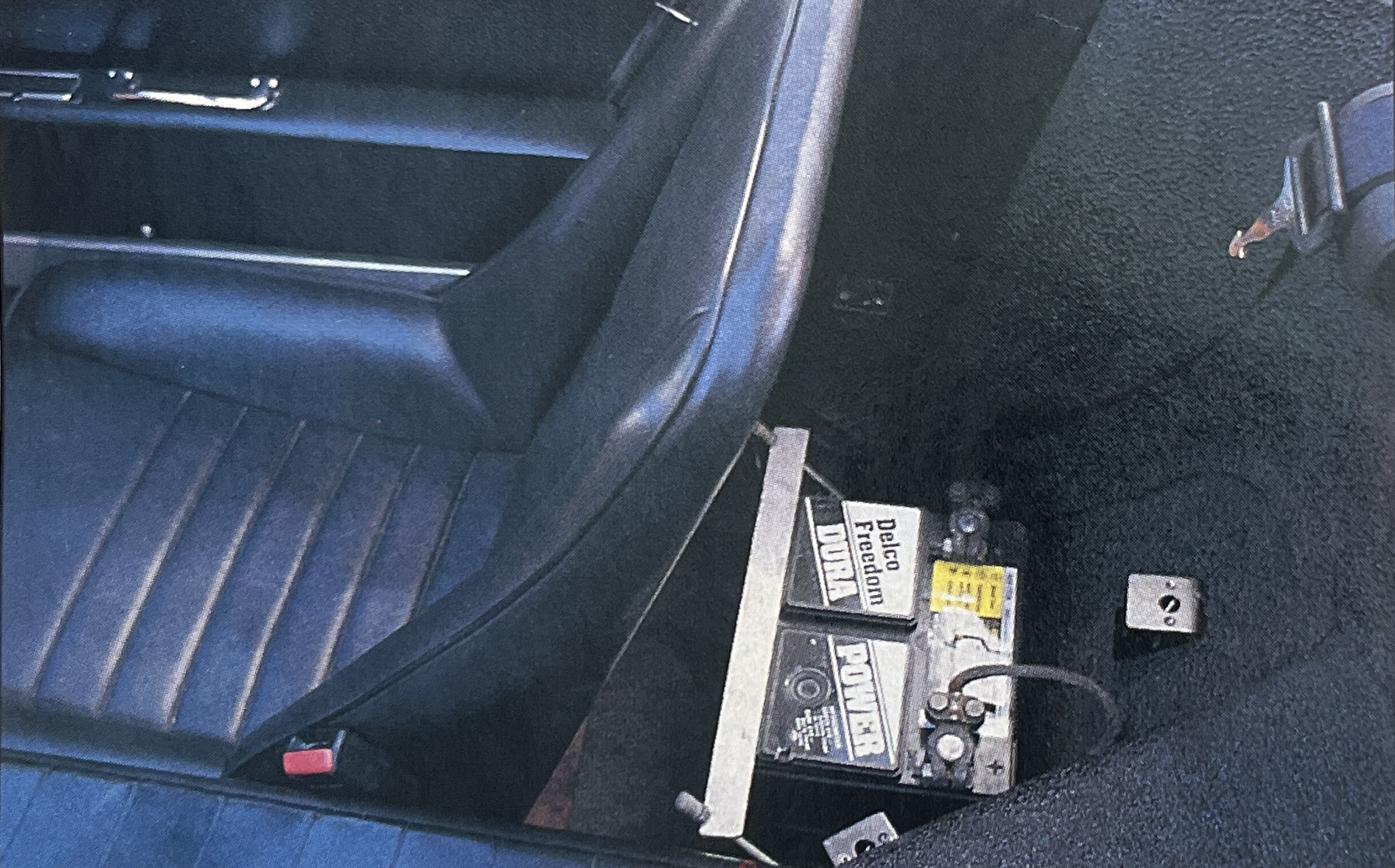
The cockpit is closefitting but not cramped, and upholstered recesses in the doors and the center console (which masks the tall frame section) allow plenty of elbowroom. From the driver’s seat, absolutely everything is within reach: the battery (behind the passenger seat), the locks on the passenger-side door and on the sliding window (pleasant fictions both, in a car with a snap-on ragtop), the glove box, and even the passenger-side heater/defroster flap under the dash. When you look around this tidy if dated little compartment, you see canny use of space everywhere. But you do not feel as if you were in a car that Santa could stuff in a stocking.
Glance outside, though, and you’re Lilliputian again. You look up at almost everything; hubcaps and bumpers of full-size cars seem suddenly immense. You see the world as a formula-car driver does. It is the view from another time. The time before governmental regulations had more to do with a car’s design than the designer himself. And a time of endless possibilities for men of vision and determination. A time like England in the 1950s and 1960s.
If you look at postwar England using the wrong perspectives, it seems to be quite the opposite sort of place. Heavy taxation had drained the nation’s brains by leading many of England’s best and brightest to seek their fortunes overseas. But, paradoxically, the socialists who levied new taxes on everything created precisely the conditions that allowed Colin Chapman to prosper.
Chapman’s prosperity came about because of a luxury tax of up to one-third the cost of a new car. This tax, coupled with the stiff down payment required by a typical British “hire-purchase” car loan, meant that ownership of anything but the most basic Austin Seven–Ford Anglia sort of car in 1950s Britain was for most people all but impossible. But the legislators left open a loophole with far-reaching consequences: the law exempted kit cars from the tax.
To a nation of back-garden tinkerers, this was no small boon. Impecunious but determined enthusiasts powered a kit-car boomlet that lasted until the advent of the value-added tax of the 1970s. Their willingness to build themselves what the manufacturers couldn’t or wouldn’t build fuelled Colin Chapman’s meteoric rise to success.
In 1952, while working as an engineer for the British Aluminium Company, Chapman and then-partner Michael Allen founded Lotus Engineering, headquartered in a garage next to the pub and hotel owned by Chapman’s father. At 24, Chapman held a newly minted engineering degree and RAF pilot’s wings and had already decided that racing was his life. He applied his formal knowledge of structural engineering to his own race cars and did so well that others soon wanted his expertise. Chapman thus established Lotus (a name whimsically chosen for his first Austin-based Special) to design and fabricate race parts and to handle tuning and conversion projects—the same kind of work that still typifies the British club-racing world.
Chapman was anything but typical. Capitalising on luck, racing success, and intense ambition, he moved quickly beyond bespoke club-racer work and, a scant six years after founding his company, produced the famous Lotus Elite, or Type 14. The Elite, the first “real” Lotus road car, was a coupé with a unitised fiberglass body and chassis, a highly tuned Coventry Climax engine, and manufacturing costs so high that Chapman lost money on every car. He was determined not to repeat the experience with the Elan.
By 1963, the Elan’s actual start of production, Chapman had mastered the art of building cars with existing componentry. And the Elan shows it. Whatever genius went into the car’s concept, fully as much lay in the selection of the off-the-shelf items that constitute so much of the Elan.
The engine is itself a hybrid, composed of a Ford five-bearing iron block and a Harry Mundy–designed aluminium twin-cam head made initially for Chapman by the venerable J.A. Prestwich company, of JAP motorcycle-engine fame. Likewise, the gearbox and the differential are Ford units, and the major segments of the front suspension are based on Triumph Vitesse bits. The steering rack is also a Triumph item, the taillight clusters are from a Vauxhall, and the door-handle hardware is from a Commer van. The list goes on and on.
Despite its mongrel parentage and the fact that it was also available as a kit, the Elan was clearly the aristocrat of the small-bore corps from the day it first fired a cylinder in anger. Its chassis was immensely rigid for its day: the Elan’s plastic body was mounted to the frame at sixteen points, making it almost devoid of the cowl shake that bedevilled so many other sports cars. Its engine made more power per litre than almost anything else available in cars with licence plates. Its suspension was the antithesis of the hardware then current: because Chapman was a devout believer in long wheel travel and soft springing, the Elan rode like a flat-cornering limo compared with its rivals. And, of course, it had glamour that few other cars of any kind could match. Diana Rigg drove an Elan in the TV series “The Avengers,” and Jim Clark used one for his personal car when he wasn’t winning the World Championship for the Chapman team.
Yet the promotional antics of the Lotus marketing people were not what made the Elan famous. The car became a legend not because of hype but because of what it did on the road and the track. And what it did was bring wins to racers and grins to street drivers. In both roles, it was a giant killer. The secret rested in its balance of power and handling.

Performance data alone did not then and do not now fully describe the Elan’s special quality of balance. Contemporary tests showed the S2 versions with a 3.9:1 rear-axle ratio, Weber carbs, and the standard cams and valves to be capable of a top speed of around 115 mph and 0-to-60-mph times of about nine seconds. My mostly restored 1966 S2 (shown and tested here) produces numbers close to those, although they are skewed by factors the road testers of the 1960s did not encounter—such as lower-octane fuel, this car’s incomplete restoration, its bored-out engine (to 1586cc), and C/D’s genuinely accurate test gear. Similarly, the skidpad figure of 0.75 g misrepresents the potential ultimate cornering ability of the Elan, partly because of my car’s unrestored suspension but mostly because its narrow, 4.5-inch rims and confined underfender areas force the car to ride on tyres much less suited to its character than tyres that were available in the late 1960s. (These days, 145/155-13 tyres are for econoboxes; in the old days, supersticky racing rubber could be had in such a skinny configuration.)
But these numbers are really incapable of describing road dancing anyway, which isn’t so much about raw performance as it is about liveliness, response, and quick transitions. The Elan’s behavior in rapid transitions is still world-class because of its light weight, low polar moment, and accurate, fine-feedback steering. Graham Arnold, former marketing director of Lotus Cars, puts it well—if less than objectively—in his book, the Illustrated Lotus Buyer’s Guide: “There is probably no other road car at any price that can out-handle an Elan. By handling I mean the ability to enter a sharp turn 25 mph too fast, brake down to cornering speed, accelerate out of the bend, swerve to avoid an old lady in a '48 Chevrolet, set the car up for the next bend, and then screech to a halt because a tree has fallen across the road.”
Today, of course, in the era of anti-lock brakes, four-wheel drive, computer-controlled suspensions with higher IQs than many drivers, and tyres wider than two of the Elan’s, a lot of other cars can match and exceed the Lotus in what Arnold goes on to call “swervability.” But those cars do so at considerable cost in weight and complexity. The Elan achieves its swervability with simple technology and an absolute minimum of weight. You come to appreciate just how simple it all is when you open the hood or put up the top.
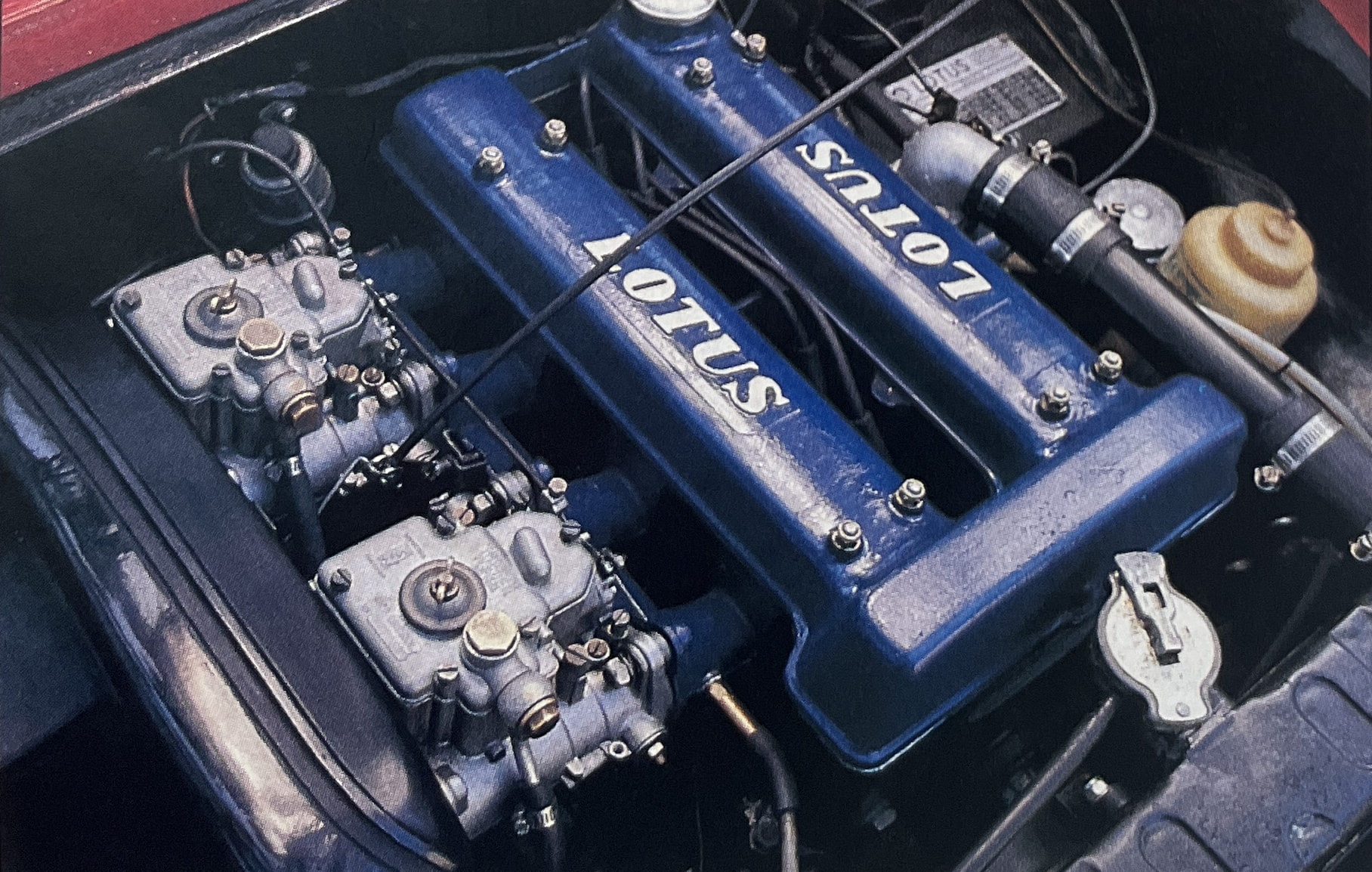
It’s startling to look at the Elan’s clean, uncluttered little engine bay and realise what the price of progress in engine efficiency has been. Today’s high-output engines need a maze of plumbing and wiring, with feedback loops and sensor support systems that baffle all but the best factory-trained mechanics. The Elan has an engine bay anyone who understands lawn mowers could comprehend.
Likewise, instead of a pull-up or power-driven convertible top, the Elan has a removable top that snaps and slots into place above two “cant rail” window frames and two “hood sticks.” In effect, you have to build your top every time you put it up (although the process allows you to use the rearmost hood stick to adjust the tightness of the top fabric). And, of course, because of the expense, space, and weight requirements of wind-up window mechanisms, this Elan has lift-up windows (S3 and S4 versions had both better tops and electric window lifts).
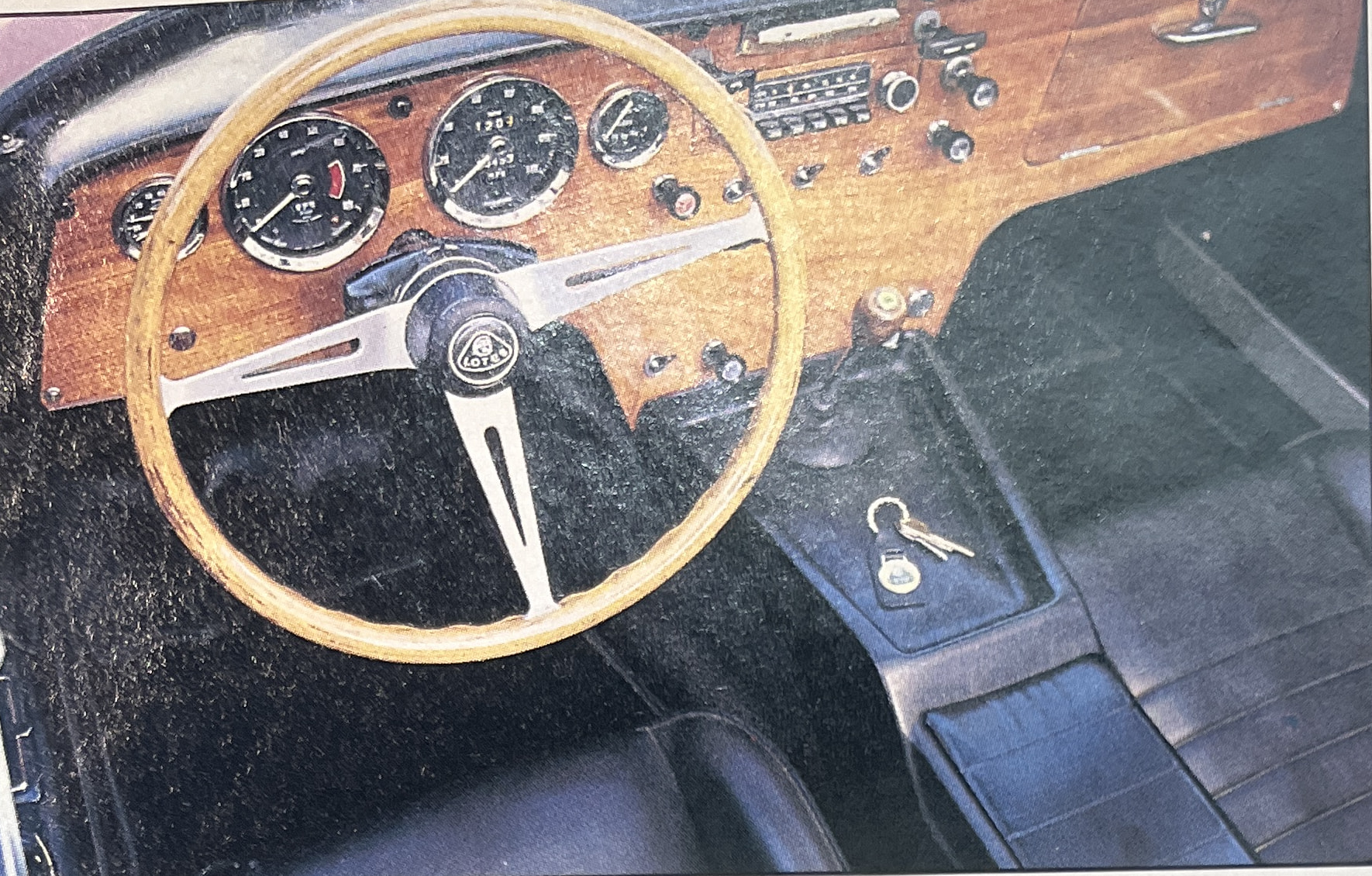
This kind of mechanical crudity is hardly what you’d expect of a car considered sophisticated in its day. But it’s important to remember that almost all British ragtops of the era required such shenanigans of their owners; it was just part of the sports-car package, like the absence of sun visors. This elementalness keeps the car lithe and trim, vital to making the Elan a Ginger Rogers to your Astaire and to making your drive a dance.
Two-lane roads too tight for most cars and too exhausting for most drivers are the best dance floors for the Elan. Unless you’re a duff dancer, you’ll soon be leading it through steps you didn’t know you had. It’s not just the chassis that encourages you to raise the rhythm, but also the engine, which is decidedly lusty.
Unlike most modern small-displacement twin-cam fours, the Lotus-Ford pumps out grunt throughout its rev range, which goes up to a 6500-rpm redline. Also unlike most modern cars, the engine note is a rasping bark, muted just a bit by its oval-piped muffler. The Elan’s feisty twin-cam four blares rather than howls, but the instant you back off, the retort of a race engine on overrun reminds you that this is not a “Bugeye” Sprite.
If you harbour any doubts about the distance between the Elan and such hardware as the Bugeye, they evaporate when the going gets bumpy, nasty, and twisty. The Elan tracks straight over road surfaces that send other small-bore cars skittering into the weeds. Its long-travel suspension absorbs rather than transmits the bumps, and the geometry keeps the wheels doing precisely what they’re supposed to do.
You steer the car with your body, it seems, and the Elan never tricks you. Like a well-set-up Formula Ford, it goes where you point it, does exactly what your hands and feet tell it to do—never more, never less. Back off in a turn you’ve misjudged, and it trails docilely into line. Overcook one, and if you’re good enough with the wheel and throttle it’ll drift right through, body leaned over, skinny tyres giving you their all, the suspension telling you exactly what it’s doing.
No dance partner is viceless, of course. Lotuses have had a lousy reputation for quality since chassis number one. Fierce Lotus loyalists will tell you it’s all hogwash, that this dancer is a lady through and through and that such calumnies derive from ignorance of proper maintenance, from Chapman-bashing, or just from the sour grapes of the recently blown off.
My experience tells me the car is flawed not in concept but in execution, and maybe “flawed” is too strong a word. Chapman did his best with what he had and could afford, given his priorities (which placed Formula 1 and Team Lotus well ahead of road cars, we’re told). That some of the Elan’s components fail more often than those available today from Japan, Inc., or elsewhere is not an indictment of the Elan but of a whole era of British manufacturing management. Suffice it to say that, as an Elan owner, I know what I have to know, and I know it’s more than a guy driving a Mazda Miata will have to know. I do not see it as a disincentive to take the Elan dancing.
Evidently, others feel the same way. Good Elans are hard to come by, even though such Lotus gurus as Rich Kamp of Kampena Motors in San Francisco say that more are coming out of storage every day (many to be sold at prices that would have seemed ludicrous when the car was new). Do these prices signal avarice, an attempt to cash in on the much-publicised narcissistic nostalgia of the baby-boomers? Or is it just the realisation that the aging road dancer in the garage is one of a kind, wise in her simple elegance and full of moves no modern car, force-fed a fattened diet of technology and safety and eco-consciousness, can ever hope to match?
Probably the truth lies somewhere between. The Elan is really just a car, after all, not something handed down from sports-car heaven but a machine ingeniously fabricated by a driven man to cash in on other men driving. Yet A.C.B. Chapman and his team of designers and fabricators knew us because they were just like us, and so he and I and all the others who succumb to the allure of this tiny dancer are wheeling through the reel together, heedless of the passage of time and dazzled by the dance.
It isn’t rational, of course. But cars never are. At least, not those we take road dancing.
Specifications
Vehicle type: front-engine, rear-wheel-drive, 2-passenger, 2-door convertible
Price as tested (1966): $5600 (estimated)
Sound system: Blaupunkt AM/FM radio, 1 speaker
ENGINE
| Type | 4-in-line, iron block and aluminium head |
| Bore × stroke | 3.28 × 2.85 in, 83.3 × 72.4mm |
| Displacement | 97 cu in, 1586cc |
| Compression ratio | 9.4:1 |
| Carburettion | 2×2-bbl Weber 40DCOE18 |
| Emissions controls | none |
| Valve gear | chain-driven double overhead cams |
| Power (SAE net) | 90 bhp @ 5500 rpm |
| Torque (SAE net) | 108 lb-ft @ 4000 rpm |
| Redline | 6500 rpm |
DRIVETRAIN
| Transmission | 4-speed |
| Final-drive ratio | 3.90:1 |
| Gear | Ratio | Mph/1000 rpm | Max. test speed |
|---|---|---|---|
| I | 3.54 | 4.8 | 31 mph (6500 rpm) |
| II | 2.40 | 7.0 | 46 mph (6500 rpm) |
| III | 1.41 | 11.9 | 78 mph (6500 rpm) |
| IV | 1.00 | 16.9 | 110 mph (6500 rpm) |
DIMENSIONS AND CAPACITIES
| Wheelbase | 84.0 in |
| Track, F/R | 47.1/48.4 in |
| Length | 145.3 in |
| Width | 56.0 in |
| Height | 45.0 in |
| Ground clearance | 6.0 in |
| Curb weight | 1540 lb |
| Weight distribution, F/R | 50.7/49.3% |
| Fuel capacity | 11.9 gal |
| Oil capacity | 4.3 qt |
| Water capacity | 8.4 qt |
CHASSIS/BODY
| Type | steel backbone frame with rigidly attached body |
| Body material | fiberglass-reinforced plastic |
INTERIOR
| SAE volume, front seat | 40 cu ft |
| trunk space | 5 cu ft |
| Front seats | bucket |
| Seat adjustments | fore and aft |
| General comfort | good |
| Fore-and-aft support | good |
| Lateral support | good |
SUSPENSION
| F | ind, unequal-length control arms, coil springs, anti-roll bar |
| R | ind, strut located by a control arm, coil springs |
STEERING
| Type | rack-and-pinion |
| Turns lock-to-lock | 2.6 |
| Turning circle curb-to-curb | 29.5 ft |
BRAKES
| F | 9.5 × 0.5-in disc |
| R | 10.0 × 0.4-in disc |
| Power assist | none |
WHEELS AND TYRES
| Wheel size | 4.5 × 13 in |
| Wheel type | stamped steel, knockoff hubs |
| Tyres | Continental Contact CT21, 155TR-13 |
| Test inflation pressures, F/R | 31/31 psi |
Car and Driver Test Results
ACCELERATION
| Seconds | |
|---|---|
| Zero to 30 mph | 3.3 |
| 40 mph | 4.7 |
| 50 mph | 7.0 |
| 60 mph | 9.2 |
| 70 mph | 13.0 |
| 80 mph | 16.0 |
| 90 mph | 24.0 |
| 100 mph | 35.0 |
| Top-gear passing time, 30–50 mph | 8.1 |
| 50–70 mph | 9.3 |
| Standing ¼-mile | 17.0 sec @ 83 mph |
| Top speed | 110 mph |
BRAKING
| 70–0 mph @ impending lockup | 214 ft |
| Modulation | good |
| Fade | none |
| Front-rear balance | good |
HANDLING
| Roadholding, 300-ft-dia skidpad | 0.75 g |
| Understeer | minimal |
COAST-DOWN MEASUREMENTS
| Road horsepower @ 30 mph | 3 hp |
| 50 mph | 9 hp |
| 70 mph | 21 hp |
INTERIOR SOUND LEVEL
| Idle | 52 dBA |
| Full-throttle acceleration | 92 dBA |
| 70-mph cruising | 86 dBA |
| 70-mph coasting | 83 dBA |
Steve Thompson is a former executive editor of Car and Driver. His latest novel is Top End.
Copyright by Car and Driver, Vol 35 No. 6, December 1989
COPYRIGHT NOTICE: This article is reproduced for non-commercial historical preservation purposes only. Copyright remains with the original publisher. If you are the rights holder and have questions or concerns about this content, please visit our Copyright and Historical Preservation Policy and contact us. We will respond within 24 business hours and will remove or restrict the content promptly upon a valid request.