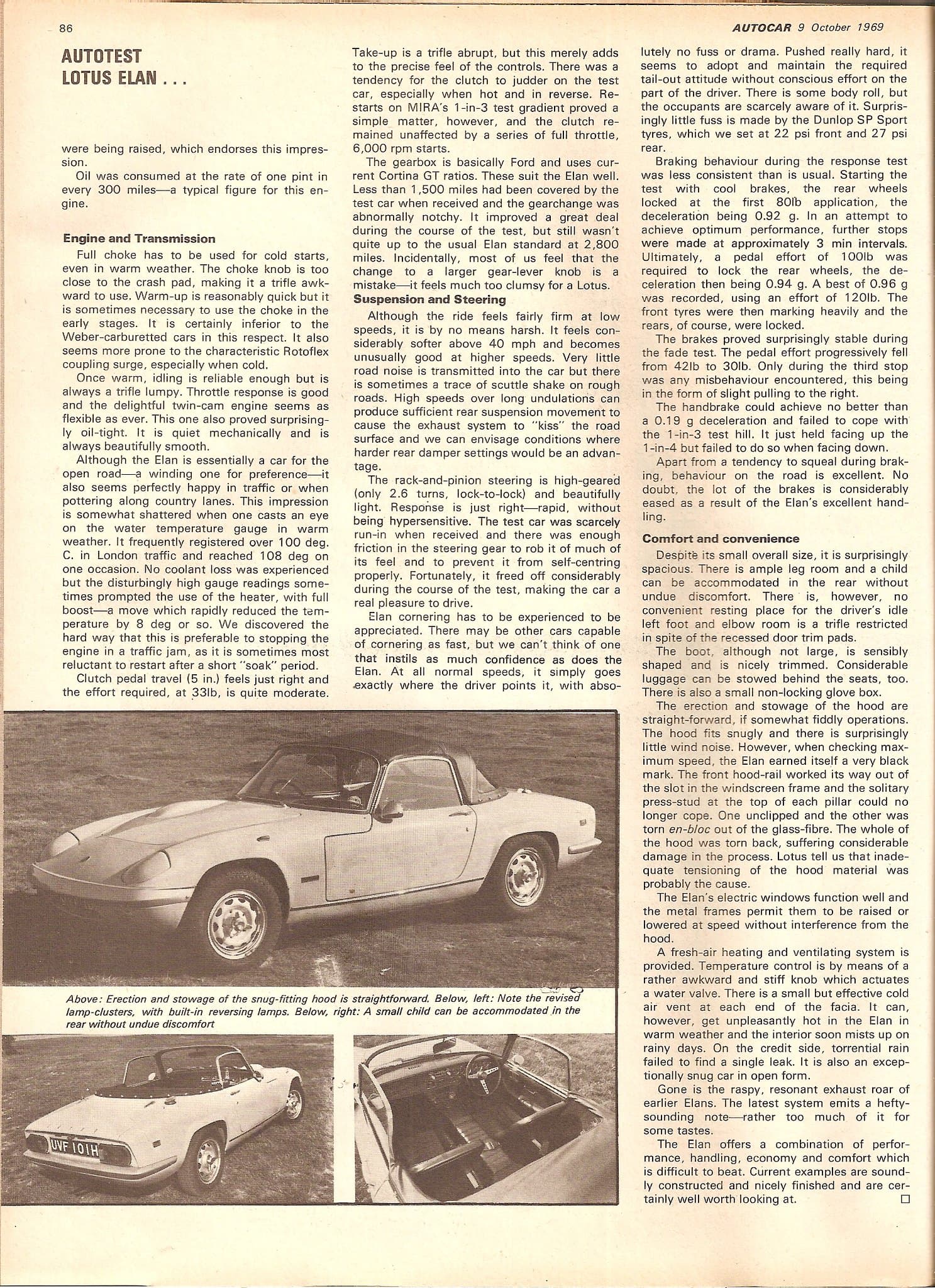
Autotest: Lotus Elan S4 Drophead S/E (1,588 c.c.)
Autocar, 9 October 1969
AT-A-GLANCE: Highly efficient open two-seater, powered by a race-bred, 1.6-litre, twin-cam engine. Competition design influence imparts outstanding roadholding and better-than-average comfort.
Manufacturer
Lotus Cars Ltd, Norwich (NOR 92W), Norfolk, England.
Prices
| Item | £ | s | d |
|---|---|---|---|
| Basic | 1,486 | 0 | 0 |
| Purchase Tax | 456 | 9 | 8 |
| Seat belts (approx) | Included in SE spec. | ||
| Total (in G.B.) | 1,942 | 9 | 8 |
Extras (inc P.T.)
| Item | £ | s | d |
|---|---|---|---|
| *Dunlop SP Sport tyres, 155-13in. | 6 | 10 | 6 |
| *Radio (Radiomobile) | 40 | 0 | 0 |
| *Radio suppression kit | 5 | 17 | 6 |
| *Air horns | 9 | 15 | 10 |
| *Tonneau cover | 15 | 13 | 4 |
| Price as tested | 2,020 | 6 | 10 |
* Fitted to test car
Performance Summary
| Measurement | Result |
|---|---|
| Mean maximum speed | 124 mph |
| Standing start ¼-mile | 15.9 sec |
| 0–60 mph | 7.8 sec |
| 30–70 mph through gears | 8.1 sec |
| Typical fuel consumption | 30 mpg |
| Miles per tankful | 270 |
It is often claimed — and justifiably so — that knowledge gained in the hard school of motor racing ultimately benefits the ordinary production car. This is particularly true of the Lotus Elan, which is a classic example of how racing design philosophy should be applied to a road-going sports car. While mid-engined machines have now ousted it from the forefront of the competition scene, it remains a quite outstandingly efficient and attractive road car. It is virtually in a class of its own in terms of performance and handling, without being in any way freakish.
The basic design has changed little since the Elan first appeared in 1962, but a great deal of detail refinement has taken place over the years. The current S4 is available in drop-head and fixed-head coupé forms. Both cost the same — £1,353 in component form, or £1,769 (inclusive of purchase tax) for the completed car. Special Equipment versions cost an extra £135 (inflated to nearly £174 in the case of a completed car). For this, one gets a more potent engine (115 bhp net, compared with the 105 bhp of the standard version), a 3.54-to-1 final drive unit (3.77-to-1 is standard), knock-on wheels with radial-ply tyres, and a vacuum brake servo with harder pads. There are also minor refinements which include a leather-covered steering wheel, a fully-carpeted boot and wing-mounted direction indicator repeaters. Safety belts also form part of the SE kit.
Our test car, a yellow drop-head Special Equipment model, was fitted with a 3.77-to-1 final drive. This lower gearing was largely offset by the use of 155-13in. Dunlop SP Sport tyres, which are available as an optional extra (standard wear on SE models is 145-13in. Firestone F100 or Goodyear G800). This gives an overall gearing of 17.4 mph per 1,000 rpm, compared with 17.6 mph when using the SE final drive and the smaller tyres.
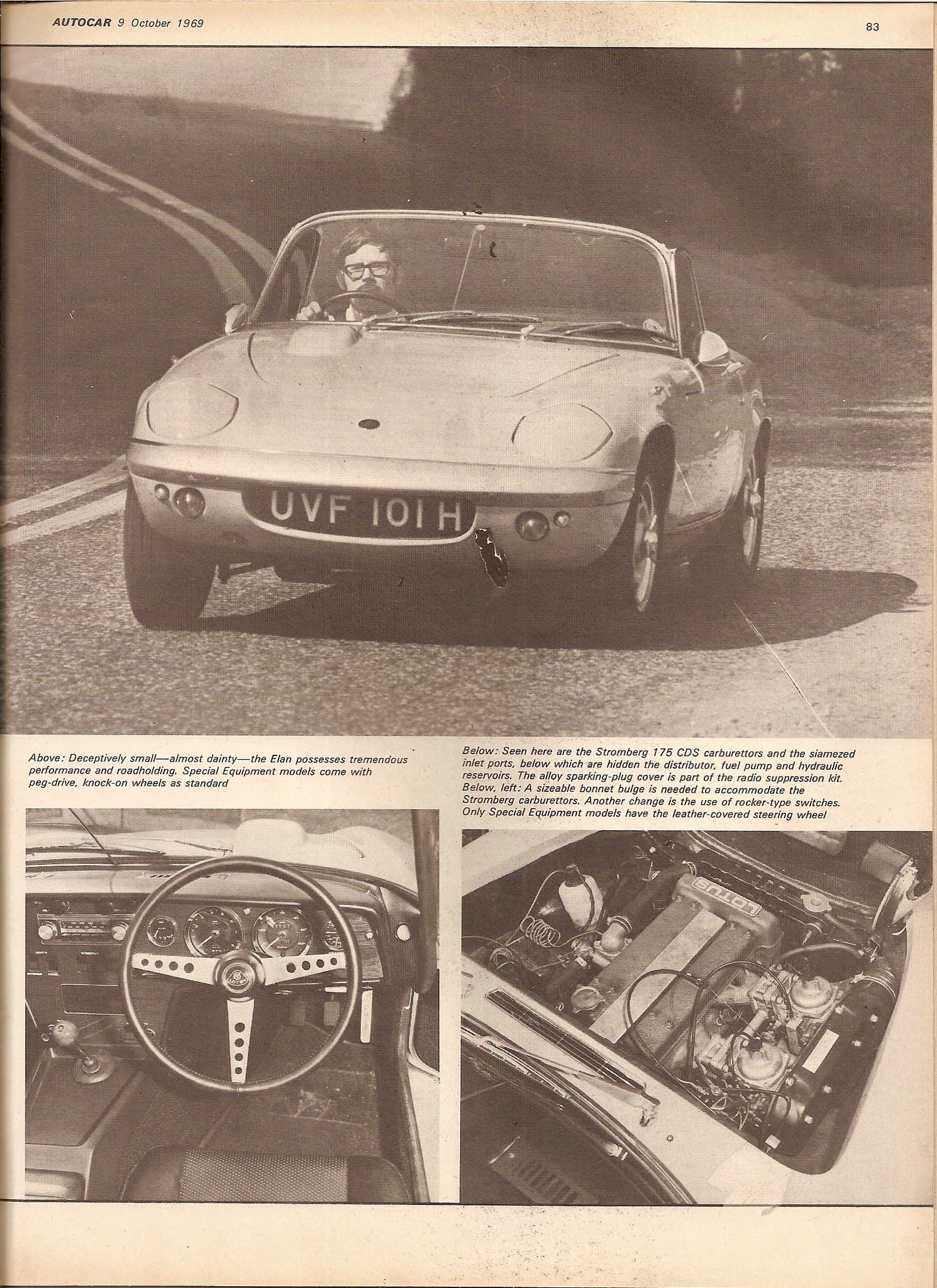
Previous twin-cam Lotus engines we have sampled, including those in early S4 Elans, have been equipped with a pair of Weber 40 DCOE carburettors. Now, in order to meet the stringent North American emission requirements, Lotus have abandoned the Webers in favour of a pair of Stromberg CD instruments. They claim that other engine changes have more than offset any power loss which may otherwise have resulted from the carburettor swap.
Performance
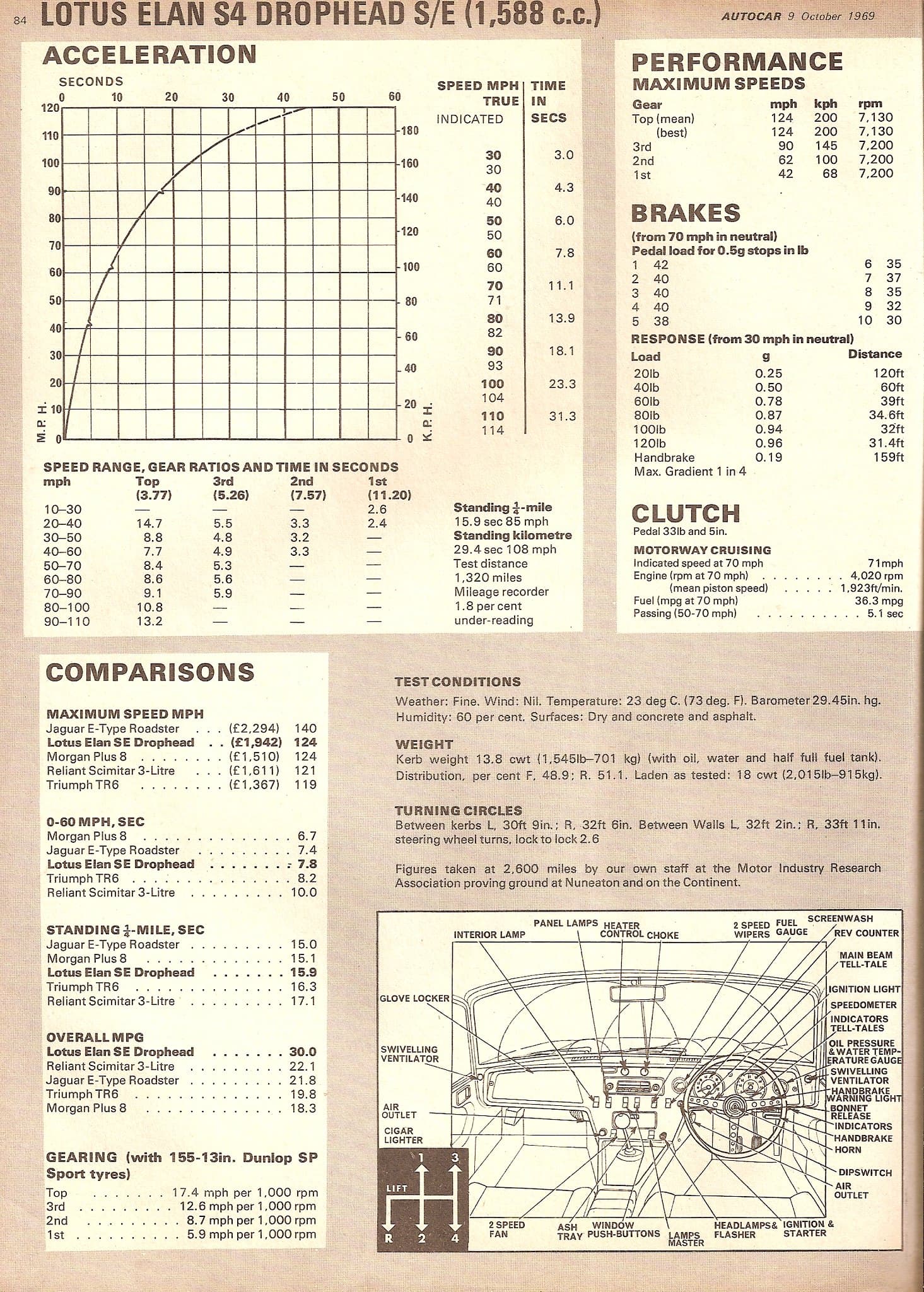
With its low weight and compact, efficient shape, the Elan easily out-performs many of its bigger-engined rivals. With the hood up, its maximum speed proved to be 124 mph — 2 mph better than that of the fixed-head model tested in mid-1967 (Autocar, 1 June 1967). This is equivalent to over 7,100 rpm — well above the engine’s peak. Even so, it is surprisingly smooth and certainly doesn’t seem to object to this treatment. We chose 7,200 rpm (the approximate speed that can be reached in top gear) as an arbitrary limit in the indirect gears but there is normally little point in exceeding the recommended limit of 6,500 rpm.
Although the speedometer is spot-on up to 60 mph, it over-reads at higher speeds. At 100 mph, for example, it reads 104 mph. The odometer, on the other hand, under-reads by a modest 1.8 per cent.
A check on the accuracy of the tachometer showed that it consistently reads a little low. The error is less than 100 rpm throughout its working range — an acceptable level of accuracy for such an instrument.
Despite slightly lower gearing, its acceleration is not quite up to that of the earlier, fixed-head model. Weight differences are too small to account for this — the drop-head’s kerb weight of 1,545lb is 29lb less than that of the fixed-head model. Even with a pair of weighty testers aboard, it had a handicap of only 19lb in the laden condition. Nevertheless, its performance is still most impressive. From rest, 60 mph comes up in 7.8 sec — only 0.2 sec slower than the Weber-carburettor car and fast enough to pip such potent rivals as the Porsche 911S and the Triumph TR6, which take 8.0 and 8.2 sec respectively. It is the top-end acceleration which suffers the most in comparison with the earlier car. It takes 2.2 sec longer to accelerate from 60 to 100 mph, the respective times being 15.5 and 13.3 sec. This difference is also reflected in the top gear times; from 30 to 90 mph the current car takes 26.3 sec, compared with the 22.6 sec taken by the earlier model.
With a sophisticated independent rear suspension layout and over 51 per cent of the kerb weight on the meaty rear tyres, traction is exceptionally good and the little car simply rockets away from the line. Although 0.2 sec slower than the fixed-head over the standing ¼-mile, the time of 15.9 sec is still extremely good.
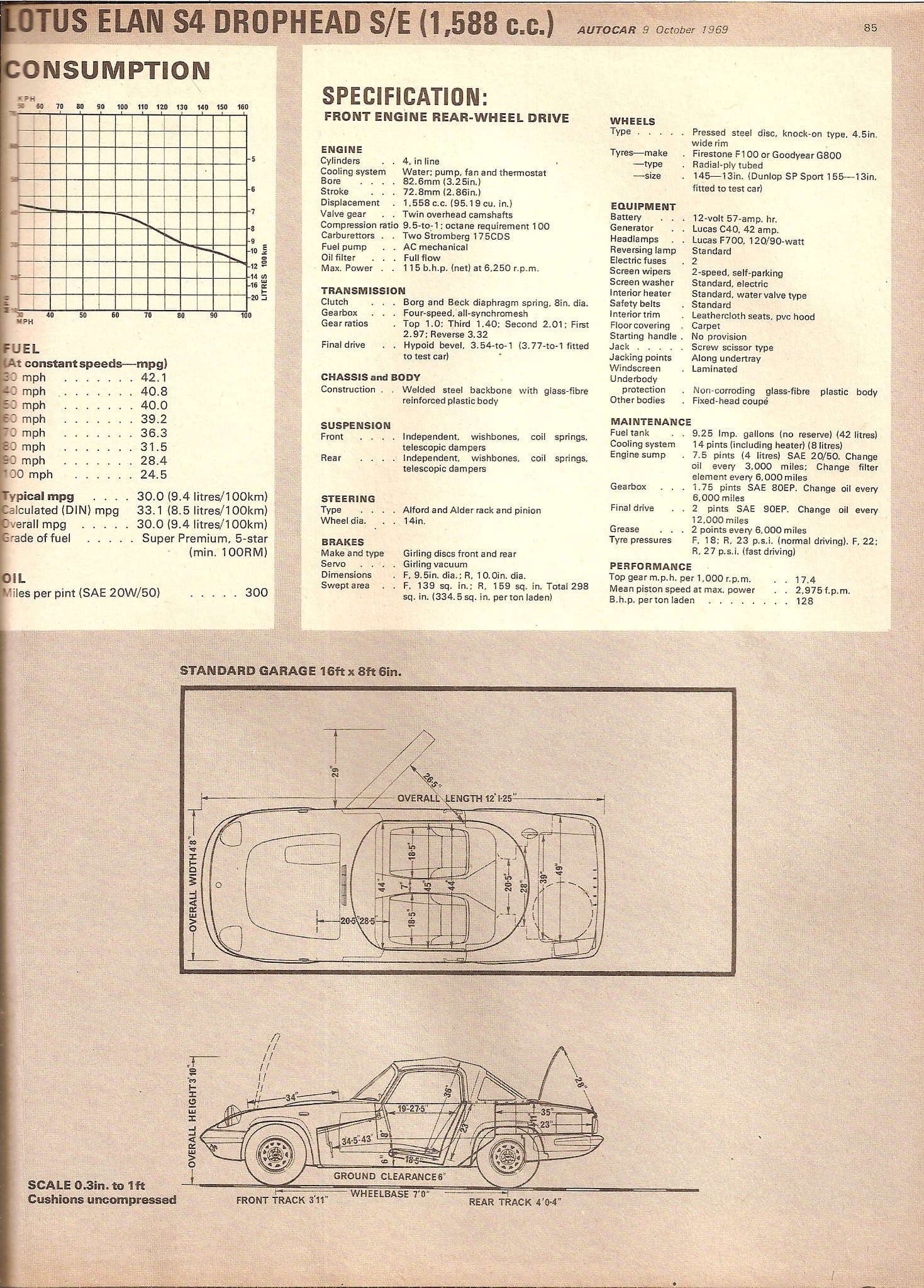
Overall petrol consumption works out at exactly 30 mpg — 4 mpg better than the earlier car. The steady-speed figures show that both return exactly the same mpg at 60 mph (39.2 mpg). At higher speeds, the Strombergs score, whereas at lower speeds, the Webers have the advantage. The mixture on the test car did, in fact, seem rich at small throttle openings. An improvement in idling quality could generally be detected as the vacuum-actuated headlamps
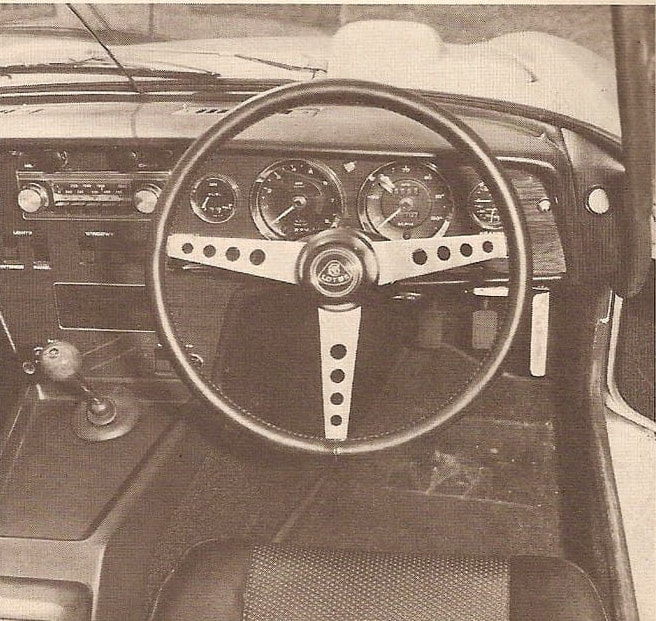
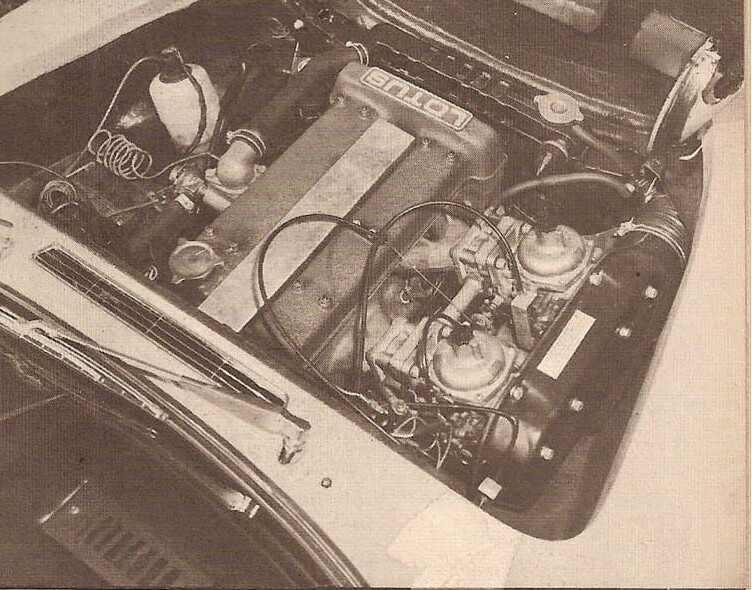
were being raised, which endorses this impression.
Oil was consumed at the rate of one pint in every 300 miles — a typical figure for this engine.
Engine and Transmission
Full choke has to be used for cold starts, even in warm weather. The choke knob is too close to the crash pad, making it a trifle awkward to use. Warm-up is reasonably quick but it is sometimes necessary to use the choke in the early stages. It is certainly inferior to the Weber-carburetted cars in this respect. It also seems more prone to the characteristic Rotoflex coupling surge, especially when cold.
Once warm, idling is reliable enough but is always a trifle lumpy. Throttle response is good and the delightful twin-cam engine seems as flexible as ever. This one also proved surprisingly oil-tight. It is quiet mechanically and is always beautifully smooth.
Although the Elan is essentially a car for the open road — a winding one for preference — it also seems perfectly happy in traffic or when pottering along country lanes. This impression is somewhat shattered when one casts an eye on the water temperature gauge in warm weather. It frequently registered over 100 deg. C. in London traffic and reached 108 deg. on one occasion. No coolant loss was experienced but the disturbingly high gauge readings sometimes prompted the use of the heater, with full boost — a move which rapidly reduced the temperature by 8 deg or so. We discovered the hard way that this is preferable to stopping the engine in a traffic jam, as it is sometimes most reluctant to restart after a short “soak” period.
Clutch pedal travel (5 in.) feels just right and the effort required, at 33lb, is quite moderate. Take-up is a trifle abrupt, but this merely adds to the precise feel of the controls. There was a tendency for the clutch to judder on the test car, especially when hot and in reverse. Re-starts on MIRA’s 1-in-3 test gradient proved a simple matter, however, and the clutch remained unaffected by a series of full throttle, 6,000 rpm starts.
The gearbox is basically Ford and uses current Cortina GT ratios. These suit the Elan well. Less than 1,500 miles had been covered by the test car when received and the gearchange was abnormally notchy. It improved a great deal during the course of the test, but still wasn’t quite up to the usual Elan standard at 2,800 miles. Incidentally, most of us feel that the change to a larger gear-lever knob is a mistake — it feels much too clumsy for a Lotus.
Suspension and Steering
Although the ride feels fairly firm at low speeds, it is by no means harsh. It feels considerably softer above 40 mph and becomes unusually good at higher speeds. Very little road noise is transmitted into the car but there is sometimes a trace of scuttle shake on rough roads. High speeds over long undulations can produce sufficient rear suspension movement to cause the exhaust system to “kiss” the road surface and we can envisage conditions where harder rear damper settings would be an advantage.
The rack-and-pinion steering is high-geared (only 2.6 turns, lock-to-lock) and beautifully light. Response is just right — rapid, without being hypersensitive. The test car was scarcely run-in when received and there was enough friction in the steering gear to rob it of much of its feel and to prevent it from self-centring properly. Fortunately, it freed off considerably during the course of the test, making the car a real pleasure to drive.
Elan cornering has to be experienced to be appreciated. There may be other cars capable of cornering as fast, but we can’t think of one that instils as much confidence as does the Elan. At all normal speeds, it simply goes exactly where the driver points it, with absolutely no fuss or drama. Pushed really hard, it seems to adopt and maintain the required tail-out attitude without conscious effort on the part of the driver. There is some body roll, but the occupants are scarcely aware of it. Surprisingly little fuss is made by the Dunlop SP Sport tyres, which we set at 22 psi front and 27 psi rear.
Braking behaviour during the response test was less consistent than is usual. Starting the test with cool brakes, the rear wheels locked at the first 80lb application, the deceleration being 0.92 g. In an attempt to achieve optimum performance, further stops were made at approximately 3 min intervals. Ultimately, a pedal effort of 100lb was required to lock the rear wheels, the deceleration then being 0.94 g. A best of 0.96 g was recorded, using an effort of 120lb. The front tyres were then marking heavily and the rears, of course, were locked.
The brakes proved surprisingly stable during the fade test. The pedal effort progressively fell from 42lb to 30lb. Only during the third stop was any misbehaviour encountered, this being in the form of slight pulling to the right.
The handbrake could achieve no better than a 0.19 g deceleration and failed to cope with the 1-in-3 test hill. It just held facing up the 1-in-4 but failed to do so when facing down.
Apart from a tendency to squeal during braking, behaviour on the road is excellent. No doubt, the lot of the brakes is considerably eased as a result of the Elan’s excellent handling.
Comfort and Convenience
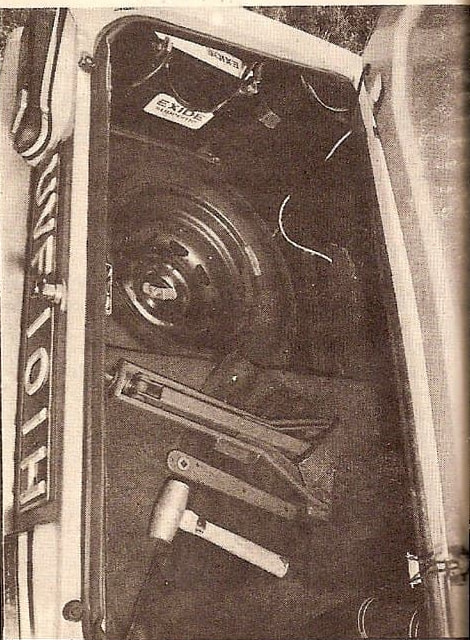
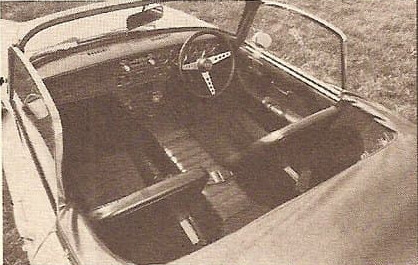
Despite its small overall size, it is surprisingly spacious. There is ample leg room and a child can be accommodated in the rear without undue discomfort. There is, however, no convenient resting place for the driver’s idle left foot and elbow room is a trifle restricted in spite of the recessed door trim pads.
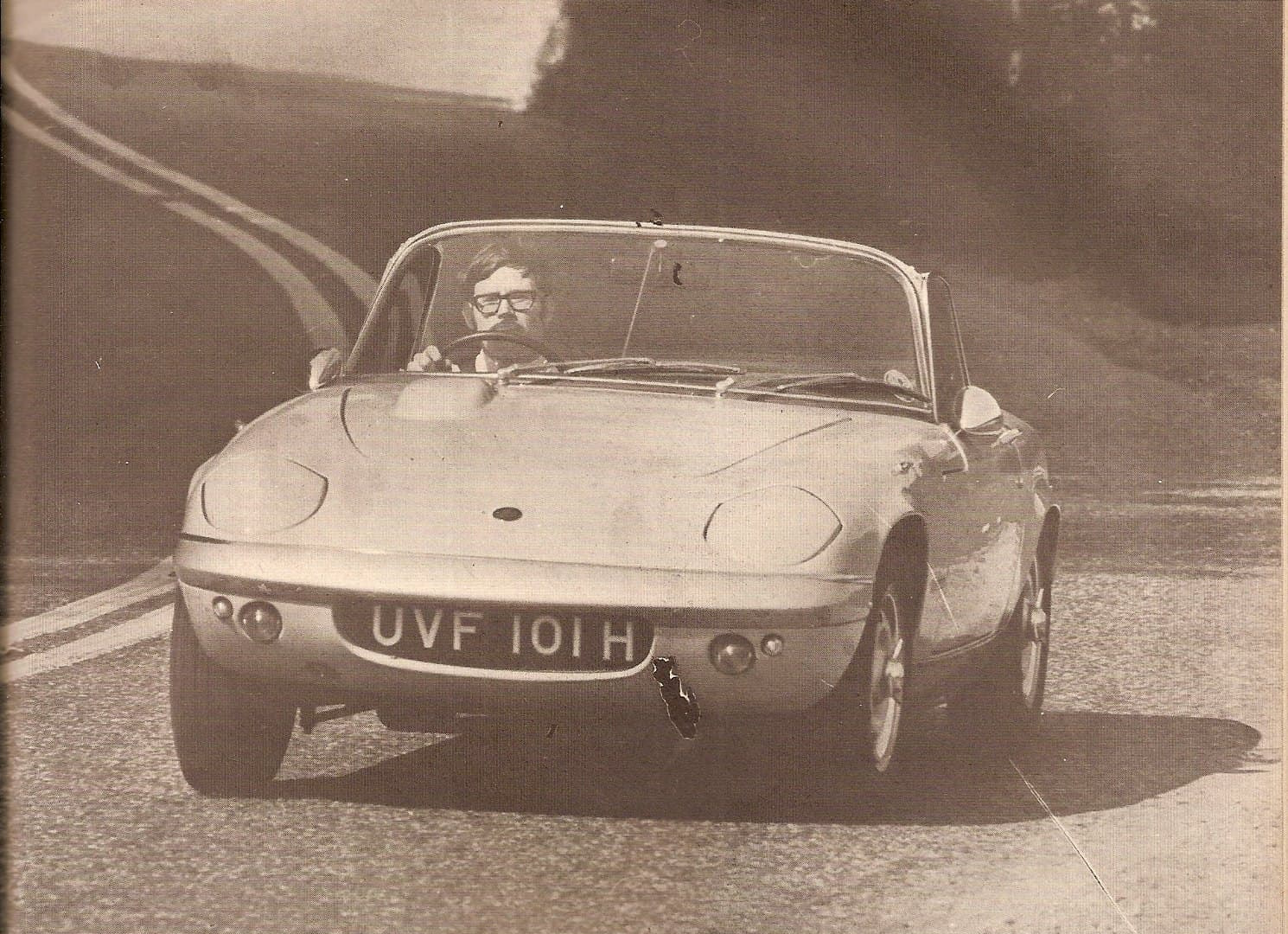
The boot, although not large, is sensibly shaped and is nicely trimmed. Considerable luggage can be stowed behind the seats, too. There is also a small non-locking glove box.
The erection and stowage of the hood are straightforward, if somewhat fiddly operations. The hood fits snugly and there is surprisingly little wind noise. However, when checking maximum speed, the Elan earned itself a very black mark. The front hood-rail worked its way out of the slot in the windscreen frame and the solitary press-stud at the top of each pillar could no longer cope. One unclipped and the other was torn en-bloc out of the glass-fibre. The whole of the hood was torn back, suffering considerable damage in the process. Lotus tell us that inadequate tensioning of the hood material was probably the cause.
The Elan’s electric windows function well and the metal frames permit them to be raised or lowered at speed without interference from the hood.
A fresh-air heating and ventilating system is provided. Temperature control is by means of a rather awkward and stiff knob which actuates a water valve. There is a small but effective cold air vent at each end of the facia. It can, however, get unpleasantly hot in the Elan in warm weather and the interior soon mists up on rainy days. On the credit side, torrential rain failed to find a single leak. It is also an exceptionally snug car in open form.
Gone is the raspy, resonant exhaust roar of earlier Elans. The latest system emits a hefty-sounding note — rather too much of it for some tastes.
The Elan offers a combination of performance, handling, economy and comfort which is difficult to beat. Current examples are soundly constructed and nicely finished and are certainly well worth looking at. □
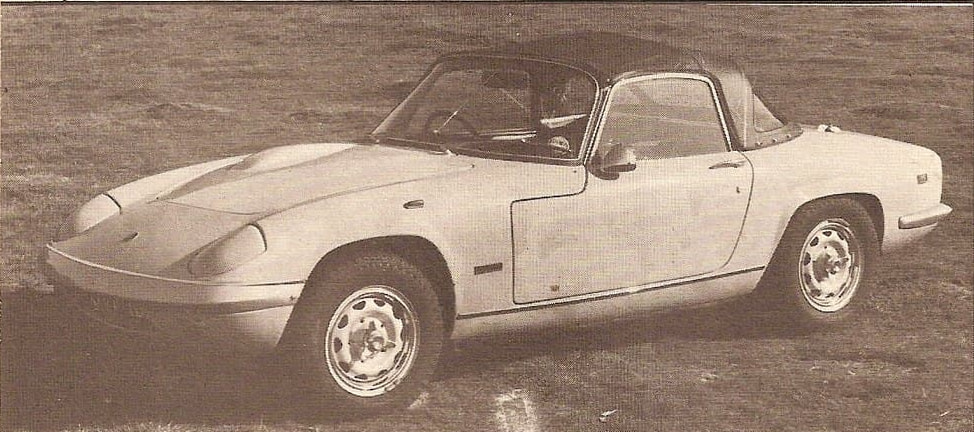
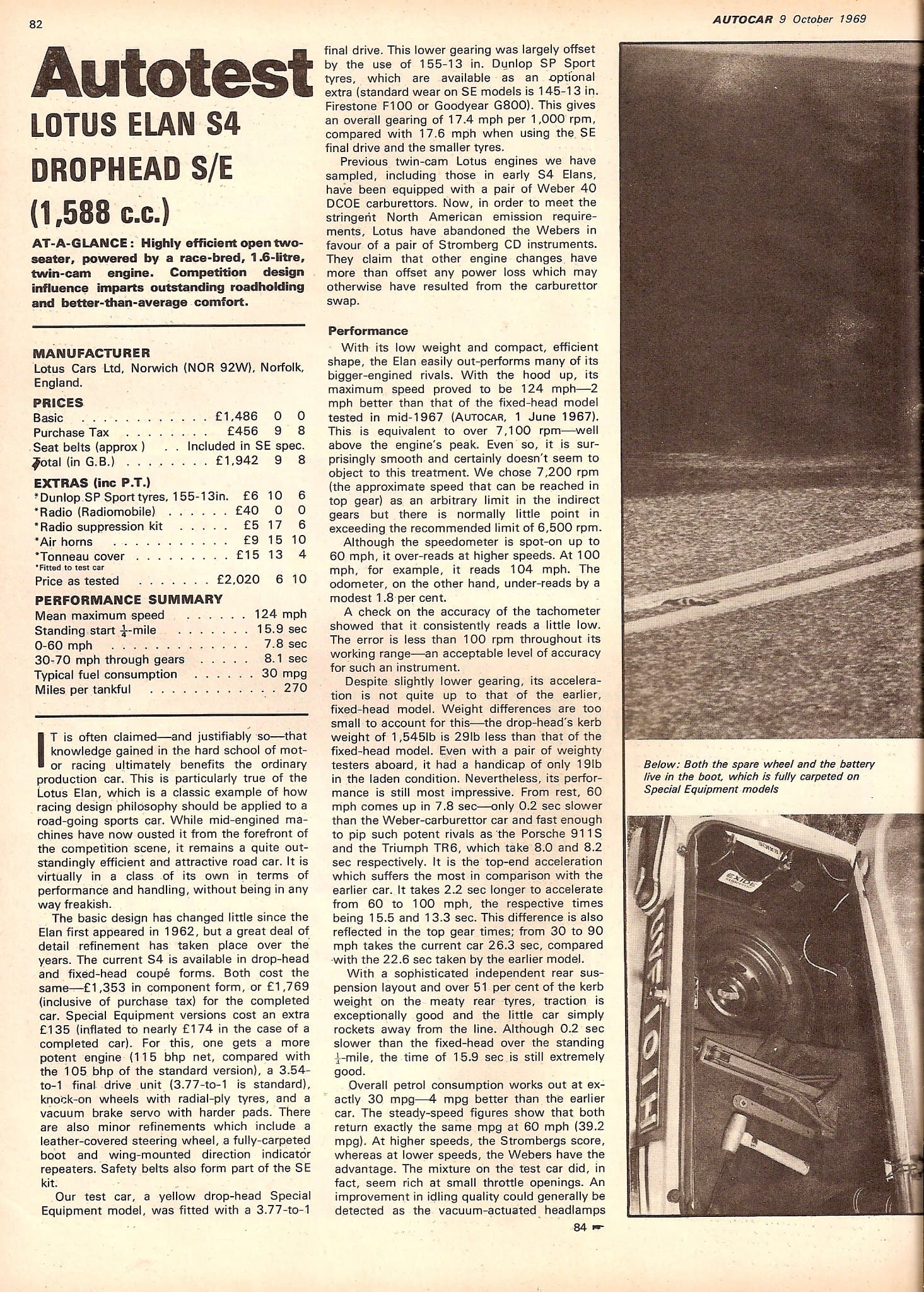
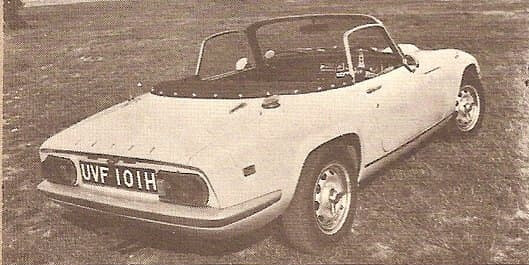
Above: Erection and stowage of the snug-fitting hood is straightforward. Below, left: Note the revised lamp-clusters, with built-in reversing lamps. Below, right: A small child can be accommodated in the rear without undue discomfort.
Performance Data
Acceleration Graph
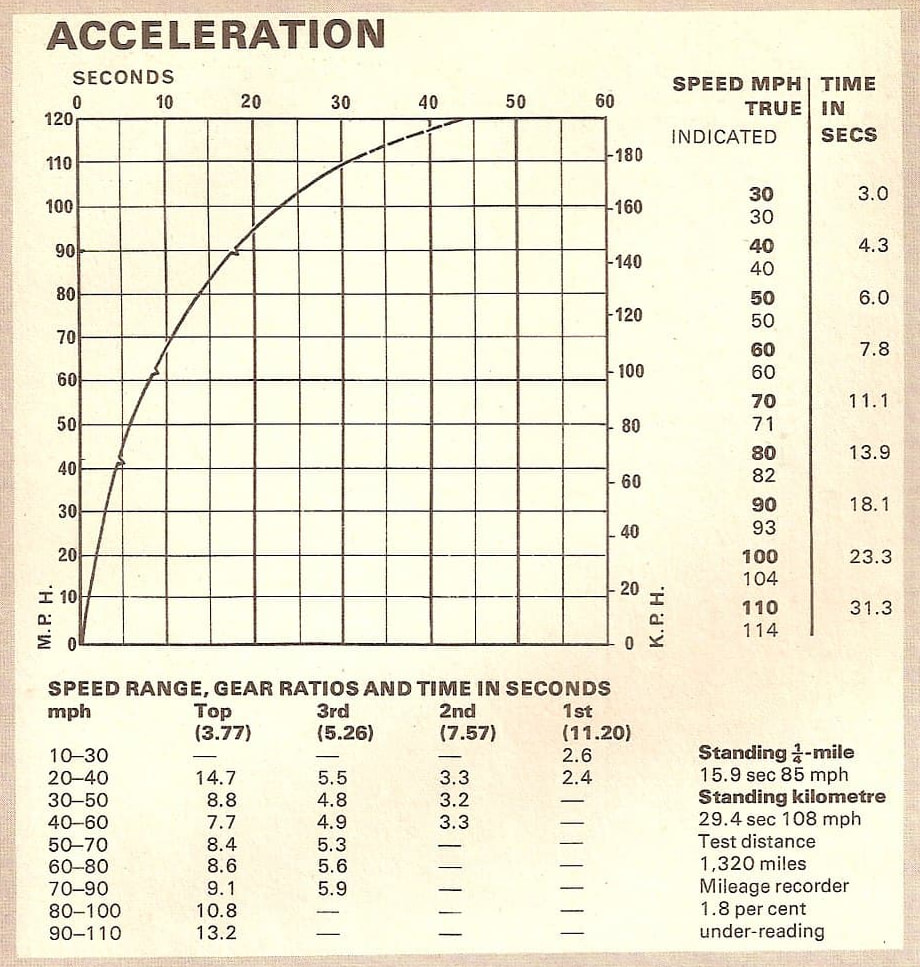
Acceleration — Speed Range, Gear Ratios and Time in Seconds
| mph | Top (3.77) | 3rd (5.26) | 2nd (7.57) | 1st (11.20) |
|---|---|---|---|---|
| 10–30 | — | — | — | 2.6 |
| 20–40 | 14.7 | 5.5 | 3.3 | 2.4 |
| 30–50 | 8.8 | 4.8 | 3.2 | — |
| 40–60 | 7.7 | 4.9 | 3.3 | — |
| 50–70 | 8.4 | 5.3 | — | — |
| 60–80 | 8.6 | 5.6 | — | — |
| 70–90 | 9.1 | 5.9 | — | — |
| 80–100 | 10.8 | — | — | — |
| 90–110 | 13.2 | — | — | — |
| Standing ¼-mile | 15.9 sec 85 mph |
| Standing kilometre | 29.4 sec 108 mph |
| Test distance | 1,320 miles |
| Mileage recorder | 1.8 per cent under-reading |
Acceleration from Rest
| Speed (mph) Indicated / True | Time (sec) |
|---|---|
| 30 / 30 | 3.0 |
| 40 / 40 | 4.3 |
| 50 / 50 | 6.0 |
| 60 / 60 | 7.8 |
| 70 / 71 | 11.1 |
| 80 / 82 | 13.9 |
| 90 / 93 | 18.1 |
| 100 / 104 | 23.3 |
| 110 / 114 | 31.3 |
Performance — Maximum Speeds
| Gear | mph | kph | rpm |
|---|---|---|---|
| Top (mean) | 124 | 200 | 7,130 |
| Top (best) | 124 | 200 | 7,130 |
| 3rd | 90 | 145 | 7,200 |
| 2nd | 62 | 100 | 7,200 |
| 1st | 42 | 68 | 7,200 |
Brakes
(from 70 mph in neutral)
Pedal load for 0.5g stops in lb
| Stop | lb | Stop | lb |
|---|---|---|---|
| 1 | 42 | 6 | 35 |
| 2 | 40 | 7 | 37 |
| 3 | 40 | 8 | 35 |
| 4 | 40 | 9 | 32 |
| 5 | 38 | 10 | 30 |
Response (from 30 mph in neutral)
| Load | g | Distance |
|---|---|---|
| 20lb | 0.25 | 120ft |
| 40lb | 0.50 | 60ft |
| 60lb | 0.78 | 39ft |
| 80lb | 0.87 | 34.6ft |
| 100lb | 0.94 | 32ft |
| 120lb | 0.96 | 31.4ft |
| Handbrake | 0.19 | 159ft |
| Max. Gradient | 1 in 4 |
Clutch
Pedal 33lb and 5in.
Motorway Cruising
| Indicated speed at 70 mph | 71 mph |
| Engine (rpm at 70 mph) | 4,020 rpm |
| (mean piston speed) | 1,923 ft/min |
| Fuel (mpg at 70 mph) | 36.3 mpg |
| Passing (50–70 mph) | 5.1 sec |
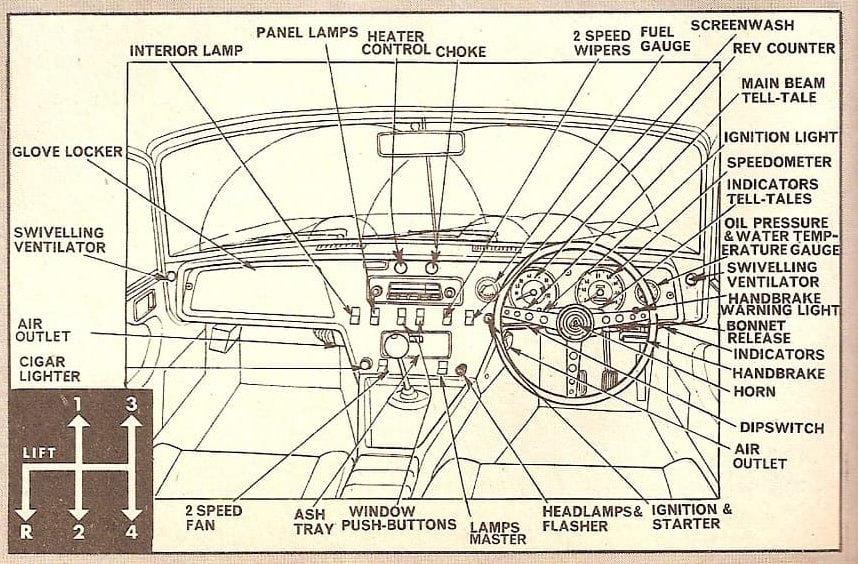
Dashboard Controls Diagram
Consumption
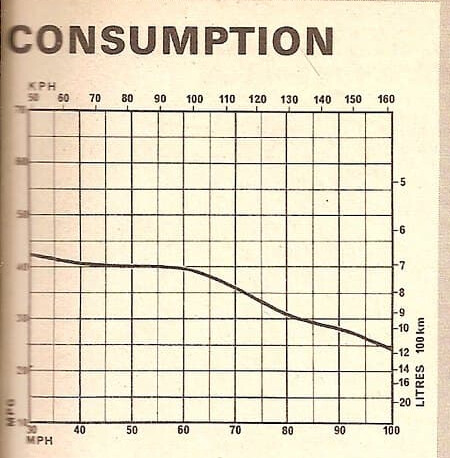
Fuel (At constant speeds — mpg)
| Speed | mpg |
|---|---|
| 30 mph | 42.1 |
| 40 mph | 40.8 |
| 50 mph | 40.0 |
| 60 mph | 39.2 |
| 70 mph | 36.3 |
| 80 mph | 31.5 |
| 90 mph | 28.4 |
| 100 mph | 24.5 |
| Typical mpg | 30.0 (9.4 litres/100km) |
| Calculated (DIN) mpg | 33.1 (8.5 litres/100km) |
| Overall mpg | 30.0 (9.4 litres/100km) |
| Grade of fuel | Super Premium, 5-star (min. 100RM) |
Oil
Miles per pint (SAE 20W/50): 300
Comparisons
Maximum Speed mph
| Car | Price | mph |
|---|---|---|
| Jaguar E-Type Roadster | £2,294 | 140 |
| Lotus Elan SE Drophead | £1,942 | 124 |
| Morgan Plus 8 | £1,510 | 124 |
| Reliant Scimitar 3-Litre | £1,611 | 121 |
| Triumph TR6 | £1,367 | 119 |
0–60 mph, sec
| Car | sec |
|---|---|
| Morgan Plus 8 | 6.7 |
| Jaguar E-Type Roadster | 7.4 |
| Lotus Elan SE Drophead | 7.8 |
| Triumph TR6 | 8.2 |
| Reliant Scimitar 3-Litre | 10.0 |
Standing ¼-Mile, sec
| Car | sec |
|---|---|
| Jaguar E-Type Roadster | 15.0 |
| Morgan Plus 8 | 15.1 |
| Lotus Elan SE Drophead | 15.9 |
| Triumph TR6 | 16.3 |
| Reliant Scimitar 3-Litre | 17.1 |
Overall mpg
| Car | mpg |
|---|---|
| Lotus Elan SE Drophead | 30.0 |
| Reliant Scimitar 3-Litre | 22.1 |
| Jaguar E-Type Roadster | 21.8 |
| Triumph TR6 | 19.8 |
| Morgan Plus 8 | 18.3 |
Gearing (with 155-13in. Dunlop SP Sport tyres)
| Gear | mph per 1,000 rpm |
|---|---|
| Top | 17.4 |
| 3rd | 12.6 |
| 2nd | 8.7 |
| 1st | 5.9 |
Test Conditions
Weather: Fine. Wind: Nil. Temperature: 23 deg C. (73 deg F.). Barometer 29.45in. hg. Humidity: 60 per cent. Surfaces: Dry and concrete and asphalt.
Weight
Kerb weight 13.8 cwt (1,545lb–701 kg) (with oil, water and half full fuel tank). Distribution, per cent F. 48.9; R. 51.1. Laden as tested: 18 cwt (2,015lb–915kg).
Turning Circles
Between kerbs L, 30ft 9in.; R, 32ft 6in. Between Walls L, 32ft 2in.; R, 33ft 11in. Steering wheel turns, lock to lock 2.6.
Figures taken at 2,600 miles by our own staff at the Motor Industry Research Association proving ground at Nuneaton and on the Continent.
Dimensions
Standard Garage: 16ft × 8ft 6in.
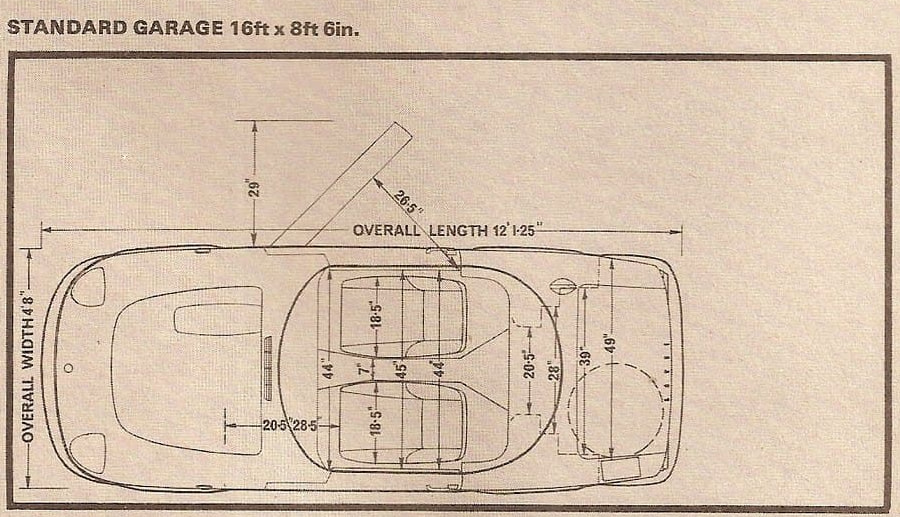
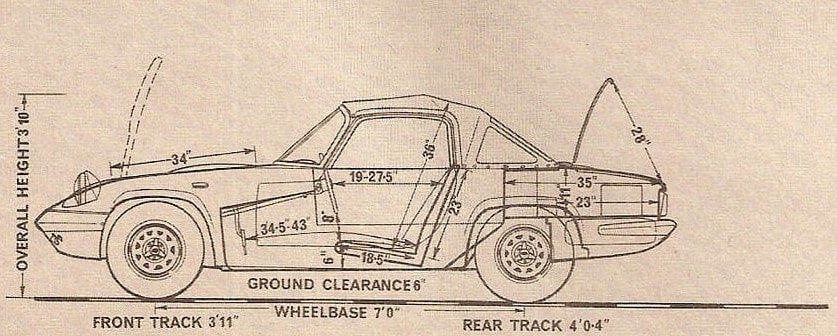
Overall Length: 12ft 1.25in. Overall Width: 4ft 8in. Overall Height: 3ft 10in. Ground Clearance: 6in. Front Track: 3ft 11in. Wheelbase: 7ft 0in. Rear Track: 4ft 0.4in.
Scale: 0.3in. to 1ft. Cushions uncompressed.
Specification: Front Engine Rear-Wheel Drive
Engine
| Cylinders | 4, in line |
| Cooling system | Water; pump, fan and thermostat |
| Bore | 82.8mm (3.25in.) |
| Stroke | 72.8mm (2.86in.) |
| Displacement | 1,588 c.c. (95.19 cu. in.) |
| Valve gear | Twin overhead camshafts |
| Compression ratio | 9.5-to-1; octane requirement 100 |
| Carburettors | Two Stromberg 175CDS |
| Fuel pump | AC mechanical |
| Oil filter | Full flow |
| Max. Power | 115 b.h.p. (net) at 6,250 r.p.m. |
Transmission
| Clutch | Borg and Beck diaphragm spring, 8in. dia. |
| Gearbox | Four-speed, all-synchromesh |
| Gear ratios | Top 1.0; Third 1.40; Second 2.01; First 2.97; Reverse 3.32 |
| Final drive | Hypoid bevel, 3.54-to-1 (3.77-to-1 fitted to test car) |
Chassis and Body
| Construction | Welded steel backbone with glass-fibre reinforced plastic body |
Suspension
| Front | Independent, wishbones, coil springs, telescopic dampers |
| Rear | Independent, wishbones, coil springs, telescopic dampers |
Steering
| Type | Alford and Alder rack and pinion |
| Wheel dia. | 14in. |
Brakes
| Make and type | Girling discs front and rear |
| Servo | Girling vacuum |
| Dimensions | F, 9.5in. dia.; R, 10.0in. dia. |
| Swept area | F, 139 sq. in.; R, 159 sq. in. Total 298 sq. in. (334.5 sq. in. per ton laden) |
Wheels
| Type | Pressed steel disc, knock-on type, 4.5in. wide rim |
| Tyres — make | Firestone F100 or Goodyear G800 |
| — type | Radial-ply tubed |
| — size | 145–13in. (Dunlop SP Sport 155–13in. fitted to test car) |
Equipment
| Battery | 12-volt 57-amp. hr. |
| Generator | Lucas C40, 42 amp. |
| Headlamps | Lucas F700, 120/90-watt |
| Reversing lamp | Standard |
| Electric fuses | 2 |
| Screen wipers | 2-speed, self-parking |
| Screen washer | Standard, electric |
| Interior heater | Standard, water valve type |
| Safety belts | Standard |
| Interior trim | Leathercloth seats, pvc hood |
| Floor covering | Carpet |
| Starting handle | No provision |
| Jack | Screw scissor type |
| Jacking points | Along undertray |
| Windscreen | Laminated |
| Underbody protection | Non-corroding glass-fibre plastic body |
| Other bodies | Fixed-head coupé |
Maintenance
| Fuel tank | 9.25 Imp. gallons (no reserve) (42 litres) |
| Cooling system | 14 pints (including heater) (8 litres) |
| Engine sump | 7.5 pints (4 litres) SAE 20/50. Change oil every 3,000 miles; change filter element every 6,000 miles |
| Gearbox | 1.75 pints SAE 80EP. Change oil every 6,000 miles |
| Final drive | 2 pints SAE 90EP. Change oil every 12,000 miles |
| Grease | 2 points every 6,000 miles |
| Tyre pressures | F, 18; R, 23 p.s.i. (normal driving). F, 22; R, 27 p.s.i. (fast driving) |
Performance
| Top gear m.p.h. per 1,000 r.p.m. | 17.4 |
| Mean piston speed at max. power | 2,975 ft/min. |
| B.h.p. per ton laden | 128 |