I offer my recent experiences for anyone trying to troubleshoot their car when it has a misfire ONLY when warm.
My Car is equipped with a crane Cams XR700 electronic ignition system. Late last year I took the distributor out to tidy up the (optical) pick up wiring & check the advance mechanism.
Over the winter I replaced the cylinder head, replaced the electric fuel pump & pressure regulator, had the distributor out & serviced the Webers ; i.e. lots of changes to both the fuel & ignition systems.
After pulling the car out of storage it ran perfectly cold, but after 15 minutes or so started mis-firing quite badly & would not continue to idle.
I checked fuel pressure & fuel delivery, both good. Checked ignition timing … good. The issue sounded like a ignition component failing when hot, ignition module, cap, rotor, ignition wires, plugs or coil… most were replaced last year… replaced cap… rotor…wires again one by one with no change.
Thoughts went back to touching the distributor last year. In a fit of desperation I read the instructions & fault finding & see "ROUGH OR INTERMITTENT OPERATION "
Improper phasing is the most likely cause of rough running on new installations. Check phasing according to instructions in the section on Completing the Installation.
What the heck is “phasing??” Reading back through the disjointed 20 pages of instructions I see a section I had not noticed before:
OPTICAL TRIGGER ADJUSTMENT PROCEDURE
The new diagnostic LED greatly simplifies the optical trigger adjustment procedure. The LED illuminates at the firing point and can be used as a static timing aid.
Reconnect the battery. Turn ignition key on, but do not crank engine. Timing marks must remain aligned.
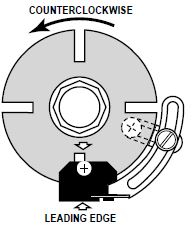
Refer to Figure 25. Select the appropriate orientation depending on direction of rotation previously
noted. Slide trigger assembly around the edge of shutter in direction opposite to distributor shaft rotation.
When the light beam from the optical trigger reaches the leading edge of a window in the shutter,the diagnostic LED will illuminate.
At this point, stop sliding the optical trigger. Tighten all screws to maintain this position. If necessary, repeat sliding procedure until you are sure optical trigger is aligned properly. You can position the mounting arm
either to the left or to the right of the mounting foot as required for proper alignment.
This alignment procedure assures that the rotor is pointing directly towards a spark plug terminal when the leading edge of a shutter window reaches the optical trigger. Correct alignment assures maximum
spark energy by reducing the gap between the rotor tip and cap terminal.
OK… I know I did not do that when I had the distributor out, so I go through the simple procedure & thankfully everything is now good!
I’m not an electronics whiz, I don’t know why this is important, “Correct alignment assures maximum
spark energy by reducing the gap between the rotor tip and cap terminal.” makes no sense to me… you do this procedure with the engine at TDC & then set the ignition timing at something like 8 degrees before TDC… Anyway you have been warned!
The adjustment sets the rotational position of the sensor within the distributor? The picture shows an eight lobe rotor so is the Cams XR700 available with shutters for 4 and 8 cylinder engines? If so the device could find itself in different types of distributor such that alignment of the sensor is necessary.
Either way, this doesn’t seem to have anything to do with running poorly when warm.
Strangely, I’m on the point of posting an entry on having fun with a Pertronix ignition (a simpler device, by the look of it).
Your symptoms are spot-on for the ignition coil failing. If you switch off & leave it to cool, does it start normally and go again for another 10-15 mins ?
If so, I’d bet it’s the coil. Happened to me twice in 48 years. Once on an MGA, second time on an Escort RS2000.
I had been leaving for hours to cool off & I originally posted I suspected the coil etc… changing the coil did not fix the issue, changinng the position of the optical sensor did…
I suppose the 12v carried through the wire, at the terminal ends also needs to deal with flexing/vibration etc. Wondering if you had replaced any of the feed wire and or terminal ends.
You sure you have the ballast powers wired the correct way? I just re instated mine and managed to connect theo two powers the wrong way around, which resulted in overheating coil and missing after running a while.
Nope, the only thing that I have changed, is to adjust the position of the optical sensor within the distributor. To my simple mechanical engineer way of thinking, this is equivalent to changing the points gap or dwell angle…
Even on a standard distributor it is important that the rotor arm aligns with a contact in the distributor cap when the points open and a spark is generated. Fortunately, Lucas have done the work for you, the position of the points is fixed relative to the distributor cap and the position of the cam on the shaft is fixed relative to the rotor arm. So with a bit of luck, the rotor arm will be adjacent to a contact in the cap at the time the cam opens the points. All that is left to screw up as an owner is getting the right lead from the distributor cap to the right plug.
This is not the case with an after-market optical pickup and chopper - which unless designed specifically for the target distributor can be fitted to generate a spark when the rotor arm and distributor cap are not in alignment. It is therefore important to check the ‘phasing’ (spark at the right position of rotor arm rotation relative to the cap). This is a bigger deal in the US with 8 contacts to aim for, we only have to worry about 4.
If the phasing is out, the engine might still run, but the spark will have to jump two gaps, the gap in the plug and the gap between the rotor arm and distributor cap contact. This can make an HT system that is otherwise fine marginal, and as the engine warms up and other effects come into play, the two gaps can be too much for the spark to cope with.
A bit long winded - but I hope this was of some interest.
Andy8421
Surely you’re not an engineer that thinks the rotor arm actually contacts the cap pickup points!
There are always 2 gaps in the discharge path.
I did have a situation where the wrong height cap, that looked visually correct, that did increase the gap and tension on the carbon pickup that caused a high speed misfire.
I think Andy means the spark plug gap & a much larger Distributor to contact gap, that ties in with the manufacturer’s statement “Correct alignment assures maximum spark energy by reducing the gap between the rotor tip and cap terminal”
Starting to make more sense, I’m just happy she’s running perfectly
Nope, I appreciate the rotor arm and distributor cap contacts aren’t supposed to touch - but they are supposed to be adjacent when the points open, and therefore the gap is small. If the rotor arm is misaligned so that the spark has to jump an appreciable distance to get to the contact, then this is where the trouble starts.
The twink doesn’t have a vacuum advance/retard in the distributor, but if it did, then this would alter the relative position of the spark to the distributor cap contacts - the advance/retard moves the base plate that the points are mounted on. This is why distributors with vacuum advance/retard have rotor arms with an extended contact area to compensate.
But the T/C distributor does have centrifugal advance, which if this ignition is sensitive to trigger timing then extra attention may be needed.
I don’t see how this issue is heat or time related, if it is a weak spark problem then perhaps more of a leaning fuel mixture situation.
Just to clarify the advance / retard comment - The centrifugal advance keeps the relationship between the rotor arm and the cam opening the points fixed, so that the position of the rotor arm relative to the contacts in the distributor cap when the points opens remains constant. Hence the narrow ended rotor arm. The vacuum advance / retard works by moving the points, changing the relationship between the point that the points open and the position of the rotor arm. Hence the rotor arm with the extended end.
In answer to your point, there are a number of heat related effects that could reduce the spark. As the coil warms up, its resistance increases reducing the primary current, the electronics in the control unit will be heat sensitive which could impact the spark, breakdown voltage of the cap and rotor arm will decrease with temperature and could also impact the spark.
If the rotor arm was in the wrong place when the points open, this would increase the gap the spark needs to jump, and could make an otherwise healthy spark marginal, so that any heat effects would be more likely to effect the running of the engine. All hypothetical of course, but it does seem to fit the OP’s symptoms.