I though I would share this as it might help someone else. I had some recent vapour lock problems with my +2, as there was a hint of an upward loop in my fuel line coming from my mechanical pump.
I decided that it was time to convert to an electric pump, and I had an old Moprod one that worked well in the engine compartment, but made a noise like a jackhammer when mounted to the engine bulkhead.
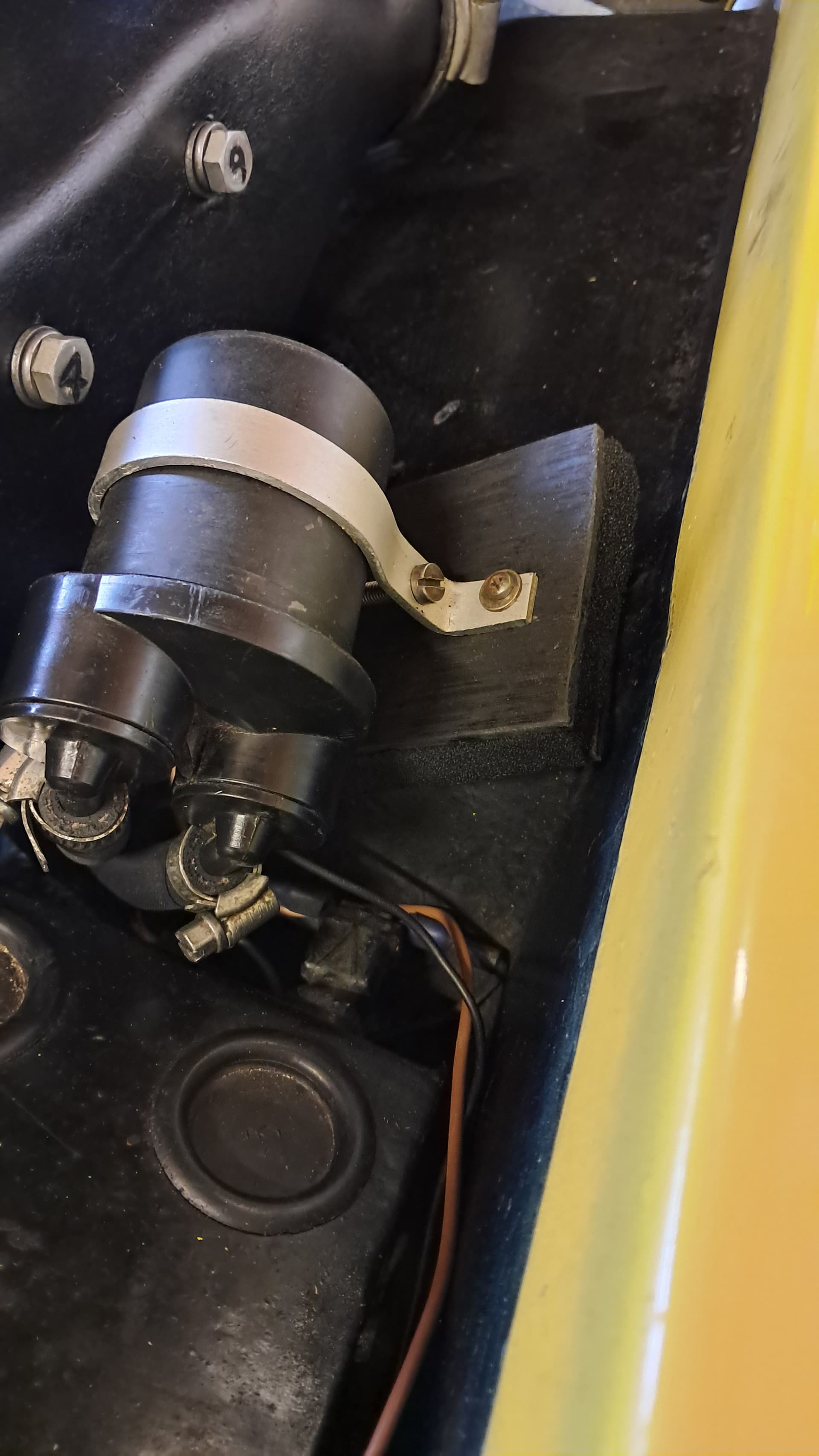
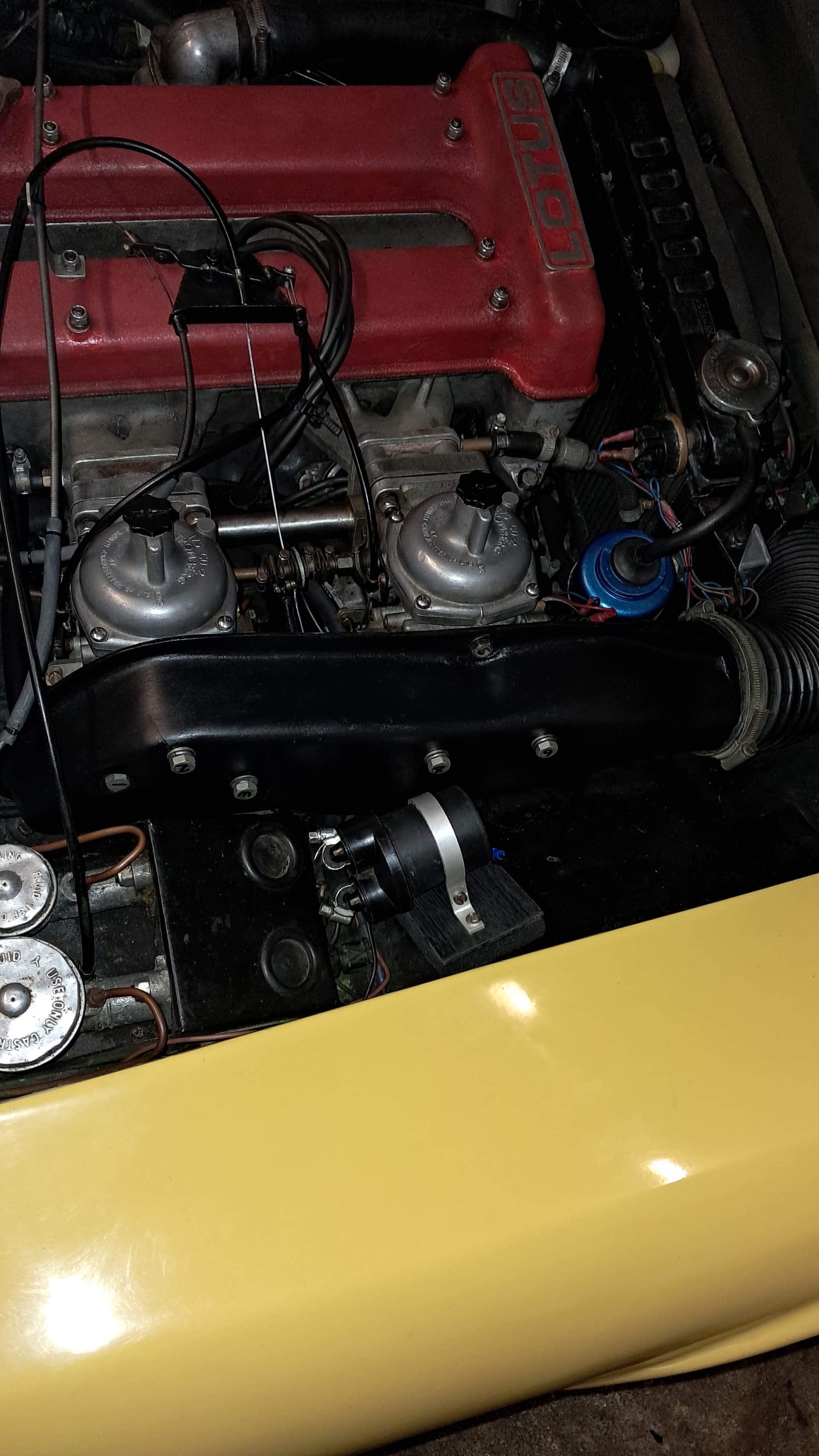
After some head scratching I decided to try mounting it on the front wing next to the Stromberg air box, and also try to isolate it acoustically from the car. With some scepticism I made up two 5mm plywood squares glued to 10mm of medium density foam using some quick set epoxy resin.
I drilled and fitted two M3 inserts to mount the pump on one square, and two more on the other square to connect to the inner wing. The whole thing was then assembled using 2 x M3 x 8 screws cooming through from the wheel space, and 2 x m3 x 8 screws to mount the pump. The idea is that there is no hard material contact - the foam does the supporting work.
I started the pump up, and was pleasantly surprised. The pump is only audible with the engine off!
After a few test runs all seems well. When you touch it, you can feel the thumps on the top part of the foam sandwich when the pump is running, but nothing on the bottom that’s screwed to the wing. Result!
See pictures attached. It may not be the most original looking setup, but it worked for me, and the pump is a doddle to change!
I’ll just add that not everything has been covered in my post regarding fitting an electric fuel pump. For safety reasons an inertia switch should be fitted in series with the 12v supply to the pump. Also, it’s best to fit an additional fuse in the supply line as well.
An update on this thread. I have been running around with 5 litres of fuel in a fuel can, secured in the boot, because the pump is now high up in the engine bay. Sure enough, this afternoon I had just left home and the engine died. You could just hear the pump running fast with the fuel gauge just above E. On my car that means 5 to 10 litres left.
I poured the spare 5 litres in and the pump ran fast for a few seconds, then slow. Good! I then completed my journey and got some more fuel!
I had though that the Huco pump could pull the 13 inches of height with a low tank on my +2, but it seems not .
I will have to mount the pump lower, under my Stromberg carbs. I will try and keep the foam sandwich, which is still working well.
PS. I have 2 inline fuel filters from Burton Power, the sintered type. I wonder if that could be too much for the pump?
I mounted my similar pump and inline filter on the outside of the boot front bulkhead, immediately inboard of the right rear wheel well. Reasonably accessible and easy to connect to the hard line coming out at the banjo fitting at the base of the the tank. Works OK. IIRC my old Mini used a similar mounting point.
I had a little facet fuel pump mounted in the boot adjacent to the fuel tank near the spare tire. The back wall of the boot was like a drum from the pump noise. So I mounted threaded inserts in the boot wall and mounted the fuel pump with these. Much better. The second time I had to smack the facet pump with my K/O hammer, I replaced it with a rotary electric pump. That was even better.
As I bought a puller pump for the engine bay, I will persist with the volume available under the carbs, which looks large enough.
The Huco 133010 pump should have been good enough on paper to work, -0.2 bar of suction apparently. It also looks genuine with well finished printing, both on the box and the pump.
I would still like to be able to change the pump by the roadside with my spare Moprod, which may still be possible if I get the location right.
I will post again if I have a solution that works down to an empty tank!
I was also concerned with roadside replacement, which is definitely a bit awkward on the boot bulkhead. I was able to reach in with the left rear wheel removed, but that definitely wouldn’t be a great idea at the roadside with only a crappy jack on hand.
I put together a small kit of fuel line fittings and an electrical connector with my spare pump. The (untested) plan was to temporarily install the spare pump under the bonnet with some zip ties and a closed cell foam pad. The idea was the spare pump would draw fuel thru the dead pump.
Based on your results I think I better at least test this scheme out with hardly any fuel in the tank as my spare pump might not have enough suction. If I can get it to work I will let you know. Unfortunately I just filled the tank for winter hibernation and I probably won’t be out for another run until spring.
I’ve been dredging the deepest recesses of my memory, and I remember altering the fuel gauge to get it to read F with a full tank by adding a series resistor. This was about 15 years ago.
I had thought that the gauge was ok at the E end, but now I am not so sure. So I might have actually run the tank dry!
So this arrangement might still be OK. I have also filled my tank up, so I will post again when I know more!
I am struggling with the gas gauge and sender combo as well. Considered a shunt resistor to tune the gauge, which was a successful approach on my replacement temperature gauge. Unfortunately my full tank gauge reading is consistently low, so an additional resistor would just make it worse.
I have this device from Spiyda that I want to try out. It digitally matches the sender and gauge at five points through the range. I have collected the required data and need to try programming it again. I had it working (sort of, needed further tuning and validation) with the stock gauge, but need to take another shot with my modern replacement Smiths fuel gauge and sender combo. The whole programming process is quite fussy. The hardest part is getting accurate sender values at the five key points one wants to use.
One thing I have determined is that my low fuel light works quite well, which is definitely reassuring. Reduced the need to get this little mod to work correctly. One of my winter projects.
 .
.