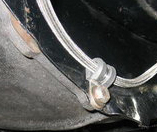
I’m trying to route my 50+ year old plastic clutch line and really can’t see a good way to do it. Do I give up and build or buy a different line? If I fit the U shaped end to the master, the plastic line runs close to the exhaust. U shaped end at the slave helps to route the line away from the exhaust but the right angled end doesn’t work at the master…
Maybe run it outside the frame and chafing against the fiberglass??
I know its not correct but I put a banjo fitting on the slave end to get a little more clearance from the exhaust and wrapped the hose in firesleeve. Also made a stainless heat shield on the exhaust near the slave. Gary
I tried installing a plastic line for originality because the DPO had made up a piece of hard line that cracked down by the slave cylinder fitting. I also had issue with routing the line so it would not melt with exhaust heat. I was not successful. The plastic line lasted about 6 months. It melted and failed during a long 4th gear climb up I-70 from Denver to Loveland, so I got to do rolling starts into first gear and shift without the clutch the whole way home…
I eventually made up a new hose of braided stainless with AN fittings almost exactly like the one RD Enterprises sells. I did slit some 7/16" fuel hose and slipped it over the braid because it started to act like a hacksaw on anything it touched.
Well, you guys have confirmed my fears. Looks like I will be doing some modification. While we are at it…can all the air be gotten out of the slave? I was thinking of removing the snap ring and turning the slave so the bleeder is at the top of it while bleeding. If that is not worth the trouble I will abandon it. The piston may actually exclude nearly all of the air with the bleeder where it is.
Before I got a pressure bleeder, I held the slave up in the air above the master to bleed it while my neighbor pressed on the clutch. Messy but it worked. I used two circlips to take up the slack of fit with the loop in the bell housing to get more useful travel.
I bought a pressure bleeder about 35 years ago, so I can do it myownself now.
My standard procedure has been to fit a clear tube to the bleeder and run that back into the master. Pump slowly till I see no more bubbles. Your procedure of doing the slave bleeding before fitting may be the best option. First I’m going to have to figure out the plumbing!
What I’m going to try is routing through the large lightening hole in the frame then forward between the body and the frame rail till i can route it up to the port side of the master. That will isolate it from exhaust heat unless the frame gets hot enough to melt plastic. Flexing due to engine vibration will be the main concern causing chafing of the tube against the frame. OOrrr, just ordering RD’s hose…
I recently bought and fitted the clutch line upgrade from Kelvedon in the UK for my 69 Plus2 and it fits really well. It is protected with braided stainless steel and looks as it it will be a big improvement
On a couple of my Elans, I used a braided PTFE flex line from the slave cylinder up to the horizontal top chassis rail just in front of the firewall, through a bulkhead fitting, then rigid line to the MC.
Kurt. Here is a picture from the top looking down at frame rail. The silver on the left is the thermostat extension of the head. I have pulled the line with firesleeve out from under the body. Normally you can’t see it. This picture is over size so I can’ t upload but one. I’ll send another from underneath. The line is routed back to the side of the bellhousing and curves forward to the slave. You’ll see it in the next picture in the next post. I hope it makes sense to you. I have tried to keep it as far away from the exhaust as possible. The exhaust header is the original cast iron manifold. from the manifold back is SS custom made by a friend who makes exotic exhaust system. I traded him some fiberglass repairs on a boat for the system. good for both of us. Gary
Here is a photo from underneath. The exhaust resonator can be seen and the line comes in from the backside of the bellhousing to the banjo fitting. I’ve never had any trouble with it in several years including the trip to LOG in Salt Lake City and that was a hot trip. Just how I did it. I hope it gives you some ideas. The orange fire sleeve is an aircraft product from either Wicks aircraft supply or Aircraft Spruce and Specialty. No affiliation with them. Gary
Folks, you have really got me thinking of a Goodridge PTFE stainless brake hose, I have a need for a replacement on another car to use up part of that kit anyway. Finished off with a hard line to the master.
I have a couple of things working against me in fitting the line. I have given the frame the 26 R treatment and have fitted a header as well. Complicates routing. I’m sure the hose routing wouldn’t be problem for a right hand drive car as a couple of you have alluded to,
I pulled the piston from another slave and discovered that it is impossible to get all of the air out of it while it is mounted. I think that Gary’s banjo fitting is about the only way I can bleed the system with the slave not fitted to the car and have enough room to fit it after bleeding. Other cars may have a bit more room but not much. I’m surprised this hasn’t been an issue since the Elan was manufactured.
I’ve only done it once or twice (I avoid messing with clutch hydraulics if at all possible) but doing a normal best effort bleed and then wedging the clutch pedal down for a day or two normally does the trick.
I guess the theory is air module are small enough to escape past the seals under pressure but the fluid isn’t.