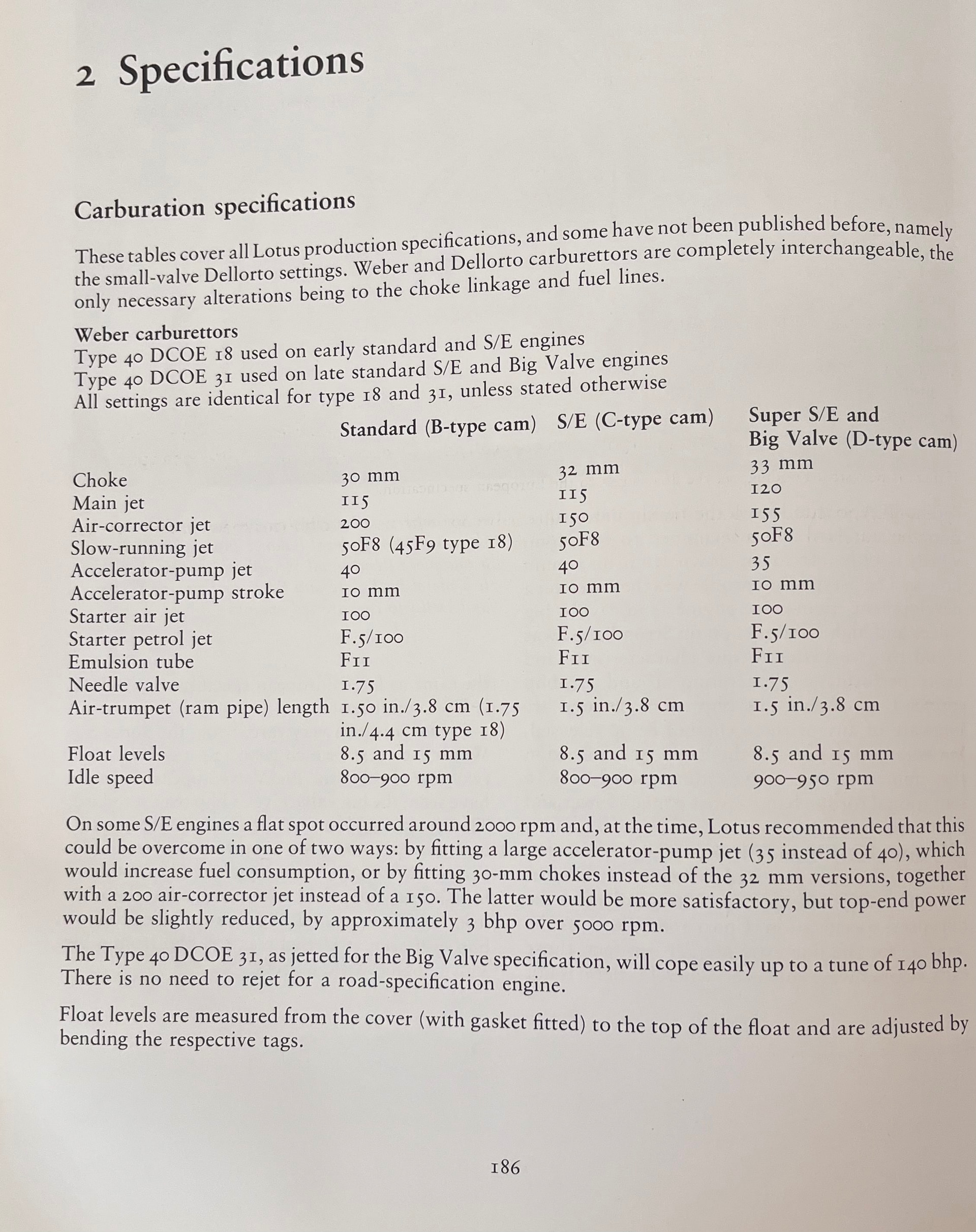
I recently bought this S3 but having a hard time achieving a Lean Best Idle on the Webers. Just trying to tune to normal road driving.
As time permits, could someone with a road application, please send me their set-up. Jets and Venturis?
Thanks.
I recently bought this S3 but having a hard time achieving a Lean Best Idle on the Webers. Just trying to tune to normal road driving.
As time permits, could someone with a road application, please send me their set-up. Jets and Venturis?
Thanks.
If the rest of the engine is standard or SE specification then the jetting per the manual for the two engine variations is the best starting point.
cheers
Rohan
I agree with the estimable Rohan. I’d start by verifying your current setup; mount integrity, fuel pressure, throttle shaft seals, float level, linkage adjustment. That kind of thing.
Great advice above.
In addition to Rohan’s recommendations, check the timing for scatter at idle. Do a compression check, engine warm and throttles wide open. Compression should be within 10% across all 4 cylindes. Otherwise one will chase mixture and synch forever.
Lastly, Twincams seem to like a slightly rich mixture. I use a Colortune but allow the flame color to just turn yellow instead of Bunsen blue.
Thanks.
BTW - Current idle/slow running jet is a 50F9. Even with a 1/4 turn out of the mixture screw, the rev. is starting out too high. Some sites for tuning for LBI state that I should be able to turn out the mixture screw 1 or even 2 turns to get an initial idle. They said if initial rev is too high this could mean that the idle jet is too big, suggests a 40F9 for a 1600 CC engine with twin webers.
Please see link.
If the revs are too high initially, it could be a vacuum leak. There should be a mount with two ‘O’ rings between the head and the carburetor. Sometimes an O ring gets dislodged, which will require pulling the carbs off. Best to replace all eight O rings at that time.
I think many of us (me included) are running 50F9s and idling normally.
What is “too high”?
I will check for vacuum leak between the manifold and the carbs. Will run engine, then spray carb cleaner at the joints, listen for change in rev.
Make sure the jets are clear/ clean - this has become a routine for me with Weber DCOE , IDA and DGAV s
Note that you can have air leakage around the screws that contributes to the problem… and that the screws themselves could have been replaced with the wrong replacement (dependent on the type and age of your Webers, but there are 2 basic variants, one with a longer, narrower taper and one with a shorter, thicker taper). EZ Turn Fuel Lube on the screws can help with air leakage there - or as a test even just a dab of grease.
Also check the choke/cold start component of the carbs - these are well enough known as leak areas that many lock them shut or blank them off altogether.
Throttle shaft seals!!! Yes, I had a heck of a time getting my Webers to function properly. I tried everything-jets, emulsion tubes, float levels, idle mixtures, using a Color-Tune, not using a color tune and so on. Finally in both desperation and exhaustion, I found a real “Weber Guy” in central Connecticut. He had the car for a day, and when i picked it up, it was humming. He had found and dealt with a throttle shaft leak.
I have been happy with Permatex #2, in NA you have Loctite 567 also easily accessible
https://vansairforce.net/threads/ez-turn-or-loctite-567.75621/
throttle shaft leak.
I will be sure to check this while running the engine and spraying the carb cleaner to check for leaks. Is carb cleaner acceptable for checking for leaks?
Yes, carb cleaner is the preferred spray. Keep a fire extinguisher at your side. Years ago, I had multiple vacuum leaks from the o-rings in between the carbs and manifold, and the throttle shafts. Keith Franck helped me by making new leather seals and working ez-turn grease into them to help sealing. We got it resolved and the idle was smooth at 900rpm after patient synching.
The article you refer to is dealing with later Weber 151’s!
On earlier Elan’s/+2 as original fitment you probably have Weber 18’s or 31’s which have the fatter, coarser mixture screws in which usually somewhere between 1/4 -3/4 out works out as the norm if you have standard engine with the standard carb jetting. Tweaking between 50F8’s or 9’s usually works.
Proviso is of course that someone has not butchered the mixture screw seats by fitting the wrong later narrower seat mixture screws used on the later Weber versions.
Alan.
For tuning DCOE carbs, google yahoo groups sidedraft central. Keith has been a wonderful resource to help troubleshoot and tune these carbs.
I used to use a Colortune on my '67, worked really well.
https://www.webstore.com/seller/DCOE_Tuner/items/?pgr=user&user_id=82598
You will need know your idling vacuum to order the idle jets, the choke size for the emulsion tubes and he sell or rents a fixture for drilling additional progression holes to eliminate the off idle stumble.
Keith Frank is super helpful and if you plan on taking advantage of his expertise you should act soon. His son is being trained to take over the manufacturing but Frank is spending more and more of his time working on his cool restorations and builds.
Just a detail on this. Keith Frank has been working on and improving Weber carburettors for over 20 years. I took his advice and drilled the extra early progression holes, although I did mine by dead reckoning and careful measurement. A 0.8mm hole, 1mm downstream from the original first hole in each barrel. That is, closer to the cylinder and is uncovered earlier. The off idle stumble was cured and it allowed me to weaken the idling mixture and not foul the plugs.
This is for the 151 carbs only
Eric in Burnley