Nigel,
Excellent points all round. I also discovered my temp gauge was reading 8C high. Smiths’ gauge accuracy is um, dodgy. Best to check with a surface thermometer or IR pyrometer on a black painted surface.
Nigel,
Excellent points all round. I also discovered my temp gauge was reading 8C high. Smiths’ gauge accuracy is um, dodgy. Best to check with a surface thermometer or IR pyrometer on a black painted surface.
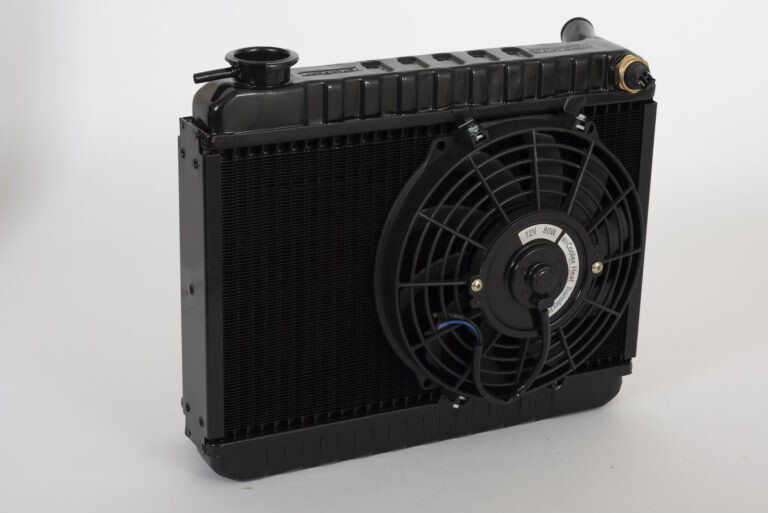
Bruce, I have a wide aluminum Coolex radiator. I ordered it with two installed fans; not sure if you also got them to supply and install your fan?
Anyway, my fans are very good quality and effective. Way quieter in operation than what I had before.
My car (modified tall block Twin Cam) consistently runs at an indicated 90 degrees with the 82 degree thermostat installed.
I say ‘indicated 90 degrees’ because I can’t really say how precise the modern replacement Smiths gauge might be; I have installed a resistor in series with the supposedly matched modern sender to get the gauge into it’s correct range, as validated by heat gun readings, an icing thermometer in the thermostat housing (Clivey Boy style with blanking cap) and surface mounted temperature strips. I used the same technique to ‘tune’ my stock gauge and replacement sender because it was also reading consistently high. Others here have had similar experience.
Quick edit after reading nkat’s excellent post. I think I used about 13 ohms on the stock gauge/sender. I am using 20 ohms in my current setup with the modern replacement gauge and sender. These resistors are available in a range of values and work well in an automotive environment.
Sounds like your setup is actually behaving in a similar fashion?
As already mentioned, the key is to make sure the cooling system will drag the temperature down about 10 degrees (~100 to 90 in my case) in short order; mine takes around five to seven minutes to cycle the fans off and hit 90 degrees.
I intend to try a lower temperature thermostat for next spring. The consensus target temperature for the Twin Cam in previous posts here seems to be about 80 to 85 degrees.
Although not relevant to your Sprint, my Plus 2 uses a heater box flap to regulate interior temperature. I have installed a coolant shutoff valve in the heater hose circuit, which allows the heater box to be isolated. This really improves cabin temperature in hot weather. Of course your Sprint setup includes a shutoff to regulate temperature.
Here is a link to the adhesive temperature strips I used. They come in various configurations and brands. For our application I think the ones that mount horizontally make the most sense. I bought a three pack, installed by the thermostat housing and the top and bottom radiator hoses.
HTH
Stu
I can’t speak for twincams in particular but on other English cars I did not have good results when running with no thermostat. They restrict water flow. I suggest gutting one and installing it to serve that purpose.
If I could add to Stugilmor’s and WDB’s posts. The thermostat also acts as a restriction orifice at higher rpm for two purposes. First is to limit flow through the head so the water pump flow is consistent through the entire block and head. There are actually restriction holes in the head gasket for this purpose as well.
Second, it puts limit on flow and increases the discharge head pressure back on its curve to reduce the chance of bubble formation from boiling in the head. It may produce only a few pounds per square inch at low speeds, but it still helps reduce chances boiling in the head. The temperature across the entire head remains more consistent.
Third, the thermostat helps the engine to reach operating temperature more quickly from cold.
My engine builder does not use thermostats in his race motors, but the restriction orifice of the thermostat housing is always there.
Probably a daft suggestion, is the fan spinning in the right direction?
What temperature is the fan switching on, are you measuring this from the dashboard temperature gauge of by an IR meter on the radiator header tank? Maybe lower the setting of this switch, some are adjustable, others are fixed and will need swapping
Does the fan have a circular surround around the blades, this greatly increases the efficiency of the fan in forcing air through the rad.
The deflector plates around the radiator are really aimed at directing the airflow through the radiator when on the move.
Good luck.
Hi Bruce
Your temperature behaviour is pretty similar to mine. I have a wide radiator and fan, and an 82c thermostat. I keep meaning to fit the cardboard deflector to improve cooling on the move but haven’t got round to to it.
My Sprint takes 5 or 10 minutes to get up to temp, and settles to between 85 and 90, depending on the ambient outside temp. If stationary it goes up to around 95. Years ago, with the original radiator, I used to put the heater on which helped reduce the temp, but not ideal in summer!
Richard
Hi Richard, the heater in the car does make a difference, luckily having a DHC some of the heat can escape! I think it’s within spec how it is setup, it’s just the fan that is not doing it’s job I think
Very interesting, thanks Nigel
Thank you Stu, the resistor trick is a great idea and I shall try those strips once I work out what the fan is contributing
WDB and Stresscraxx,
Tx. All very helpful.
The thermostat point: I hadn’t heard of the cylinder head pressure distribution function before. Mine is out because we don’t have warmup problems out here and because I sought maximum flow in the cooling circuit.
What do you mean by ‘gut the thermostat’, please? I have seen some run with just the outer ring but otherwise, only with the bulb intact. Uneducated, I took the view that there would be little effective difference between a 10mm ring restriction there and none at all. Not so?
NK
NK,
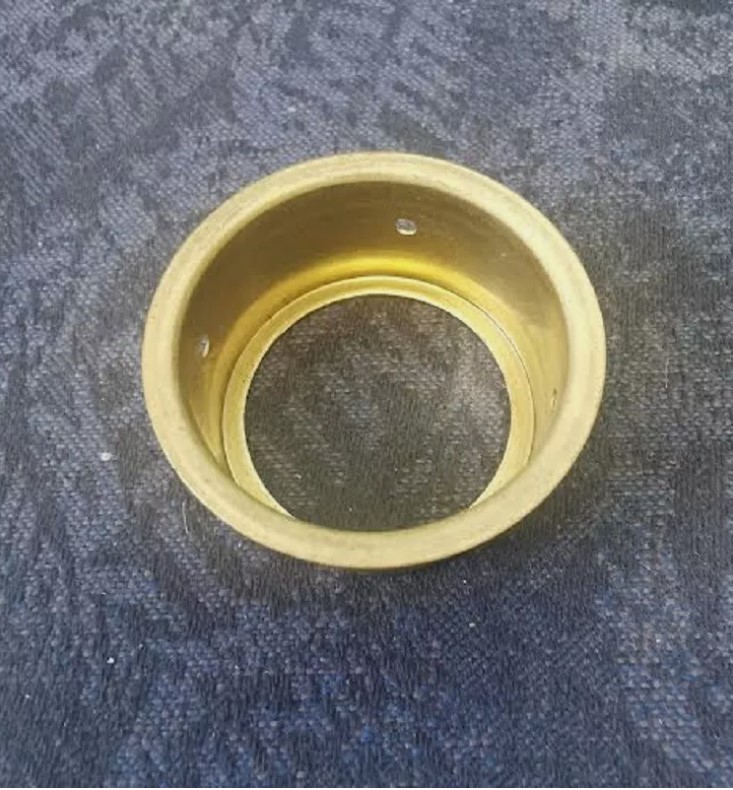
I used to race Minis in the mid 80s. BL ‘special tuning’ sold a restrictor plate to replace the thermostat in competition ‘A’ series engines. As mentioned above, the flow of water around an engine is a carefully balanced thing to promote even cooling at different pump speeds. Just whipping the thermostat out can do more harm than good.
FWIW, BL thermostat replacement restrictor below:
“What do you mean by ‘gut the thermostat’, please?”
In other words, cut and remove the “bridge” that holds the thermostat inner disc and the wax plug cartridge, so there is only a the center hole left in the disc.
It’s most important as Andy advises above.
In my experience, what you describe is pretty common behaviour for Elan S4s. I have a large aluminium radiator and a good fan in mine, and have no problems with overheating at normal road speeds. It has a 1760cc engine with L2 cams. I can cruise at 70-80mph all day with temperature around 77C. In traffic, it will soon get up to 90C and when idling, with the fan on, it will slowly increase to around 95C. However, if I rev the engine gently, the temperature drops by a good 10C very quickly. Let it idle normally and it soon creeps up again. So I have adopted the habit of revving it gently every 30 seconds or so whilst sat in a traffic queue. Try this and see if it helps in your Sprint. I’ve also noticed that if I let it idle for a few minutes after a good hard run, it will get very hot, very quickly, yet if I open the bonnet and let it idle it drops back to 90C-ish. So, two conclusions: 1) water circulation is poor below 1200rpm and 2) hot air does not escape from the engine bay fast enough when the bonnet is closed and the car is stationary. A more powerful fan might help. I have a spare bonnet and I’m thinking of fitting some aftermarket vents and running with that for day-to-day use, fitting the original for shows and other events where nit-pickers may be present.
Hi Nigel,
Yes I agree with those points and that is my experience at the moment before a deeper dive. In Brian Buckland’s excellent book, he talks about how the water pump is geared to take account of high revs, so at low revs it is lacking. He says dilemma then is to rev up and increase flow but in the knowledge that the heat goes up as well.
Hi Bruce
In my experience (with an aluminium radiator) you only need to bring the revs up briefly to around 2-2.5K rpm every now and then to bring the temperature back down to below 90C and keep it there. Popping the bonnet a crack helps a lot, even though it doesn’t look very elegant. I added an extra link (welding rod) to my bonnet spring so it only opens an inch or two. You should be able to reach round out of the side window to shut it again - not a very elegant solution, but it provides a bit of peace of mind! I’ve known people fit an electric water pump, but I think that’s overkill. Part of the problem is definitely ventilation - if I take the bonnet off it will idle all day at between 80 and 90C, so I’ve been thinking about modifying a spare bonnet or providing another exit route under the wings. Getting more air flow under the bonnet helps the carbs, too, if you are on Webers.
Nigel
Presumably as it’s a Sprint you have the two holes in the inner left hand of the engine bay; a Lotus modification to improve cooling by giving the hot air some means of escape from the engine bay (I believe that’s what they are for). How about helping move that hot air with the addition of a couple of 3” PC cooling fans? Something like these ARCTIC P8 PWM PST Slim 80mm Black PC Fan 3000RPM 22CFM 12v 4-Pin Cable Splitter | eBay UK Cheap enough to rig up as a temporary experiment if nothing else.
Mike
You read my mind Mike, I was thinking the same! One to add to my list of experiments
Those holes are very helpful in moving hot air out of the engine bay as wheel wells are natural low pressure areas, as long as the car is moving. If one side is not enough, you can mirror them on the right. I fit a bit of screen over mine to keep debris out.
Mike,
FWIW, to save you the trouble of buying the fan, a typical smallish electric radiator mounted fan of the type sold for use in the Elan draws somewhere between 10 and 20amps. My Wife’s Merc SUV’s fan has a separate feed direct from the battery fused at 50amps (though part of that 50amps will be to cover start up surge), so lets say it draws 30amps steady state.
The fan you have linked to draws 100mA, that’s 0.1 amp. Now, efficiency certainly comes into it, but if we use current draw as a surrogate for the amount of puff the fan has, then the PC fan you linked to will have 1/100 of the puffing power of a typical Elan radiator fan.
Useful for cooling your rice pudding, not much help in keeping the Elan cool.
Edit: A more useful suggestion would be to make sure you have a decent seal around the rad. The engine is quite tight fit in the engine bay, and just recirculating hot air isn’t going to help cool the rad. I have replaced the millboard deflector under the rad with a homebrew ally deflector that actually fits, made sure the gaps down the side of the rad are as small as possible, and have replaced the ratty foam on the bonnet so it seals properly against the top of the rad. Cutting the two recommended additional holes on the left hand inner wing helps to eject the heat from the exhaust manifold. The comments above about cooling being better with the bonnet open reinforce the point that airflow restriction / reflow is at least part of the problem at tickover.