AUTO TEST: Lotus Plus 2S 130/5
An ambling option for the businessman’s express
Autocar, 5 October 1972
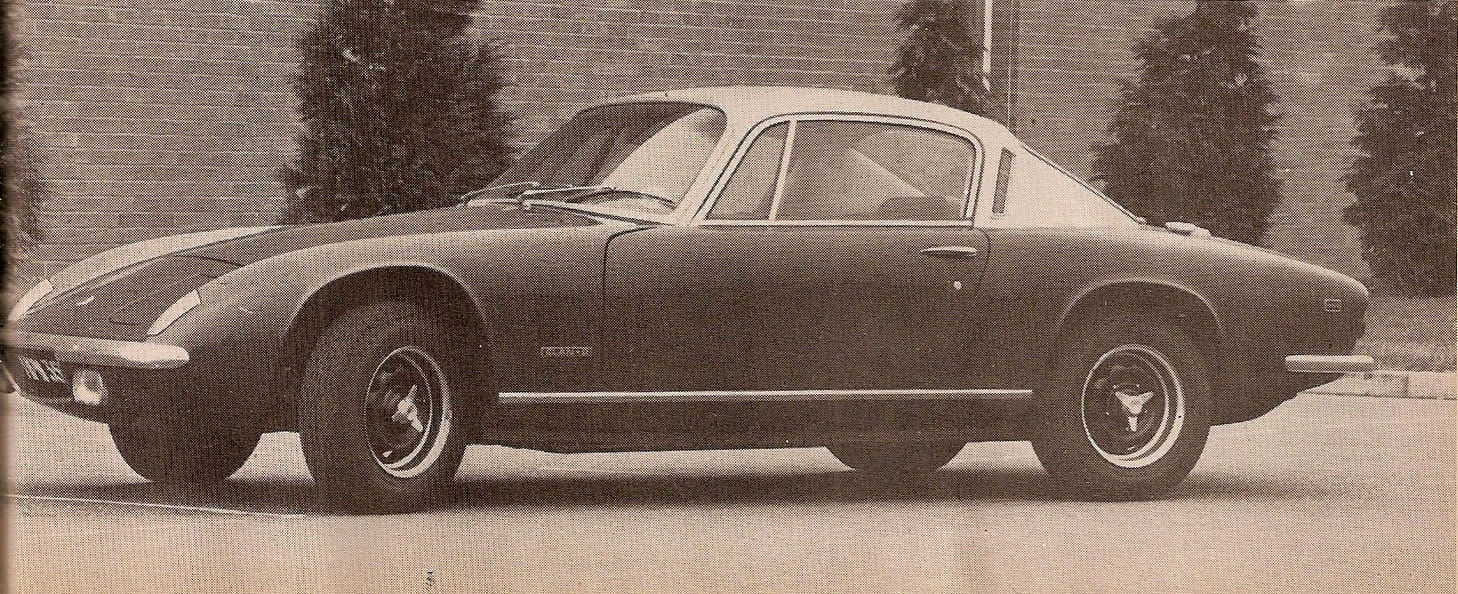
AT-A-GLANCE: Five-speed gearbox option for biggest Lotus gives much more relaxed cruising and better overall consumption. Performance otherwise unaffected, handling and brakes as before; a light, sensitive driver’s car. Ride not as good as usual, but detail finish improved
With the growth of Britain’s motorway system, and the ever-increasing tendency to take motoring holidays or business trips in Europe, the need for restful high-speed cruising has become more apparent. This is particularly so in the case of smaller, higher-powered cars, of which the Lotus models are perhaps the prime examples.
For Lotus, the problem was not an easy one. There are higher final drive ratios than the 3.77 unit fitted as standard in the Plus 2S 130 (such as the Ford 3.09 axle in the Capri 3000); but the use of such a unit would raise the lower gears and make starting from rest difficult, as well as killing the mid-range acceleration. This could be overcome by using a wider-ratio set of gears, but would hardly be an acceptable solution, because it would spoil the sporting nature of the car. Nor is there enough room for a conventional overdrive of the Laycock type.
The answer has now been found in the form of a five-speed gearbox in which the fifth gear, Alfa-fashion, is effectively an overdrive, having a ratio of 0.8. Fourth gear is direct, corresponding to top gear in the four-speed box. Second and third gears in the five-speed box are marginally closer than their four-speed equivalents, but first is markedly lower.
This new box has been made available as a £120 option on the Plus 2S 130; when supplies are sufficient the option will be extended to the Elan Sprint. In the Plus 2, the 3.77 final drive is retained, and the car is otherwise changed.
Performance and economy
Since the lower gears in the five-speed box — first excepted — are similar to those in the standard-equipment four-speed box, it is to be expected that acceleration times will be about the same, and they are. The lower first gear makes it easier to spin the wheels when getting away from rest, but the time to 30 mph comes down to 2.7 sec. compared with 2.9 sec.
Unlike our previous test car, this one was fitted with the ignition governor which prevents over-revving. It allowed a margin over the 6,500rpm red line on the rev counter (which was almost dead accurate over its whole range), cutting in at 6,800rpm; this was sufficient to permit 35mph in first gear (compared with 41mph in the four-speed car), 60mph in second and 88mph in third. The car would also run to the governor in fourth, giving a maximum of 121mph; it would not quite match this in fifth, giving a mean maximum of 120mph and taking a long time to get there.
Three things conspired against our getting really good performance figures out of this latest test car. The first was the governor; while undoubtedly a good thing where normal driving in production cars is concerned, it inhibits the tester who knows that fractions of a second are lost if the governor is invoked. One therefore tends to change up earlier. In the Lotus, which has its peak power as high as 6,500rpm, this likewise leads to a slight sacrifice in the standing-start times.
There is also no doubt that the quality of the five-speed gearchange does not match that of the familiar four-speed box. It must be borne in mind that our test car was one of the first three to be run, and full production cars will certainly be better; but we found a tendency to baulk in first and third, while the gate was ill-defined enough to make the change from second to third an awkward one if attempted quickly. Indeed, this spoiled several of our acceleration runs, and in the end we settled for a slightly slower change for the sake of making sure of getting the gear. Finally, the car had hardly covered sufficient mileage to be giving of its best. In the circumstances, it is creditable that the figures are as close to those we have for the four-speed car.
In normal driving, the slightly leisurely action of the gearchange does not matter so much — changing down seems easier and more precise than changing up. Surprisingly for an engine producing 81bhp (net) per litre, the Lotus power unit is completely untemperamental. It is entirely possible to start from rest in second gear, while third pulls smoothly from 10mph and fourth from 20. Fifth gear is not really happy below 30mph, but the car held this speed without complaint when we were taking the steady-speed fuel figures.
Fifth gear should be treated, as Lotus clearly intended, as a genuine overdrive. It is a usable gear if one is not in too much of a hurry, but our figures show how much one gains by slipping down to the direct-drive fourth. In particular, fifth has little reserve of acceleration above 90mph, while fourth takes the car on strongly to beyond 110mph. In the normal way, therefore, one tends to accelerate as one would in the four-speed car and then change up to fifth at the chosen cruising speed. This attitude is encouraged by the Alfa-pattern layout of the gearchange, with the lower four gears in a conventional H and fifth out on the right, opposite reverse.
Where the new fifth gear undoubtedly serves its purpose is in reducing the noise and strain of high-speed cruising. It brings about a reduction of 1,100rpm when the car is cruising at 100mph, and this is reflected in the steady-speed fuel consumptions above all. When compared with the four-speed car, there are substantial improvements at every speed, though the gap narrows as the speed rises. In absolute terms, the figures are outstandingly good. To better 30mpg at 80mph, and achieve all but 24mpg at 100mph, is a remarkable achievement which underlines both the efficiency of the engine and the aerodynamic cleanness of the body.
When the “big-valve” version of the Lotus twin-cam engine was announced for the Plus 2 and Elan, we found that the extra power (achieved by improving the breathing) had been gained at the expense of low-speed consumption. The Plus 2 we tested in 1971 was more economical at a steady 40mph than at 30. This deficiency — hardly more than a minor one in any case — now seems to have been remedied, and the present test car achieved better than 50mpg at 30mph. It is noteworthy that, apart from any tuning changes which may have had something to do with this result, Dellorto carburettors are now fitted. They seem to share with the Weber the ability to give easy starting; we never had to use choke on the test car, though several mornings during the test period were cold and very damp. Three or four stabs on the accelerator were always enough to prime the engine for an instant start, and there was no tendency to stall when driving away.
The overall consumption we managed was an outstanding 25mpg, a lot better than any other car in this class, and markedly better than we obtained with the four-speed car. Naturally, the gains are greatest when the Plus 2 is cruised on a motorway; its natural, entirely unstrained cruising speed seems to be about 90mph. One period when it was mostly driven this way gave us better than 29mpg; on the other hand a quick trip on back roads, followed by the performance test session at MIRA, dropped the consumption to 22mpg because so little advantage was taken of the fifth gear. Oil consumption, with an engine whose piston rings could hardly have been bedded in, was an entirely reasonable 1,000 miles per pint.
Handling and brakes
Almost the first thing one notices about the Plus 2 is the lightness of the steering, by comparison with almost any other car of similar size. Despite this lightness, the steering is high-geared, with only 2.6 turns from lock to lock, for a moderate 34ft turning circle.
The reason for this combination of characteristics is partly that less than half the car’s kerb weight is on the front wheels; the occupants sit nearly enough at the centre of gravity, hardly upsetting the balance at all. For the rest, the front suspension geometry — clearly set up with Lotus’ tremendous racing background playing a part — ensures that the response to any steering wheel movement is quick and positive even by the standards of rack and pinion systems. There is a penalty in the form of considerable kick-back over rough surfaces, but if left to itself and guided with the fingertips the car steers a remarkably straight mean course in these circumstances.
Despite the rearward weight bias, the Plus 2 has good natural straight-line stability, but the car is noticeably disturbed by sidewinds. It can be felt giving a characteristic double twitch when it is driven into and out of the wake of a large, fast-moving lorry.
This particular car felt as though it had been set up to oversteer very slightly all the time, whereas its predecessor was almost neutral, oversteering only when cornered extremely hard. For a keen driver, it is no bad thing to have a modicum of permanent oversteer, for it takes most of the work out of driving; one twitch of the wheel takes the car into the corner, while another straightens it up at the exit. The only snag is that this presupposes sufficient skill to place the car on the right line. It is a skill that comes with practice, but if the entry to the corner is not right it can result in a series of corrections and an untidy, swooping line, as we found on the banked corners of the MIRA high-speed circuit. On the whole, we would rather see the Plus 2 set up just on the understeering side of neutral, turning to oversteer for the benefit of the skilled driver when he is pressing on.
Just as the handling seemed a trifle over-sensitive at times in this particular car, so did the brakes. One could sense the servo coming into operation with rather too much enthusiasm, giving good check braking for very little effort on the pedal. This is no bad thing in itself — it is entirely right that such a car should have light, precise, well-matched controls — but we felt that the action of the brakes was not progressive enough, making it difficult to stop without a jerk from low speeds.
When stopping hard, the four big discs play their part as usual, giving over 1g on our decelerometer for a pedal effort of 70lb. At this top end of the range the brakes are more progressive, and it is easy to maintain the wheels just on the point of locking. Handbrake performance has been improved, and the brake now holds the car either way on the 1-in-3 test slope, from which a restart is possible with the help of a little clutch slip — the lower first gear must help here.
Comfort and convenience
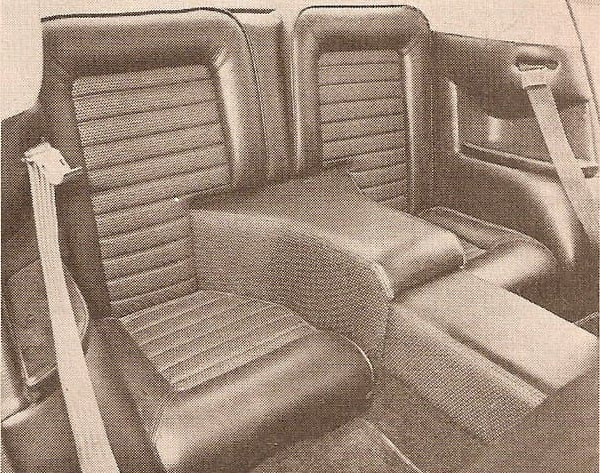
The Plus 2 can be considered either as a very comfortable two-seater or a cramped four-seater. The back seat, short of both head and knee room, is suitable for children up to their early teens; there is sufficient room for small adults on short trips. With only two occupants, advantage can be taken of the wide range of fore and aft seat movement, which proved more than adequate for all our staff drivers. The seats themselves are well-shaped to give support under the thighs, in the small of the back and under the shoulders, but are set rather low in the car. This eases the problem of entry, but makes for visibility problems for short drivers. In absolute terms, the Lotus is not a car which can be entered or left with real dignity.
Perhaps because of its newness, the test car had a rather poor low-speed ride, certainly harsher than we are accustomed to finding in Lotus products. It felt as though the dampers were responding rather harshly; presumably another thousand miles or so will soften them up a bit. The underlying quality of the springing was still impressive; once or twice we braced ourselves for an unavoidable pothole and found little or no shock passed through to the occupants. It was more a case of the car being constantly upset by the sort of frequently repaired, undulating surface one finds in many town side roads. At higher speeds, the ride became very much better and on a motorway the Plus 2 rides better than many saloon cars. This, plus the small roll angles when cornering, makes it reassuring for front seat passengers, who usually comment that the car does not seem to be going as fast as it really is.
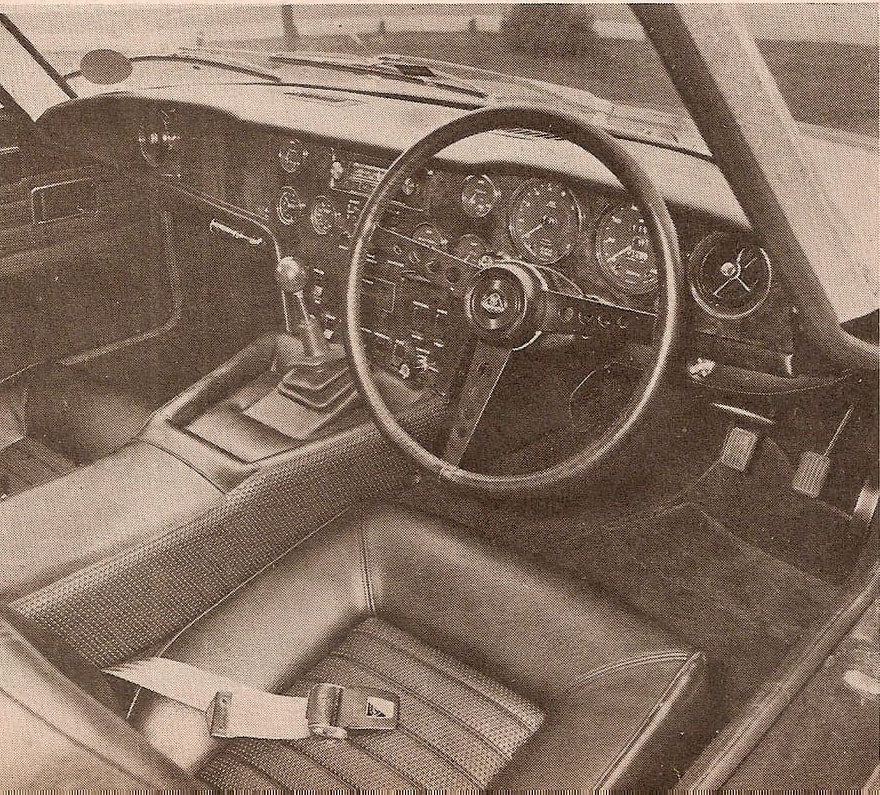
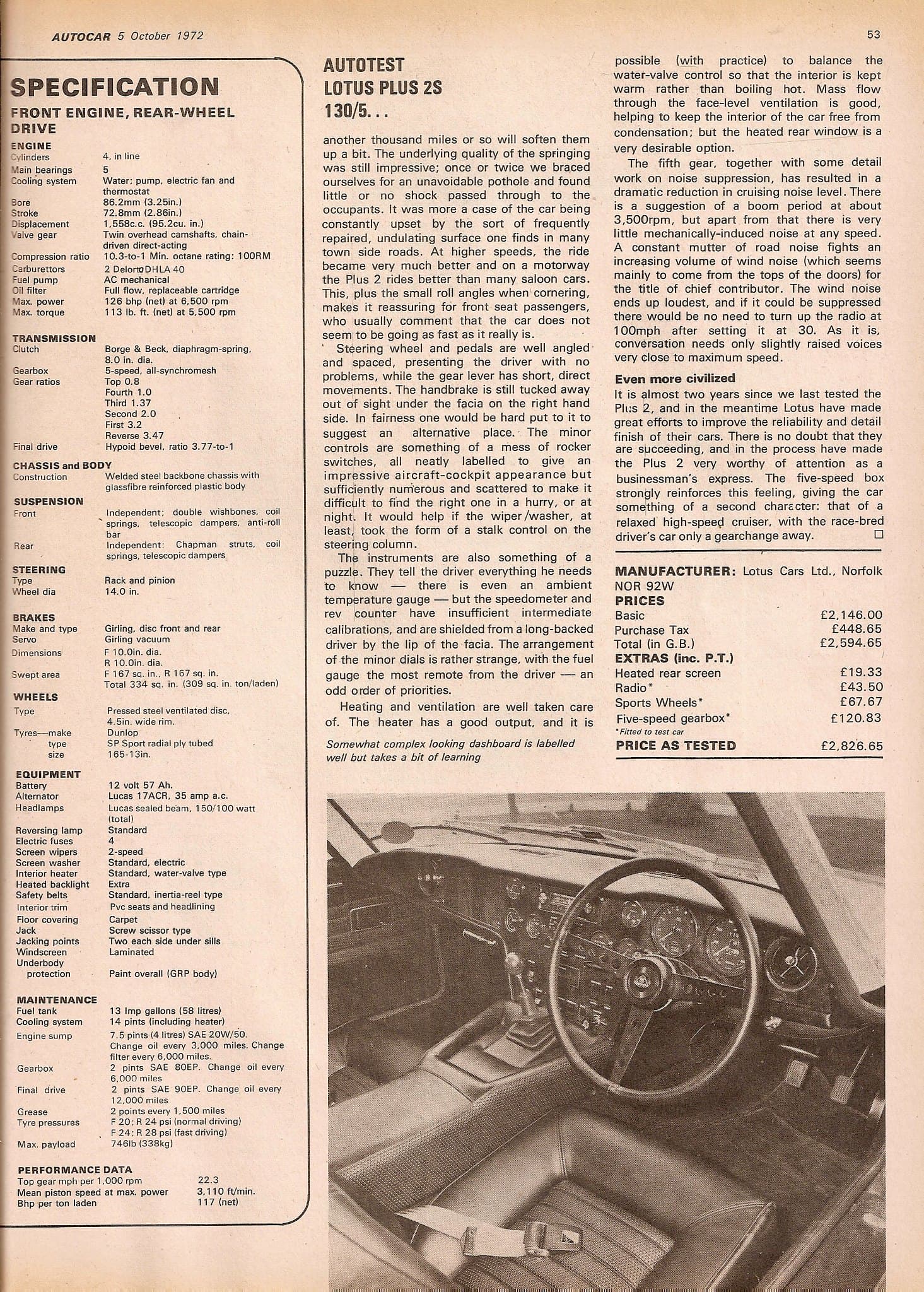
Steering wheel and pedals are well angled and spaced, presenting the driver with no problems, while the gear lever has short, direct movements. The handbrake is still tucked away out of sight under the facia on the right hand side. In fairness one would be hard put to it to suggest an alternative place. The minor controls are something of a mess of rocker switches, all neatly labelled to give an impressive aircraft-cockpit appearance but sufficiently numerous and scattered to make it difficult to find the right one in a hurry, or at night. It would help if the wiper/washer, at least, took the form of a stalk control on the steering column.
The instruments are also something of a puzzle. They tell the driver everything he needs to know — there is even an ambient temperature gauge — but the speedometer and rev counter have insufficient intermediate calibrations, and are shielded from a long-backed driver by the lip of the facia. The arrangement of the minor dials is rather strange, with the fuel gauge the most remote from the driver — an odd order of priorities.
Heating and ventilation are well taken care of. The heater has a good output, and it is possible (with practice) to balance the water-valve control so that the interior is kept warm rather than boiling hot. Mass flow through the face-level ventilation is good, helping to keep the interior of the car free from condensation; but the heated rear window is a very desirable option.
The fifth gear, together with some detail work on noise suppression, has resulted in a dramatic reduction in cruising noise level. There is a suggestion of a boom period at about 3,500rpm, but apart from that there is very little mechanically-induced noise at any speed. A constant mutter of road noise fights an increasing volume of wind noise (which seems mainly to come from the tops of the doors) for the title of chief contributor. The wind noise ends up loudest, and if it could be suppressed there would be no need to turn up the radio at 100mph after setting it at 30. As it is, conversation needs only slightly raised voices very close to maximum speed.
Even more civilized
It is almost two years since we last tested the Plus 2, and in the meantime Lotus have made great efforts to improve the reliability and detail finish of their cars. There is no doubt that they are succeeding, and in the process have made the Plus 2 very worthy of attention as a businessman’s express. The five-speed box strongly reinforces this feeling, giving the car something of a second character: that of a relaxed high-speed cruiser, with the race-bred driver’s car only a gearchange away.
Photo captions
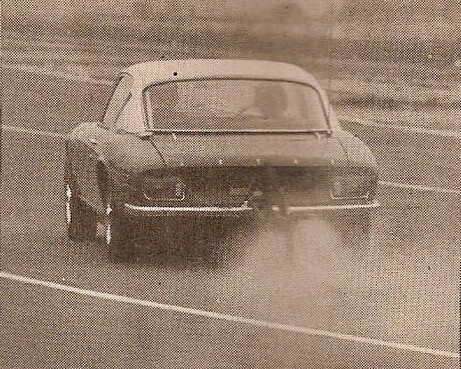
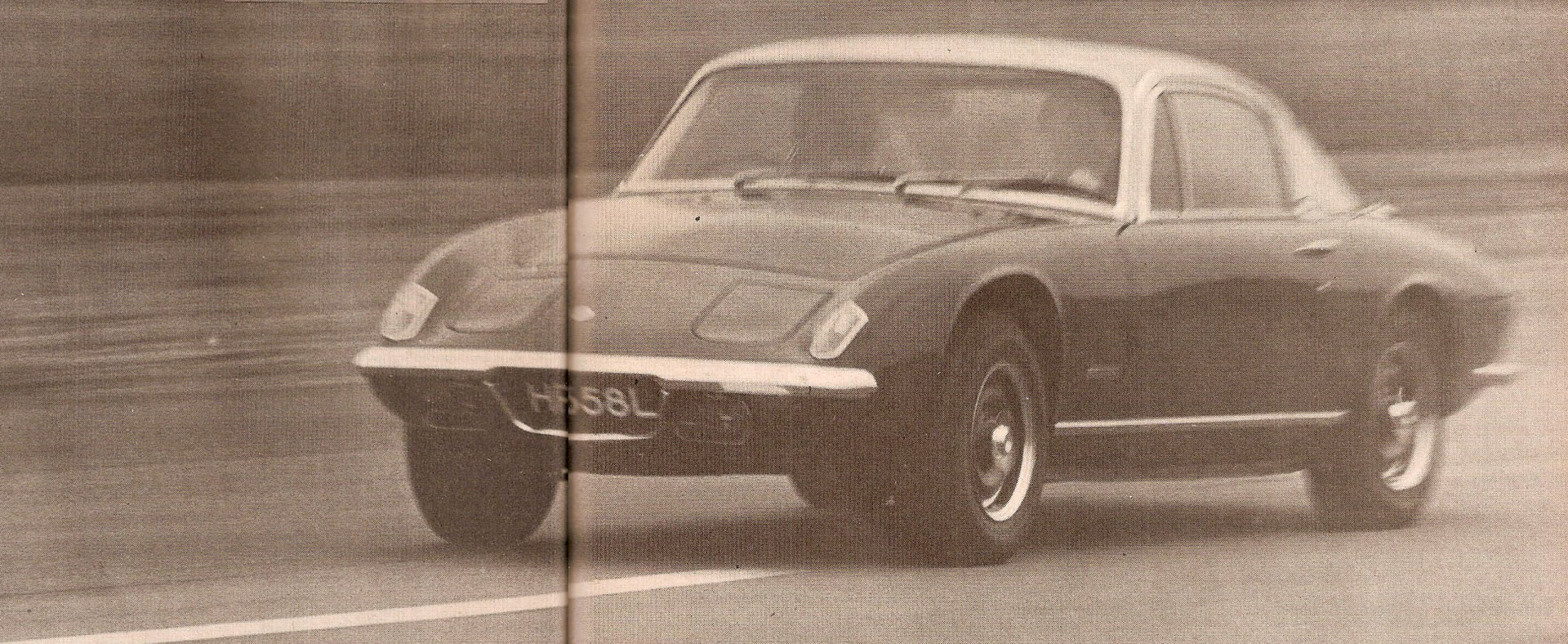
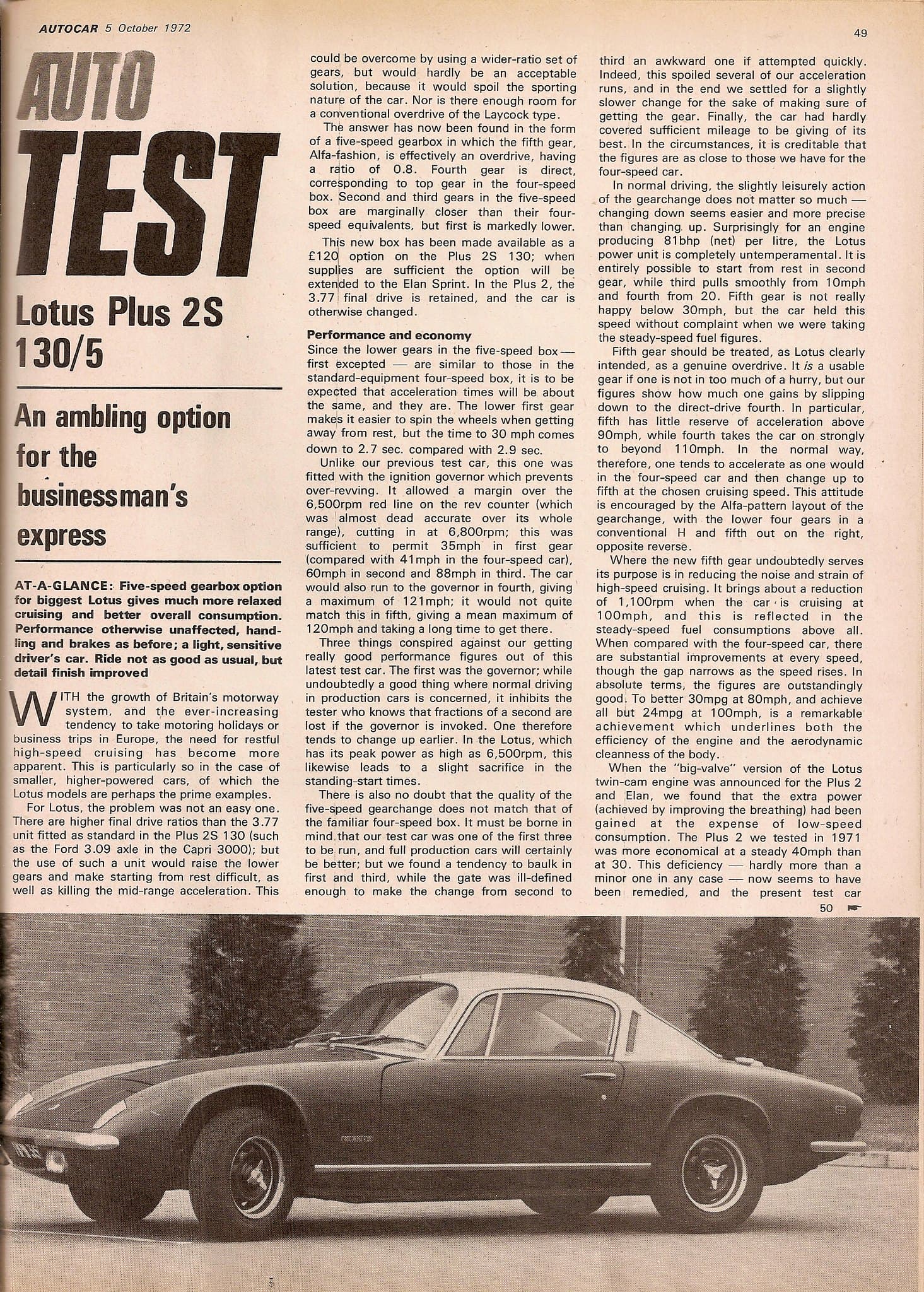
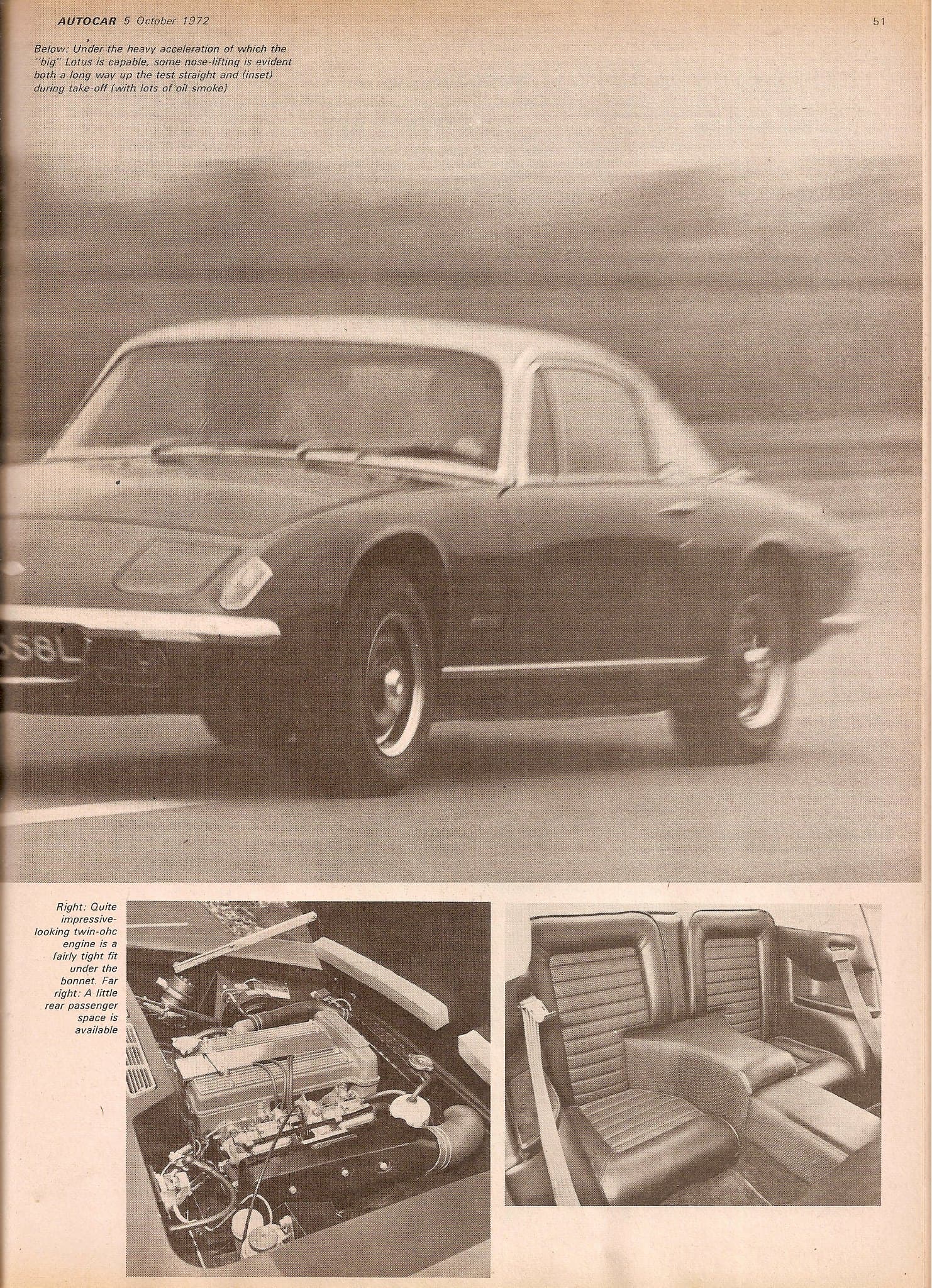
Below: Under the heavy acceleration of which the “big” Lotus is capable, some nose-lifting is evident both a long way up the test straight and (inset) during take-off (with lots of oil smoke)
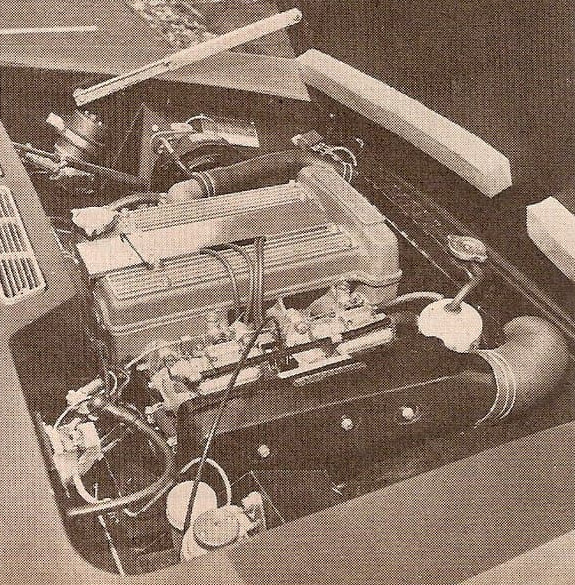
Right: Quite impressive-looking twin-ohc engine is a fairly tight fit under the bonnet.
Far right: A little rear passenger space is available.
Somewhat complex looking dashboard is labelled well but takes a bit of learning.
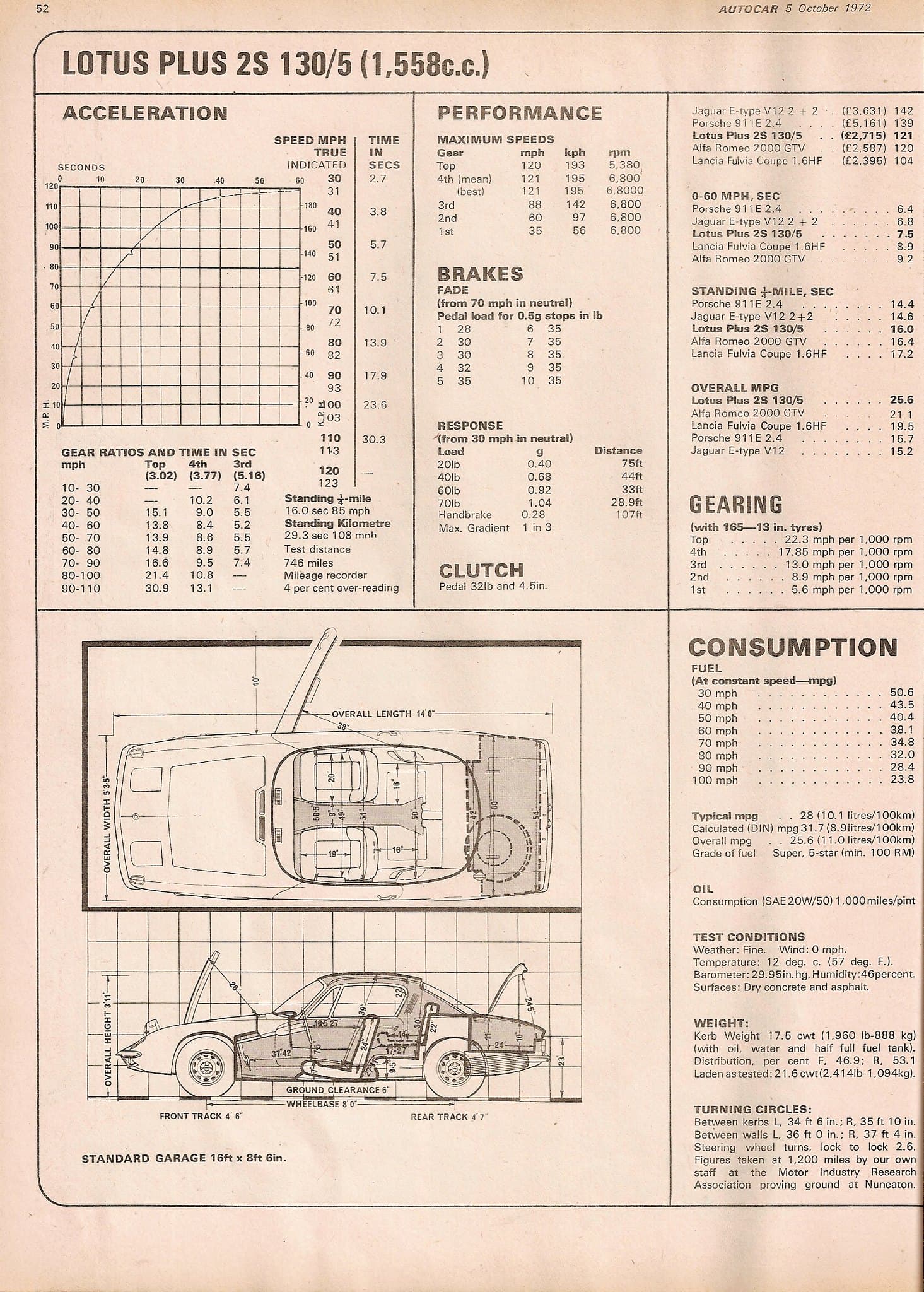
LOTUS PLUS 2S 130/5 (1,558c.c.) — Test Data
ACCELERATION
Gear ratios and time in sec
| mph | Top (3.02) | 4th (3.77) | 3rd (5.16) |
|---|---|---|---|
| 10–30 | — | — | 7.4 |
| 20–40 | — | 10.2 | 6.1 |
| 30–50 | 15.1 | 9.0 | 5.5 |
| 40–60 | 13.8 | 8.4 | 5.2 |
| 50–70 | 13.9 | 8.6 | 5.5 |
| 60–80 | 14.8 | 8.9 | 5.7 |
| 70–90 | 16.6 | 9.5 | 7.4 |
| 80–100 | 21.4 | 10.8 | — |
| 90–110 | 30.9 | 13.1 | — |
Standing ¼-mile: 16.0 sec 85 mph
Standing Kilometre: 29.3 sec 108 mph
Test distance: 746 miles
Mileage recorder: 4 per cent over-reading
Speeds in gears (mph, indicated):
| Speed | Time (secs) |
|---|---|
| 30 | 2.7 |
| 40 | 3.8 |
| 50 | 5.7 |
| 60 | 7.5 |
| 70 | 10.1 |
| 80 | 13.9 |
| 90 | 17.9 |
| 100 | 23.6 |
| 110 | 30.3 |
| 113 | — |
| 120 | — |
| 123 | — |
(True/indicated speed columns: 30/31, 40/41, 50/51, 60/61, 70/72, 80/82, 90/93, 100/03)
PERFORMANCE
Maximum speeds
| Gear | mph | kph | rpm |
|---|---|---|---|
| Top | 120 | 193 | 5,380 |
| 4th (mean) | 121 | 195 | 6,800 |
| 4th (best) | 121 | 195 | 6,800 |
| 3rd | 88 | 142 | 6,800 |
| 2nd | 60 | 97 | 6,800 |
| 1st | 35 | 56 | 6,800 |
BRAKES
Fade (from 70 mph in neutral)
Pedal load for 0.5g stops in lb
| Stop | lb | g | lb |
|---|---|---|---|
| 1 | 28 | 6 | 35 |
| 2 | 30 | 7 | 35 |
| 3 | 30 | 8 | 35 |
| 4 | 32 | 9 | 35 |
| 5 | 35 | 10 | 35 |
Response (from 30 mph in neutral)
| Load | g | Distance |
|---|---|---|
| 20lb | 0.40 | 75ft |
| 40lb | 0.68 | 44ft |
| 60lb | 0.92 | 33ft |
| 70lb | 1.04 | 28.9ft |
| Handbrake | 0.28 | 107ft |
| Max. Gradient | 1 in 3 |
CLUTCH
Pedal 32lb and 4.5in.
Comparisons
Price (£) and 0–60 mph (sec):
| Model | Price | 0–60 mph |
|---|---|---|
| Jaguar E-type V12 2+2 | £3,631 | 142 |
| Porsche 911E 2.4 | £5,161 | 139 |
| Lotus Plus 2S 130/5 | £2,715 | 121 |
| Alfa Romeo 2000 GTV | £2,587 | 120 |
| Lancia Fulvia Coupé 1.6HF | £2,395 | 104 |
0–60 MPH, SEC:
| Model | Secs |
|---|---|
| Porsche 911E 2.4 | 6.4 |
| Jaguar E-type V12 2+2 | 6.8 |
| Lotus Plus 2S 130/5 | 7.5 |
| Lancia Fulvia Coupé 1.6HF | 8.9 |
| Alfa Romeo 2000 GTV | 9.2 |
Standing ¼-mile, sec:
| Model | Secs |
|---|---|
| Porsche 911E 2.4 | 14.4 |
| Jaguar E-type V12 2+2 | 14.6 |
| Lotus Plus 2S 130/5 | 16.0 |
| Alfa Romeo 2000 GTV | 16.4 |
| Lancia Fulvia Coupé 1.6HF | 17.2 |
Overall MPG:
| Model | mpg |
|---|---|
| Lotus Plus 2S 130/5 | 25.6 |
| Alfa Romeo 2000 GTV | 21.1 |
| Lancia Fulvia Coupé 1.6HF | 19.5 |
| Porsche 911E 2.4 | 15.7 |
| Jaguar E-type V12 | 15.2 |
GEARING
(with 165–13 in. tyres)
| Gear | mph per 1,000 rpm |
|---|---|
| Top | 22.3 |
| 4th | 17.85 |
| 3rd | 13.0 |
| 2nd | 8.9 |
| 1st | 5.6 |
CONSUMPTION
Fuel (at constant speed — mpg)
| Speed | mpg |
|---|---|
| 30 mph | 50.6 |
| 40 mph | 43.5 |
| 50 mph | 40.4 |
| 60 mph | 38.1 |
| 70 mph | 34.8 |
| 80 mph | 32.0 |
| 90 mph | 28.4 |
| 100 mph | 23.8 |
Typical mpg: 28 (10.1 litres/100km)
Calculated (DIN) mpg: 31.7 (8.9 litres/100km)
Overall mpg: 25.6 (11.0 litres/100km)
Grade of fuel: Super, 5-star (min. 100 RM)
Oil: Consumption (SAE 20W/50) 1,000 miles/pint
TEST CONDITIONS
Weather: Fine. Wind: 0 mph.
Temperature: 12 deg. c. (57 deg. F.).
Barometer: 29.95in. hg. Humidity: 46 per cent.
Surfaces: Dry concrete and asphalt.
WEIGHT
Kerb weight 17.5 cwt (1,960 lb–888 kg) (with oil, water and half full fuel tank).
Distribution, per cent F, 46.9; R, 53.1
Laden as tested: 21.6 cwt (2,414lb–1,094kg).
TURNING CIRCLES
Between kerbs L, 34 ft 6 in.; R, 35 ft 10 in.
Between walls L, 36 ft 0 in.; R, 37 ft 4 in.
Steering wheel turns, lock to lock 2.6
Figures taken at 1,200 miles by our own staff at the Motor Industry Research Association proving ground at Nuneaton.
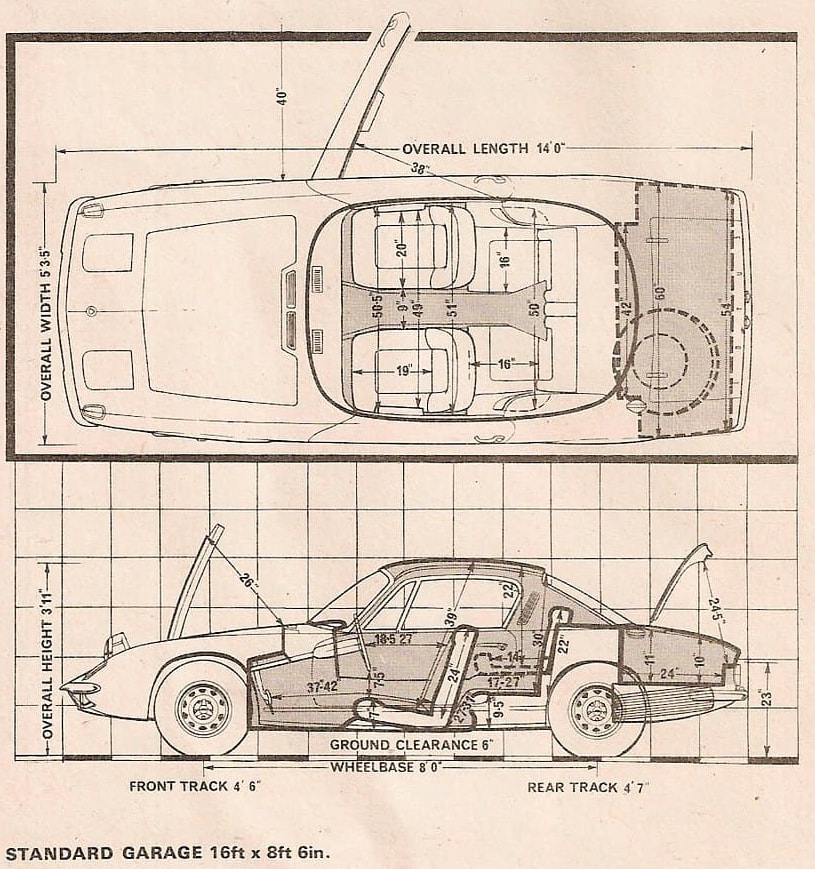
Dimensions
Overall length: 14ft 0in.
Overall width: 5ft 3.5in.
Overall height: 3ft 11in.
Ground clearance: 6in.
Wheelbase: 8ft 0in.
Front track: 4ft 6in.
Rear track: 4ft 7in.
Standard garage: 16ft × 8ft 6in.
SPECIFICATION
FRONT ENGINE, REAR-WHEEL DRIVE
Engine
| Cylinders | 4, in line |
| Main bearings | 5 |
| Cooling system | Water; pump, electric fan and thermostat |
| Bore | 86.2mm (3.25in.) |
| Stroke | 72.8mm (2.86in.) |
| Displacement | 1,558c.c. (95.2cu. in.) |
| Valve gear | Twin overhead camshafts, chain-driven direct-acting |
| Compression ratio | 10.3-to-1 Min. octane rating: 100RM |
| Carburettors | 2 Dellorto DHLA 40 |
| Fuel pump | AC mechanical |
| Oil filter | Full-flow, replaceable cartridge |
| Max. power | 126 bhp (net) at 6,500 rpm |
| Max. torque | 113 lb. ft. (net) at 5,500 rpm |
Transmission
| Clutch | Borge & Beck, diaphragm-spring, 8.0in. dia. |
| Gearbox | 5-speed, all-synchromesh |
| Gear ratios | Top 0.8 / Fourth 1.0 / Third 1.37 / Second 2.0 / First 3.2 / Reverse 3.47 |
| Final drive | Hypoid bevel, ratio 3.77-to-1 |
Chassis and Body
| Construction | Welded steel backbone chassis with glassfibre reinforced plastic body |
Suspension
| Front | Independent; double wishbones, coil springs, telescopic dampers, anti-roll bar |
| Rear | Independent; Chapman struts, coil springs, telescopic dampers |
Steering
| Type | Rack and pinion |
| Wheel dia | 14.0in. |
Brakes
| Make and type | Girling, disc front and rear |
| Servo | Girling vacuum |
| Dimensions | F 10.0in. dia. / R 10.0in. dia. |
| Swept area | F 167 sq. in., R 167 sq. in. / Total 334 sq. in. (309 sq. in. ton/laden) |
Wheels
| Type | Pressed steel ventilated disc, 4.5in. wide rim |
| Tyres — make | Dunlop |
| type | SP Sport radial ply tubed |
| size | 165–13in. |
Equipment
| Battery | 12 volt 57 Ah. |
| Alternator | Lucas 17ACR, 35 amp a.c. |
| Headlamps | Lucas sealed beam, 150/100 watt (total) |
| Reversing lamp | Standard |
| Electric fuses | 4 |
| Screen wipers | 2-speed |
| Screen washer | Standard, electric |
| Interior heater | Standard, water-valve type |
| Heated backlight | Extra |
| Safety belts | Standard, inertia-reel type |
| Interior trim | Pvc seats and headlining |
| Floor covering | Carpet |
| Jack | Screw scissor type |
| Jacking points | Two each side under sills |
| Windscreen | Laminated |
| Underbody protection | Paint overall (GRP body) |
Maintenance
| Fuel tank | 13 Imp gallons (58 litres) |
| Cooling system | 14 pints (including heater) |
| Engine sump | 7.5 pints (4 litres) SAE 20W/50. Change oil every 3,000 miles. Change filter every 6,000 miles. |
| Gearbox | 2 pints SAE 80EP. Change oil every 6,000 miles |
| Final drive | 2 pints SAE 90EP. Change oil every 12,000 miles |
| Grease | 2 points every 1,500 miles |
| Tyre pressures | F 20; R 24 psi (normal driving) / F 24; R 28 psi (fast driving) |
| Max. payload | 746lb (338kg) |
Performance Data
| Top gear mph per 1,000 rpm | 22.3 |
| Mean piston speed at max. power | 3,110 ft/min. |
| Bhp per ton laden | 117 (net) |
Manufacturer and Prices
MANUFACTURER: Lotus Cars Ltd., Norfolk NOR 92W
| Basic | £2,146.00 |
| Purchase Tax | £448.65 |
| Total (in G.B.) | £2,594.65 |
Extras (inc. P.T.):
| Heated rear screen | £19.33 |
| Radio* | £43.50 |
| Sports Wheels* | £67.67 |
| Five-speed gearbox* | £120.83 |
*Fitted to test car
PRICE AS TESTED: £2,826.65

Copyright by Autocar, Vol 137 No. 3988, October 5, 1972
COPYRIGHT NOTICE: This article is reproduced for non-commercial historical preservation purposes only. Copyright remains with the original publisher. If you are the rights holder and have questions or concerns about this content, please visit our Copyright and Historical Preservation Policy and contact us. We will respond within 24 business hours and will remove or restrict the content promptly upon a valid request.