Autocar Road Test No. 1988 — Lotus Elan 1600
AUTOCAR, 21 August 1964
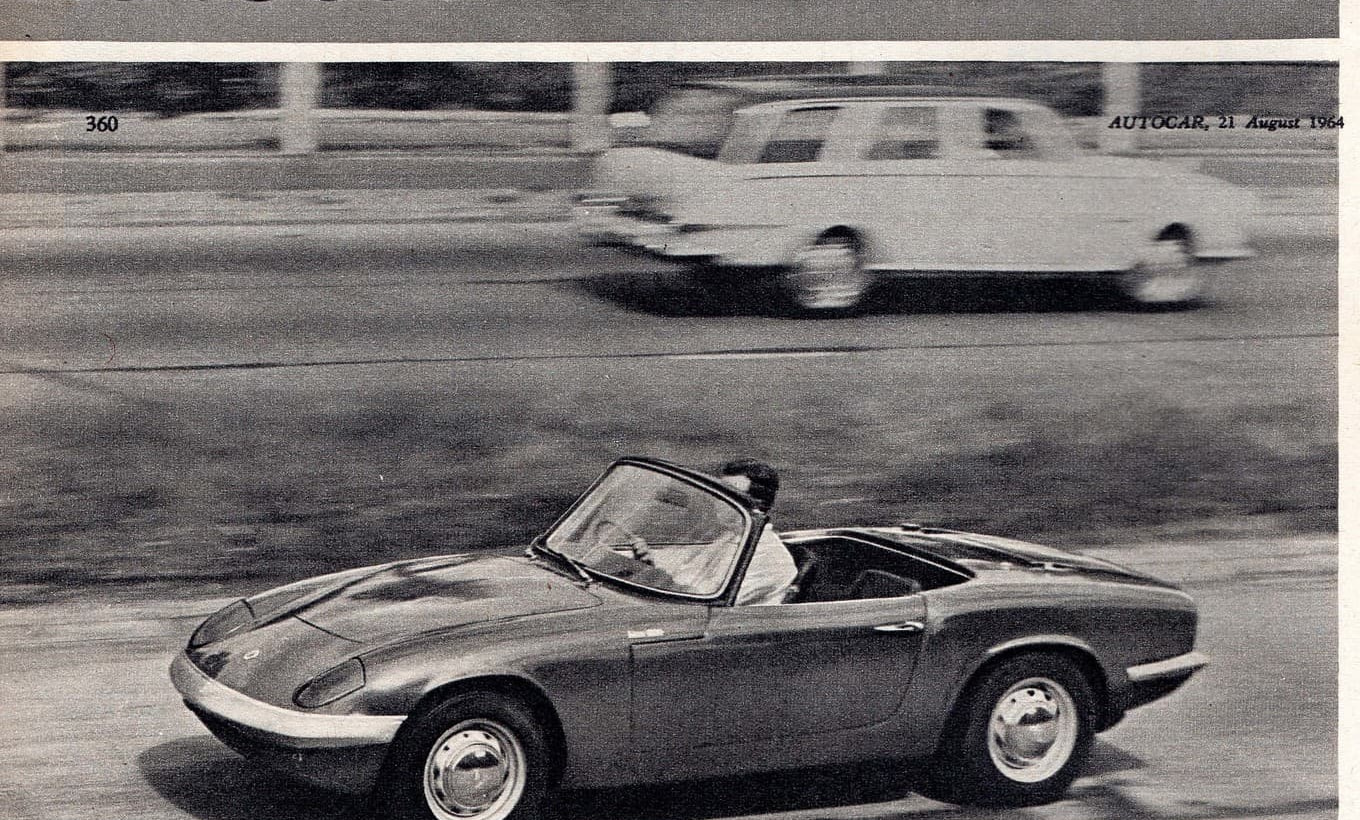
Lotus Elan 1600 — 1,558 c.c.
Make: LOTUS Type: Elan 1600 (1,558 c.c.) (Front engine, rear-wheel drive)
Manufacturer: Lotus Cars Ltd., Delamare Rd., Cheshunt, Hertfordshire.
NO ONE has succeeded in defining a sports car precisely; there are always marginal models and extremes within the acceptable band covered by the term, so one must qualify and explain. Without doubt the Elan is a sports car — thoroughbred because it owes its characteristics almost entirely to Lotus racing experience. In its construction, suspension, lightness and appearance it is very modern. With a mention of the twin-cam, twin Weber five main-bearing engine we complete a quick pen picture of a sports car built as such from scratch, by people who know what keen drivers want. But such a car, assembled in limited numbers, and well equipped, cannot be cheap.
The Elan was introduced nearly two years ago (with 1,499 c.c. engine) and a great deal of development and refining has gone on since then. In its superior fits and finish alone it shows an important advance over the Elite. A deep welded steel chassis, almost cruciform, but with a short central backbone section, gives a very strong and rigid basis upon which the reinforced plastic body is mounted. Over rough roads there is no apparent body shake and the very minimum of movement around the doors.
Similar in most respects to the racing suspensions, that of the Elan, even so, is far from stiff by sports car standards. At the front there are wishbones and coil springs; at the rear, unusually wide lower wishbones and above them, Chapman struts with coil springs and inner Aeon rubber buffers. The rear suspension has ample travel and will “bottom,” only when heavily loaded over very bad surfaces. On one of our regular continental-type test sections of road, which is heavily cambered, undulating and in places covered with minor depressions, the Elan gave a gentler, less disturbed ride at speed and held its heading better than any other sports car we can recall. Gone are the days when a suspension had to be stiffened right up to get good road-holding. The full 6in. of ground clearance is a real advantage.
On more normal roads, the adhesion is well above average and the cornering power almost uncanny. With tyre pressures set for fast driving (22 p.s.i. front, 26 p.s.i. rear) cornering is beautifully balanced, and if pushed to the limits on a track, the tyres begin to slide very gently. The driver has time to react, and with the aid of the throttle or steering, to decide which end shall drift first or most.
Another inheritance from racing relations is the quick, light steering. For those unaccustomed to these qualities it takes a few miles to get used to them, but all our drivers praised the steering highly and approved the diminutive 15in. steering wheel. The steering column is telescopic and collapsible as a safety measure.
As one would expect the car owes a good deal of its attraction to the twin-cam Ford-Lotus engine, now of 1,558 c.c. capacity. This is remarkably tractable, docile at slow speeds, quiet and with the pull of a lion from 2,000 to 6,500 r.p.m. in top gear. Perhaps the present standard gear ratios are not ideal for road work but they are satisfactory. We would prefer a slightly lower bottom gear (which should be easier on the clutch) and a higher top. The one gives a maximum usable speed of 42 m.p.h., the other requires nearly 6,000 r.p.m. to cruise at 100 m.p.h.
The car is a fraction faster with the hood up than with it down, and wind roar builds up considerably over about 80 m.p.h. The hood itself remains taut and scarcely flaps even at high speeds. Only at wide throttle openings is the exhaust heard clearly; most of the time the note is unusually subdued.
The engine in the test car is smooth throughout its range. It has practically run out of breath at 6,900 r.p.m. and there are no apparent peaks or troughs in the torque or power curves. When timing accelerations there was no advantage in holding an intermediate gear above 6,000 r.p.m., and, in fact, as an example 70 to 90 m.p.h. takes 0·6sec less in top than in third.
Because cars may get into inexperienced hands, the Elan (like the Cortina Lotus) is delivered with a special rotor arm in the distributor incorporating a cut-out governor set to operate at 6,600 r.p.m. — the start of the red zone on the rev counter. This is to prevent anyone from driving for long periods at 7,000 r.p.m. in top or exceeding the absolute limit of about 7,500 r.p.m. in the intermediate gears, either of which might well damage the engine. For those who know what they are about the special rotor arm can simply be exchanged for an ordinary one, and up to 7,000 r.p.m. used with discretion. An engine damaged through over-speeding would not be covered by the warranty. The test car did not have a governor and the maximum speeds in the intermediate gears are at an indicated 7,000 r.p.m.
The Elan’s top speed with 3·9 to 1 final drive is 115 m.p.h. at an engine speed of 6,950 r.p.m. At a governed 6,600 r.p.m. the speed would be approximately 108 m.p.h. in top and 85 m.p.h. in third. The fitting of Dunlop SP41 tyres, optional extras which suit the car very well, gives a smaller rolling radius, and reduces the advertised 17·1 m.p.h. per 1,000 r.p.m. in top gear. This accounts for the slight discrepancy in indicated and calculated r.p.m., and for some of the speedometer error of the test car.
From cold the engine is an instant starter, usually requiring little or no choke; when hot it often takes a number of turns to fire.
All the forward gears are synchronised, so first can be used regularly without a thought about the change-down. The changes are a bit notchy (the car had done only 2,000 miles) but can be made very precisely and quickly. Reverse was sometimes rather difficult to engage.
The combination of a lusty engine, quick gearbox and a light car give an exhilarating performance as may be seen from the measured performance figures. Add the comfort and the precision of control, and you have the ingredients for remarkably rapid and relaxed journeys. The smallest open stretch permits quick, safe overtaking.
Maximum speed and high cruising speeds are quite sufficient for most owners, but they could be more pleasant if achieved at lower r.p.m. This might also further improve the high-speed petrol consumption. While a figure of 28–30 m.p.g. for normal give-and-take journeys is very good, it increases steeply for continuous speeds, from 39 m.p.g. at 60 m.p.h. to 24 m.p.g. at 80 m.p.h. The tank holds 10 Imp. gallons so journey range should be over 250 miles between fill-ups. The carburettor settings may vary a little and Lotus tell us that Elans set on the rich side accelerate a fraction faster than the test car but use a little more fuel.
Oil consumption increased when the car was driven hard for long periods and on motorways, the oil pressure, which starts at about 35 p.s.i., dropped to 28–30 p.s.i. The water temperature rose to 90deg on hot days, but never higher. Normally little oil is used and the water temperature stays at about 80deg C. For the whole test, the oil consumption was at the rate of 1,800 m.p.g.
A characteristic which bothered us at times is the springiness in the transmission. In slow traffic, or when reversing, it was hard to prevent snags, leading sometimes to judder, like that in some front-drive and some rear-engined cars with short halfshafts and no prop shaft. In the Elan this is a penalty among advantages for having Metalastik rubber couplings at both ends of each half-shaft.
The Girling disc brakes (9·5in. front, 10in. rear) are of generous size for the weight of the car. They do not seem to need servo assistance and during our test always gave the driver confidence in their power. When braking very hard, the car showed no inclination to slew round. After repeated stops from 80 m.p.h. the brakes naturally became very hot but there was no fading.
There were mixed feelings about the appearance of the instrument panel, some saying that the layout is bitty and the woodwork amateurish. We understand that the current panel may not be the last word. In contrast everyone on our staff approved the shape and comfort of the bucket seats; they really locate the driver and passenger, and support the body correctly. There is also sufficient adjustment to provide comfortable stretch for a six-footer. The mechanism has a front link that causes the seat to rise and tip slightly forward when positioned for short drivers.
The pedals are not quite so good, being too close together and allowing no parking space for the clutch foot. Except that the accelerator has a rather long movement and a heavy return spring, the operation of the pedals was satisfactory. The clutch has a short, positive engagement which caused some first-time drivers to stall. In fact, it is not too abrupt and is soon found to suit the car well.
Small refinements are the provision of a lockable cubby-hole in front of the passenger, a cigarette lighter on the panel, ashtrays in each door, and concealed headlamps which open up with the aid of a vacuum cylinders.
These lamps have a flasher switch which operates automatically when they are exposed until they are also switched on to “steady” for night use. The beams have adequate spread and range. Apart from being neat and clean the retractable lamps permit a low wing line while still complying with height regulations at night. They also allow an excellent view out over the low, clean nose of the car. It would not be too difficult to separate the operating mechanisms and fit an extra switch so as to be able to wink one eye!
A useful moulded tray is provided on top of the transmission hump and around the gear lever. The door trim is neat, a map-cum-courtesy lamp is provided on the panel, and below it a radio.
The detachable hood is original and ingenious in its design, and can be put up easily in a couple of minutes or removed even quicker. The structure depends upon two substantial plastic side members like boomerangs, which are located by metal pegs at each end, and form a frame round the top and back of the side windows, similar to that of a closed car. Two separate transverse hoops, the rear one of which swings up to tension the hood, complete the frame-work. When not in use the bits can be strapped away in the boot, and a neat tonneau cover may be bought as an extra.
Side windows of laminated glass slide up or down, but have no winders. They are accurately guided and supported by plated metal channels at the front edges of the doors. They remain firm if kept up when the hood is off. Thanks mainly to these glass windows with their rigid frames, the car with hood up is well sealed against rain and is surprisingly free from draughts. We drove through a heavy storm at speed without any water entering the car. The wipers and washer do their jobs except at the curved extremities of the screen, which the blades cannot follow.
If the side windows are opened to increase fresh air flow there is a good deal of additional noise and draughts at head level. With windows shut, quite a lot of cold (or hot) air comes in through the heater ducts so some must also be escaping — probably under the back edges of the hood.
When the car is open there is little wind buffeting over or round the screen until about 80 m.p.h. is reached; above this speed it increases. Open or closed, the radio can be heard easily up to about 70 m.p.h.
Another interesting design detail is the attachment of the plastic engine-hatch. This has two catches at the rear edge, released by twin toggles on the instrument panel. At the front corners, curved runners turn and slide in matching sockets into which they are pulled by a tension coil spring at each side. There are no hinges, and if the two springs are unhooked the hatch will lift off. When released by the toggles, the hatch conveniently opens up under the action of the same two springs.
Although the heater/demister unit seems very effective so far as could be judged in summer weather, its outlets at each side of the central panel, with small individual flaps, are not neat. What is more, they are sharp-cornered and at knee level. The grilles for the screen demisting, on the top of the resilient coaming, between which is the radio speaker, are very neat. In general, the cockpit is tidy and the moulded floor and side coverings are practical and fit well.
For a small sports car luggage accommodation is generous. Apart from the area behind the seats (the battery is mounted in a case in the left-hand well) in which a grown-up could sit crosswise for a short lift, there is a boot fit for one large or two small suitcases. Beneath the boot floor are the spare wheel and the fuel tank.
The engine compartment is tidily arranged and the upper parts keep clean. The only inaccessible component is the distributor which is tucked away under the front Weber. It can be reached without too much trouble, but it is a dirty and fiddly business.
To those with misgivings about the durability, and thus the value for money, of the Lotus Elan, we can only say at this stage that the car seems much stronger and better-made than some of its predecessors.
Anyone to whom the Elan is likely to appeal should try to arrange a trial run because this is very much a driver’s car. The advantages, and the effects on handling, of it being 400–500lb lighter than competitive, though mainly cheaper, models on the market, should be experienced as well as read about.
Prices
| Item | £ | s | d |
|---|---|---|---|
| Two-seater coupé | 1,148 | 0 | 0 |
| Purchase tax | 239 | 14 | 7 |
| Total (in G.B.) | 1,387 | 14 | 7 |
Extras (inc. P.T.)
| Extra | £ | s | d |
|---|---|---|---|
| Tonneau Cover | 11 | 15 | 7 |
| Hardtop | 68 | 0 | 0 |
| S.P. Tyres | 10 | 5 | 5 |
| Radio (Radiomobile) | 37 | 0 | 0 |
| Oil Cooler | 15 | 0 | 0 |
| Close ratio gearbox | 35 | 0 | 0 |
| Heater | 21 | 0 | 0 |
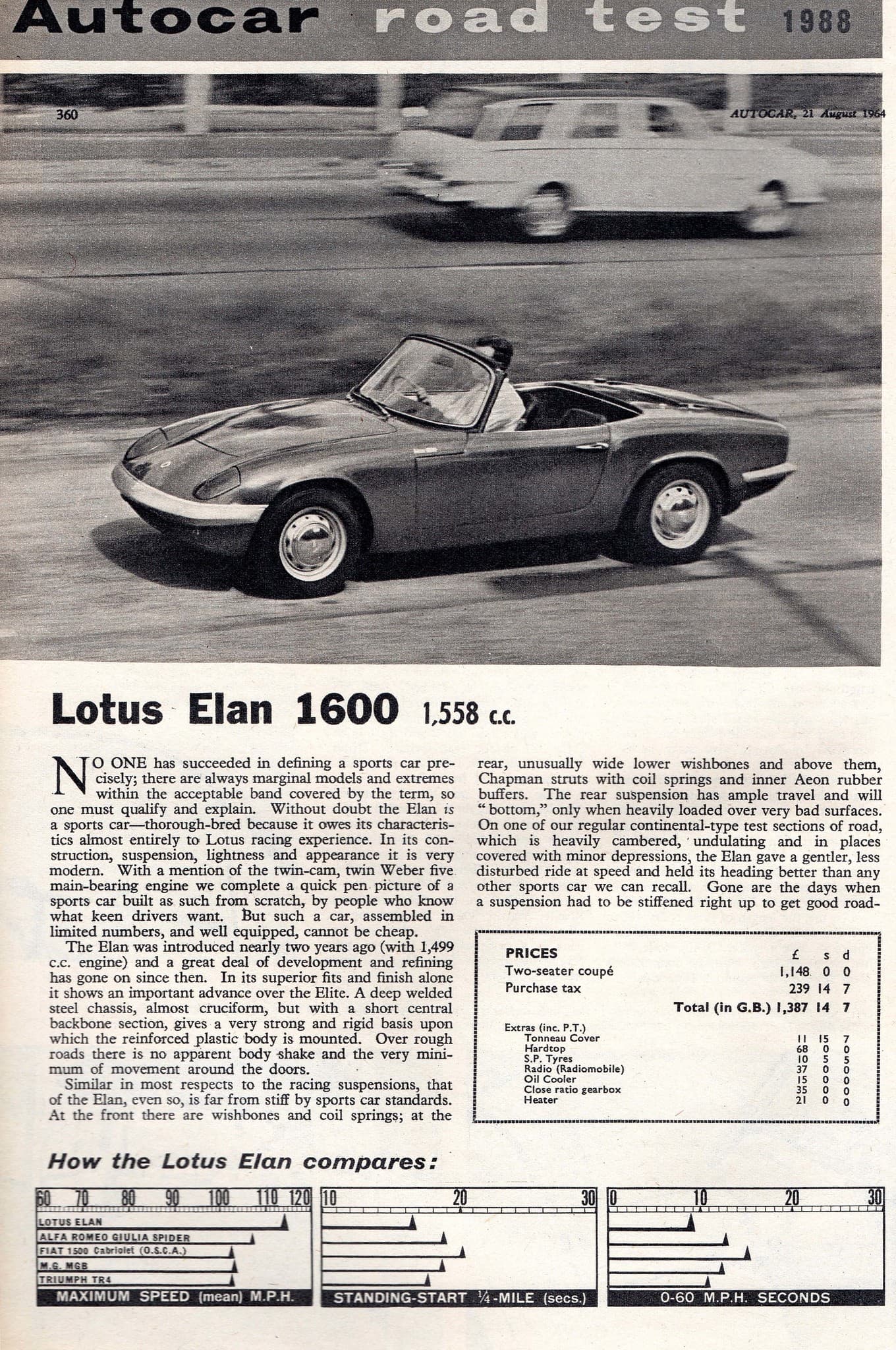
How the Lotus Elan Compares

Comparators: Lotus Elan, Alfa Romeo Giulia Spider, Fiat 1500 Cabriolet (O.S.C.A.), M.G. MGB, Triumph TR4
Test Conditions & Technical Data
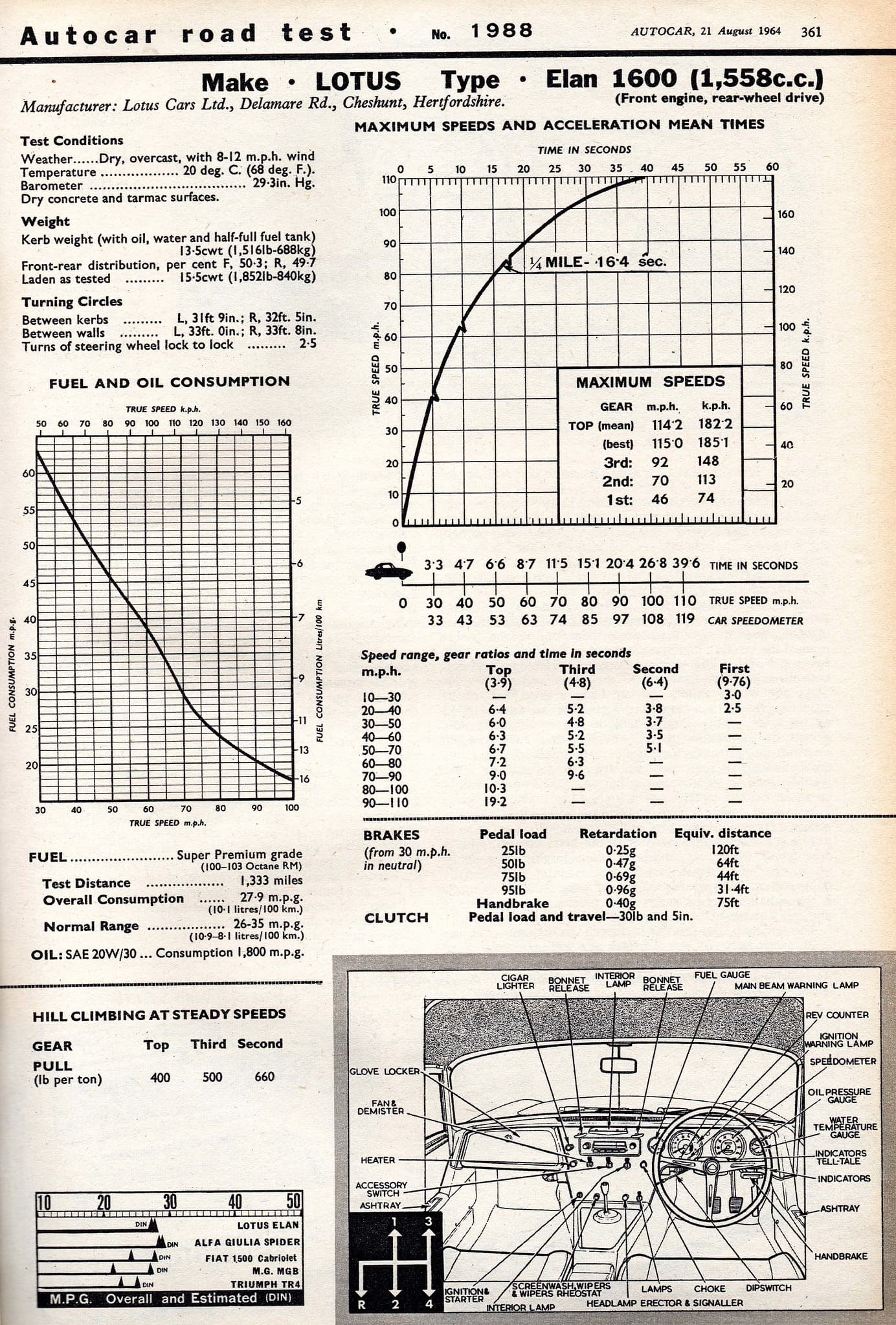
Test Conditions
- Weather: Dry, overcast, with 8–12 m.p.h. wind
- Temperature: 20 deg. C. (68 deg. F.)
- Barometer: 29·3in. Hg.
- Dry concrete and tarmac surfaces.
Weight
- Kerb weight (with oil, water and half-full fuel tank): 13·5cwt (1,516lb–688kg)
- Front-rear distribution, per cent F. 50·3; R. 49·7
- Laden as tested: 15·5cwt (1,852lb–840kg)
Turning Circles
- Between kerbs: L. 31ft 9in.; R. 32ft. 5in.
- Between walls: L. 33ft. 0in.; R. 33ft. 8in.
- Turns of steering wheel lock to lock: 2·5
Maximum Speeds and Acceleration
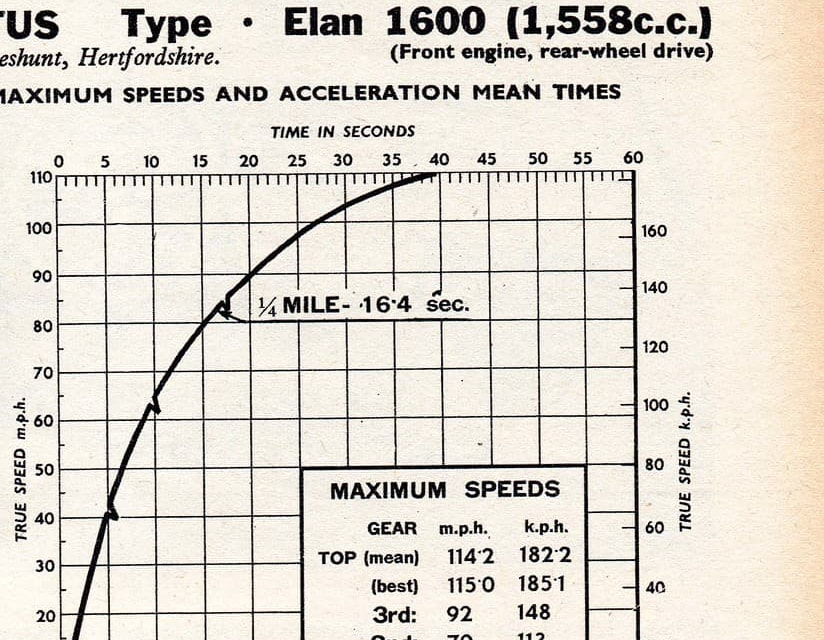
Maximum Speeds
| Gear | m.p.h. | k.p.h. |
|---|---|---|
| TOP (mean) | 114·2 | 182·2 |
| (best) | 115·0 | 185·1 |
| 3rd | 92 | 148 |
| 2nd | 70 | 113 |
| 1st | 46 | 74 |
¼ Mile: 16·4 sec.
Time in seconds from rest: 3·3 — 4·7 — 6·6 — 8·7 — 11·5 — 15·1 — 20·4 — 26·8 — 39·6
| True Speed m.p.h. | 0 | 30 | 40 | 50 | 60 | 70 | 80 | 90 | 100 | 110 |
|---|---|---|---|---|---|---|---|---|---|---|
| Car Speedometer | 33 | 43 | 53 | 63 | 74 | 85 | 97 | 108 | 119 | — |
Speed Range, Gear Ratios and Time in Seconds
| m.p.h. | Top (3·9) | Third (4·8) | Second (6·4) | First (9·76) |
|---|---|---|---|---|
| 10–30 | — | — | — | 3·0 |
| 20–40 | 6·4 | 5·2 | 3·8 | 2·5 |
| 30–50 | 6·0 | 4·8 | 3·7 | — |
| 40–60 | 6·3 | 5·2 | 3·5 | — |
| 50–70 | 6·7 | 5·5 | 5·1 | — |
| 60–80 | 7·2 | 6·3 | — | — |
| 70–90 | 9·0 | 9·6 | — | — |
| 80–100 | 10·3 | — | — | — |
| 90–110 | 19·2 | — | — | — |
Fuel and Oil Consumption
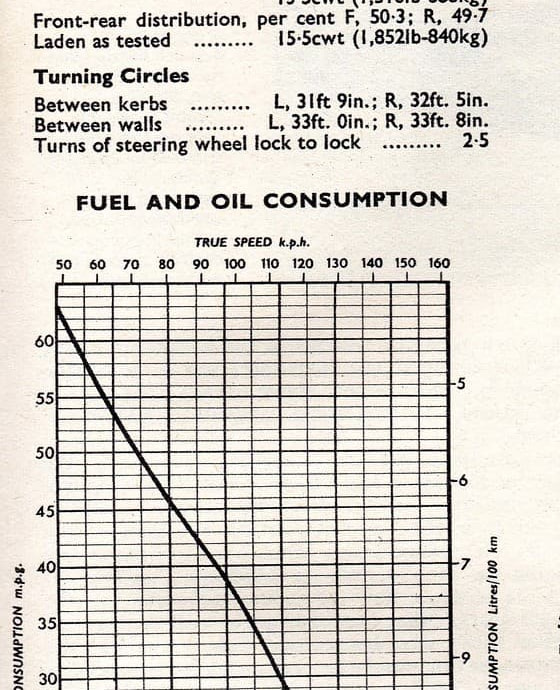
- Fuel: Super Premium grade (100–103 Octane RM)
- Test Distance: 1,333 miles
- Overall Consumption: 27·9 m.p.g. (10·1 litres/100 km.)
- Normal Range: 26–35 m.p.g. (10·9–8·1 litres/100 km.)
- OIL: SAE 20W/30 … Consumption 1,800 m.p.g.
Hill Climbing at Steady Speeds
| Gear | Pull (lb per ton) |
|---|---|
| Top | 400 |
| Third | 500 |
| Second | 660 |
Brakes & Clutch
| Pedal Load (from 30 m.p.h. in neutral) | Retardation | Equiv. Distance |
|---|---|---|
| 25lb | 0·25g | 120ft |
| 50lb | 0·47g | 64ft |
| 75lb | 0·69g | 44ft |
| 95lb | 0·96g | 31·4ft |
| Handbrake | 0·40g | 75ft |
CLUTCH: Pedal load and travel — 30lb and 5in.
MPG Comparison
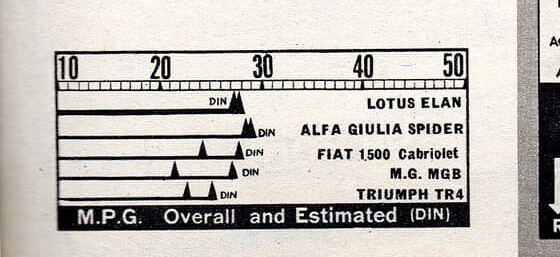
Comparators: Lotus Elan, Alfa Giulia Spider, Fiat 1500 Cabriolet, M.G. MGB, Triumph TR4
Controls and Instruments
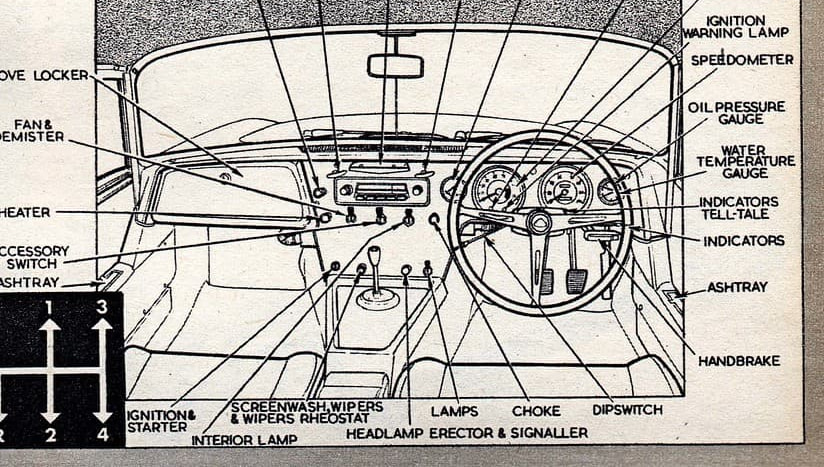
Key controls identified: Cigar lighter, Bonnet release (×2), Interior lamp, Fuel gauge, Main beam warning lamp, Rev counter, Ignition warning lamp, Speedometer, Oil pressure gauge, Water temperature gauge, Indicators tell-tale, Indicators, Ashtray, Handbrake, Heater, Accessory switch, Fan & demister, Glove locker, Ignition/starter, Interior lamp, Screenwash/wipers & wipers rheostat, Headlamp erector & signaller, Lamps, Choke, Dipswitch
Interior & Body
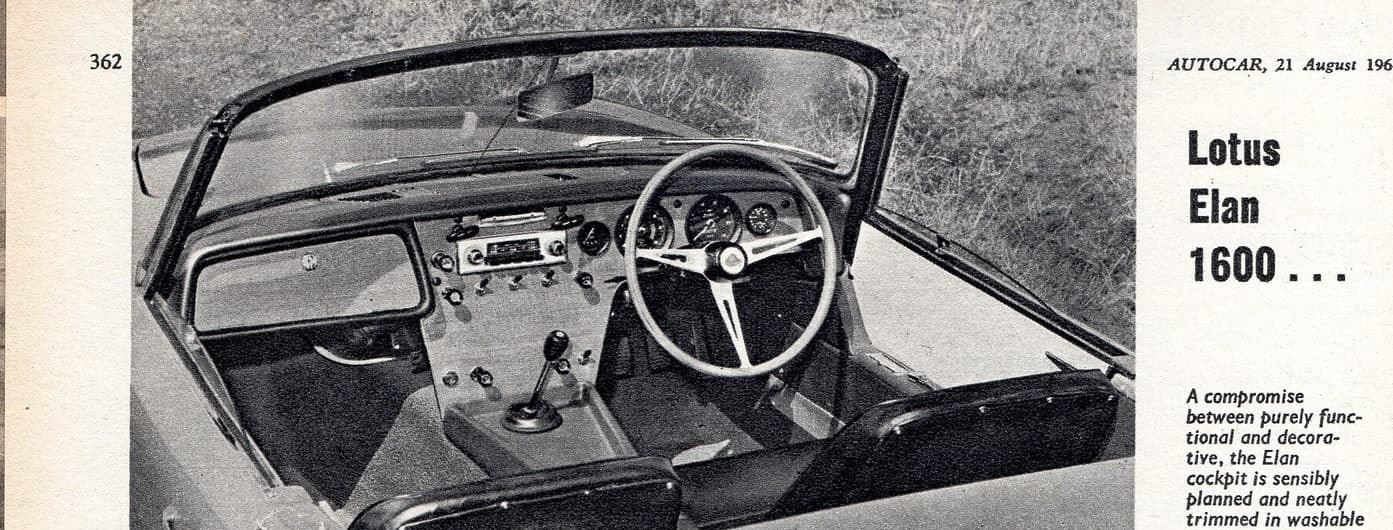
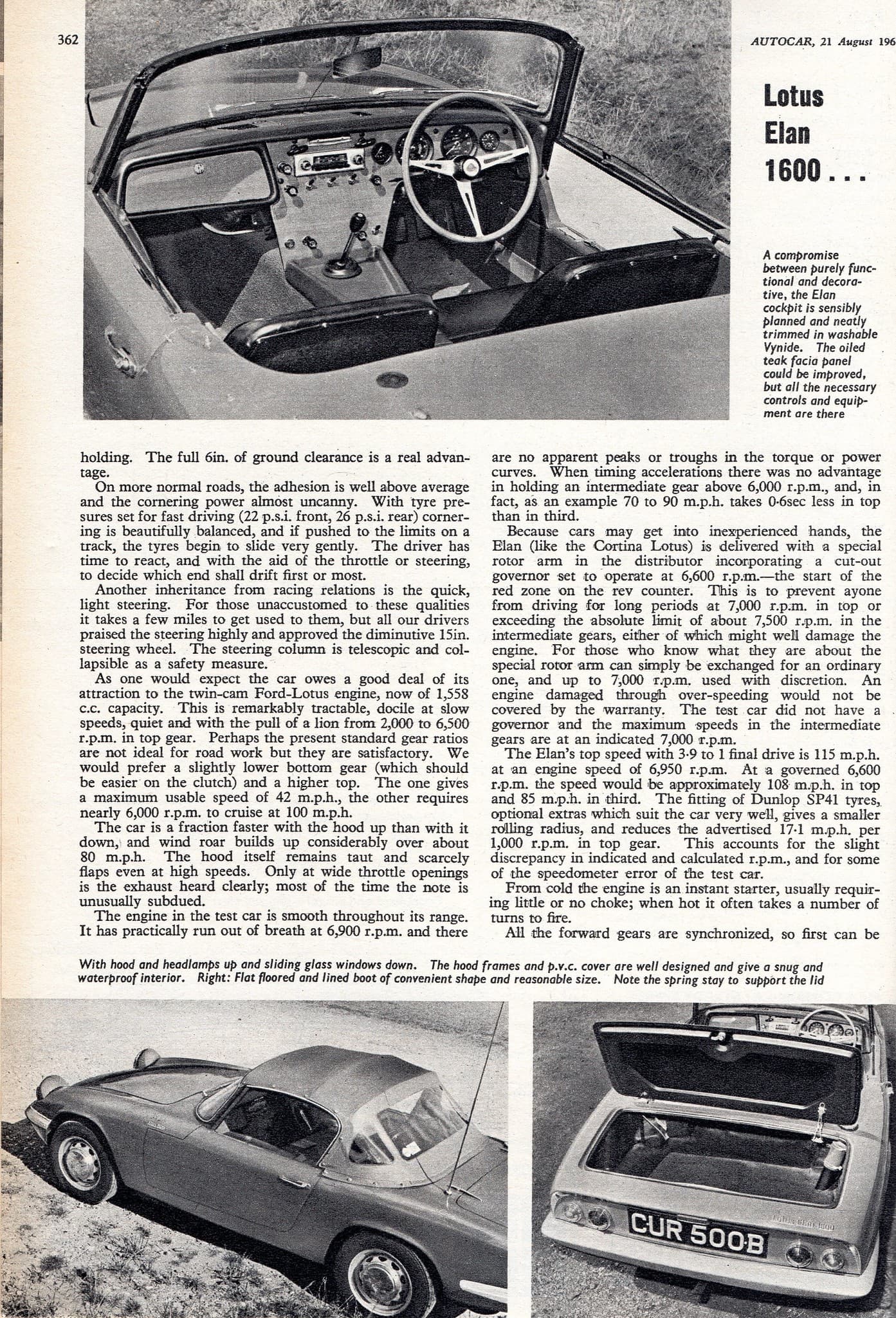
A compromise between purely functional and decorative, the Elan cockpit is sensibly planned and neatly trimmed in washable Vynide. The oiled teak facia panel could be improved, but all the necessary controls and equipment are there.
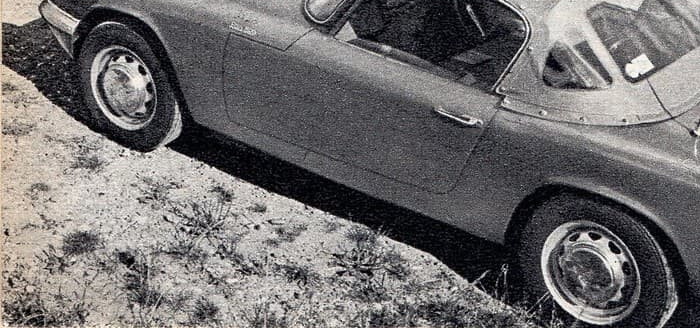
With hood and headlamps up and sliding glass windows down. The hood frames and p.v.c. cover are well designed and give a snug and waterproof interior.
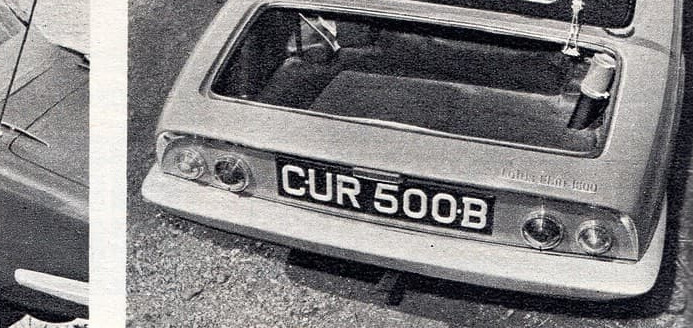
Flat floored and lined boot of convenient shape and reasonable size. Note the spring stay to support the lid.
Exterior
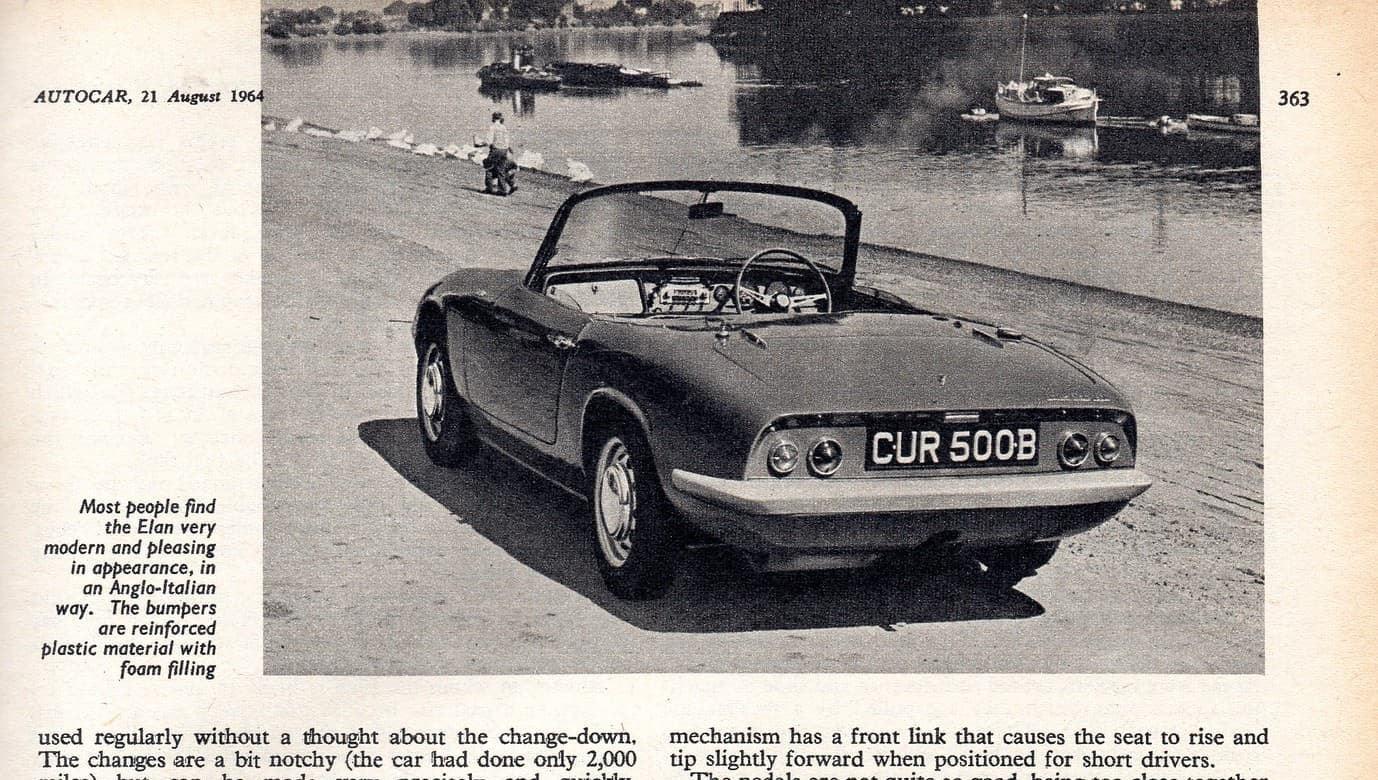
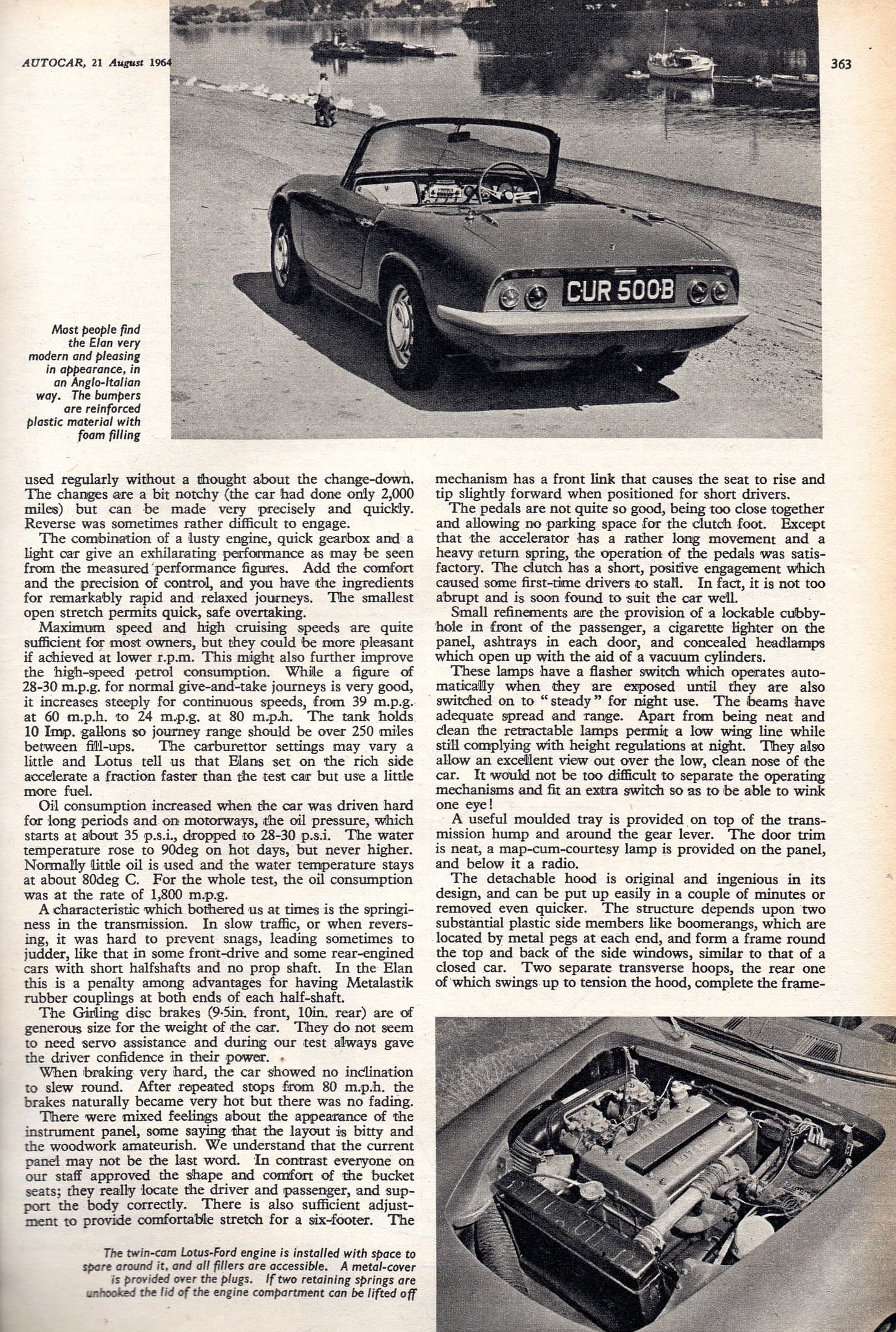
Most people find the Elan very modern and pleasing in appearance, in an Anglo-Italian way. The bumpers are reinforced plastic material with foam filling.
Engine Compartment
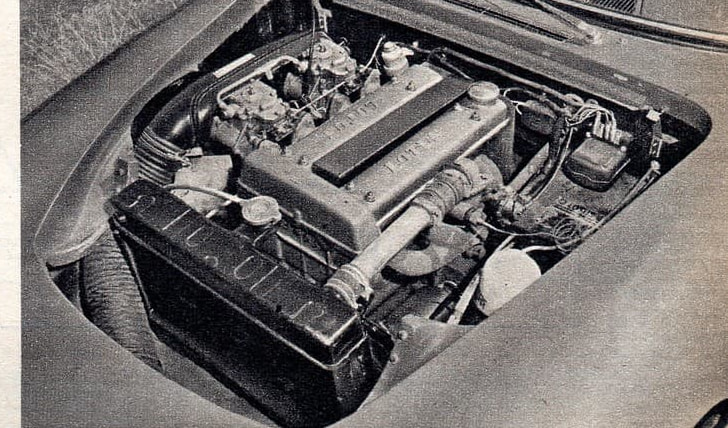
The twin-cam Lotus-Ford engine is installed with space to spare around it, and all fillers are accessible. A metal cover is provided over the plugs. If two retaining springs are unhooked the lid of the engine compartment can be lifted off.
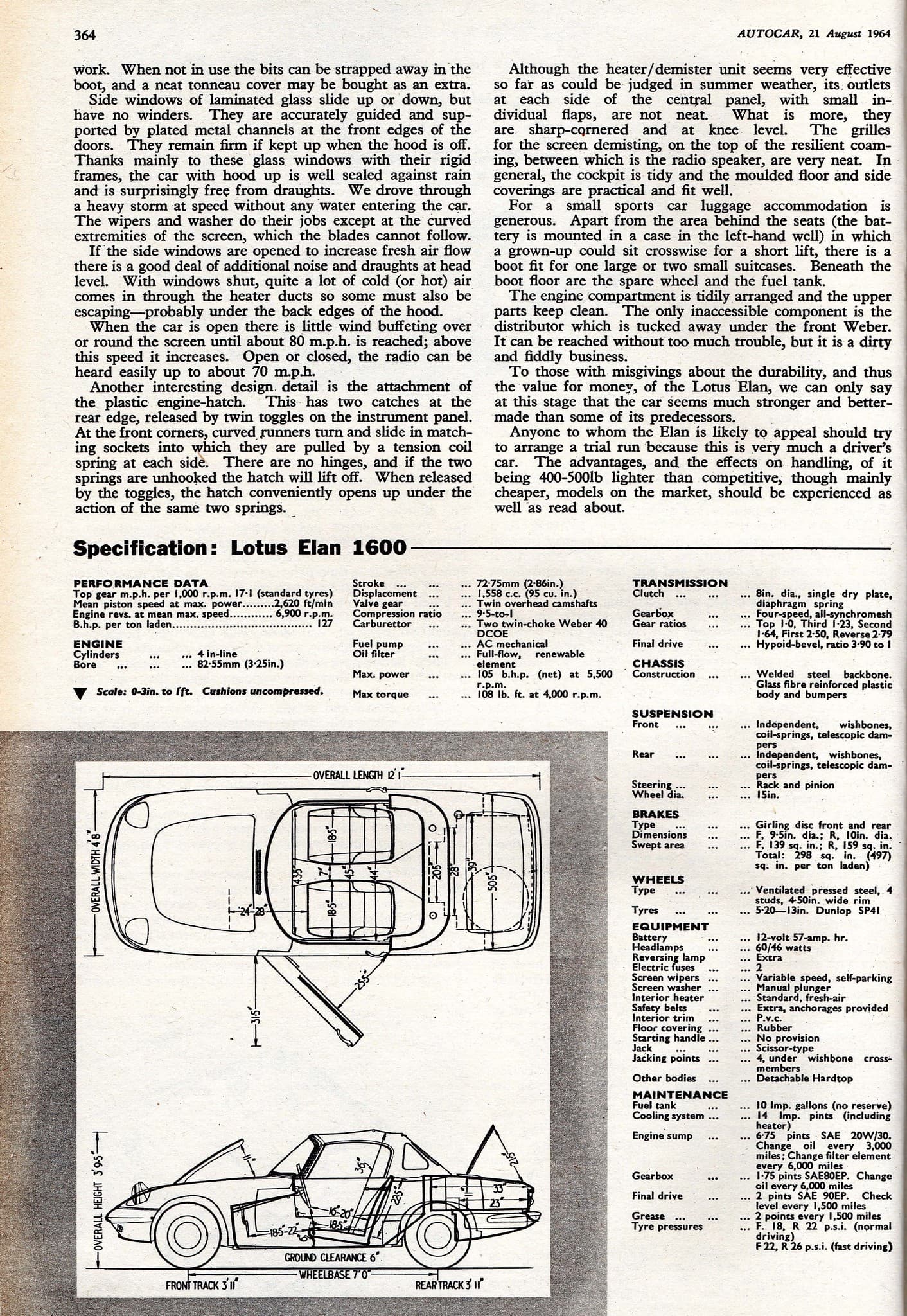
Specification: Lotus Elan 1600
Performance Data
- Top gear m.p.h. per 1,000 r.p.m.: 17·1 (standard tyres)
- Mean piston speed at max. power: 2,620 ft/min
- Engine revs. at mean max. speed: 6,900 r.p.m.
- B.h.p. per ton laden: 127
Engine
| Cylinders | 4 in-line |
| Bore | 82·55mm (3·25in.) |
| Stroke | 72·75mm (2·86in.) |
| Displacement | 1,558 c.c. (95 cu. in.) |
| Valve gear | Twin overhead camshafts |
| Compression ratio | 9·5-to-1 |
| Carburettor | Two twin-choke Weber 40 DCOE |
| Fuel pump | AC mechanical |
| Oil filter | Full-flow, renewable element |
| Max. power | 105 b.h.p. (net) at 5,500 r.p.m. |
| Max torque | 108 lb. ft. at 4,000 r.p.m. |
Transmission
| Clutch | 8in. dia., single dry plate, diaphragm spring |
| Gearbox | Four-speed, all-synchromesh |
| Gear ratios | Top 1·0, Third 1·23, Second 1·64, First 2·50, Reverse 2·79 |
| Final drive | Hypoid-bevel, ratio 3·90 to 1 |
Chassis
| Construction | Welded steel backbone. Glass fibre reinforced plastic body and bumpers |
Suspension
| Front | Independent, wishbones, coil-springs, telescopic dampers |
| Rear | Independent, wishbones, coil-springs, telescopic dampers |
| Steering | Rack and pinion |
| Wheel dia. | 15in. |
Brakes
| Type | Girling disc front and rear |
| Dimensions | F. 9·5in. dia.; R. 10in. dia. |
| Swept area | F. 139 sq. in.; R. 159 sq. in. Total: 298 sq. in. (497 sq. in. per ton laden) |
Wheels
| Type | Ventilated pressed steel, 4 studs, 4·50in. wide rim |
| Tyres | 5·20–13in. Dunlop SP41 |
Equipment
| Battery | 12-volt 57-amp. hr. |
| Headlamps | 60/46 watts |
| Reversing lamp | Extra |
| Electric fuses | 2 |
| Screen wipers | Variable speed, self-parking |
| Screen washer | Manual plunger |
| Interior heater | Standard, fresh-air |
| Safety belts | Extra, anchorages provided |
| Interior trim | P.v.c. |
| Floor covering | Rubber |
| Starting handle | No provision |
| Jack | Scissor-type |
| Jacking points | 4, under wishbone cross-members |
| Other bodies | Detachable Hardtop |
Maintenance
| Fuel tank | 10 Imp. gallons (no reserve) |
| Cooling system | 14 Imp. pints (including heater) |
| Engine sump | 6·75 pints SAE 20W/30. Change oil every 3,000 miles; change filter element every 6,000 miles |
| Gearbox | 1·75 pints SAE90EP. Change oil every 6,000 miles |
| Final drive | 2 pints SAE 90EP. Check level every 1,500 miles |
| Grease | 2 points every 1,500 miles |
| Tyre pressures | F. 18, R. 22 p.s.i. (normal driving); F. 22, R. 26 p.s.i. (fast driving) |
Dimensions Diagram
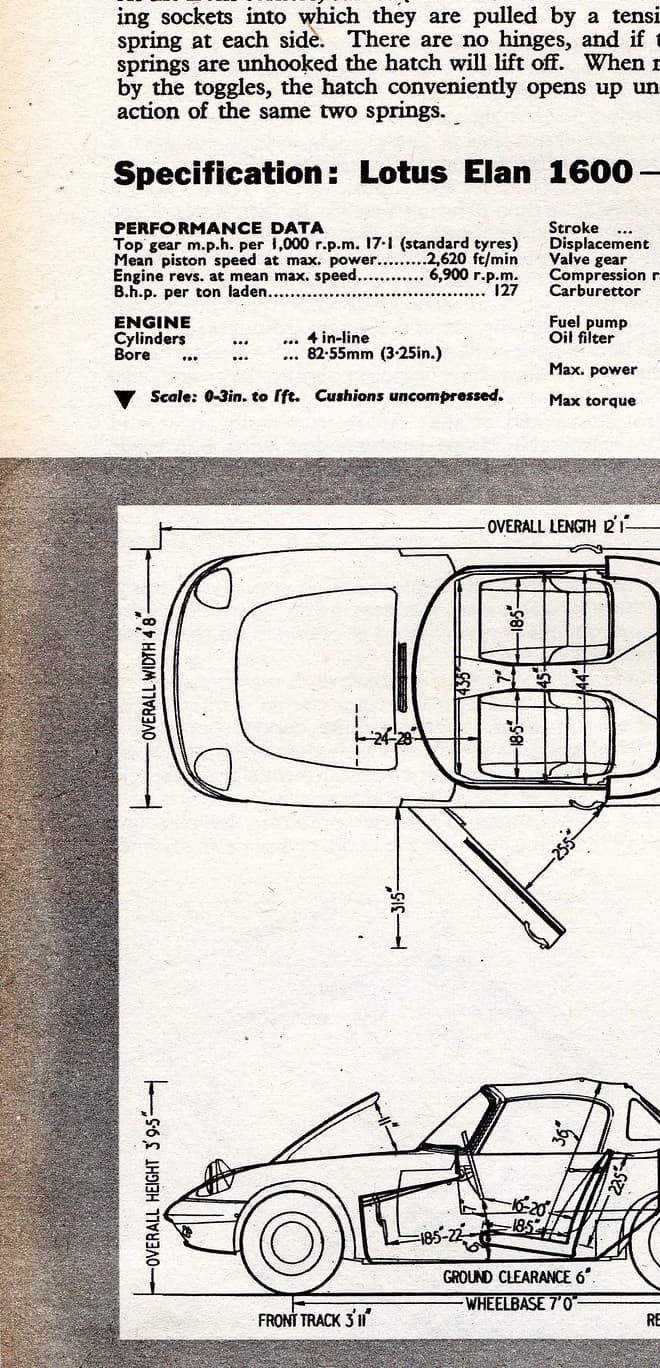
Scale: 0–3in. to 1ft. Cushions uncompressed.
Key dimensions:
- Overall length: 12ft 1in.
- Overall width: 4ft 8in.
- Overall height: 3ft 9·5in.
- Wheelbase: 7ft 0in.
- Front track: 3ft 11in.
- Rear track: 3ft 11in.
- Ground clearance: 6in.
Notes
[1] The Elan was originally introduced with a 1,499 c.c. engine; the 1,558 c.c. unit had been in production for some time prior to this August 1964 road test.
[2] The special cut-out rotor arm governor (set to 6,600 r.p.m.) is fitted as standard to prevent engine damage in inexperienced hands; it can be replaced with a standard rotor arm by knowledgeable owners.
[3] Dunlop SP41 tyres were fitted to the test car as optional extras; they give a slightly smaller rolling radius than the standard specification, which accounts for minor discrepancies between indicated and calculated r.p.m. figures and some speedometer error.
Copyright by Autocar, Vol. 121 Issue 3575, August 21, 1964
COPYRIGHT NOTICE: This article is reproduced for non-commercial historical preservation purposes only. Copyright remains with the original publisher. If you are the rights holder and have questions or concerns about this content, please visit our Copyright and Historical Preservation Policy and contact us. We will respond within 24 business hours and will remove or restrict the content promptly upon a valid request.